Portuguese
  Spanish


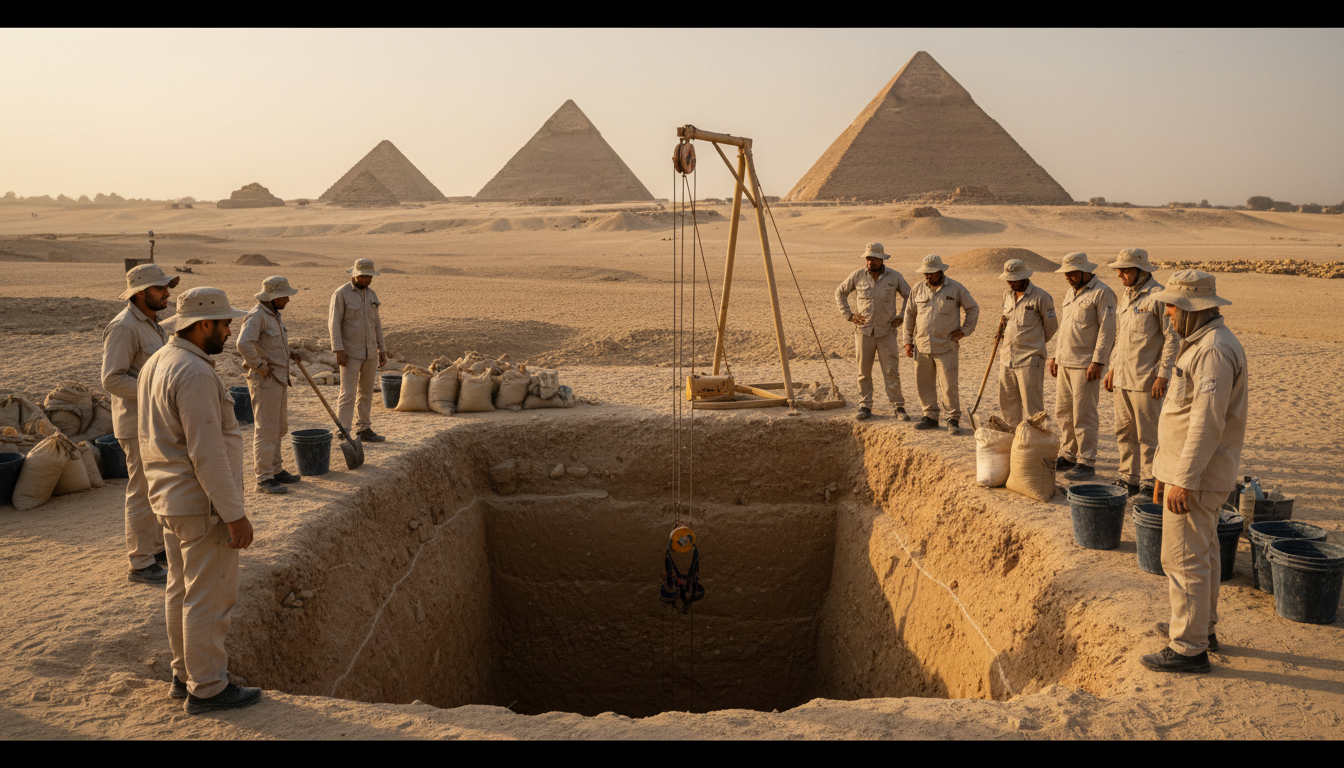


An archaeological mission from the Supreme Council of Antiquities of Egypt descended 15 meters into a sealed shaft in the Saqqara necropolis and opened the limestone coffin untouched for 4,300 years with a mummy covered in thin gold leaves over the face and chest.
The discovery of the gold-covered mummy in Saqqara occurred during excavations by the Zahi Hawass Foundation for Archaeology and Heritage team in partnership with the Supreme Council of Antiquities.
According to the Smithsonian Magazine, the limestone coffin was found sealed at the bottom of a 15-meter shaft that no one had opened since the Old Kingdom of Egypt.
Archaeologists identified three adjacent tombs that belonged to a priest named Khnumdjedef, a judge and writer named Fetek, and a third man who may have the name Messi.
-
Extreme Heat of 41.3°C Warps Roads in Germany, Causes Autobahn Asphalt to Crack, Injures People, and Forces Snowplows to Cool Down Highways

-
AI Security System in Brazil Aims to Cut False Alarms by Differentiating Pets from Intruders, Enhancing 24/7 Monitoring for Homes and Businesses

-
Archaeologists Discover 1,500-Year-Old Byzantine Mosaic with Greek Biblical Inscription in Israel, Uncover Ruins of 10 Buildings Near Kiryat Gat
-
Ohio Carpenter Finds 308-Gram Meteorite the Size of a Baseball After Dreaming of Its Location




According to the team, all findings date from the 5th and 6th dynasties of the Old Kingdom, between 2500 and 2100 BC.
The tombs expand what was known about the religious and legal elite of the time.
According to the archaeological record, the gold-covered mummy is one of the rare intact discoveries in the region, as most of the tombs in Saqqara have been looted over the centuries.
The 15-meter shaft that remained sealed for 4,300 years under the Egyptian desert
The entrance to the shaft was covered with ancient mortar, indicating that the coffin had never been touched after the burial.
Compared to other tombs in the region, the level of preservation caught the team’s attention.
“This is an extremely rare discovery because the gold is usually stripped by looters at the first opportunity,” stated Zahi Hawass in a statement to the Daily Galaxy.
Therefore, finding the gold still attached to the mummy indicates that the site escaped human action since the 25th century BC.
According to the Supreme Council of Antiquities, the gold material was cut into thin sheets and fixed over the bandages with plant resin, a technique reserved for high-status individuals.
According to Egyptologists, in the religion of the Old Kingdom, gold was considered the “flesh of the gods” and protected the body in the passage to the afterlife.

The gold-covered mummy in Saqqara came with tombs of the priest Khnumdjedef, the judge Fetek, and the priest Messi
The priest Khnumdjedef served the cult of Pharaoh Unas, the last monarch of the 5th dynasty.
Additionally, Fetek was both a judge and a scribe, a role reserved for men of high trust in the royal house.
As reported by the Egypt Independent, the third name, provisionally read as Messi, is still under study because the inscription is partially erased.
Firstly, the inscriptions speak of offerings of bread, beer, and oil to the gods Osiris and Anubis.
Secondly, there are lists of palace positions that offer new data on the administrative daily life of the Old Kingdom.
On the other hand, part of the painted hieroglyphs is faded due to moisture seeping into the tomb, and the team will use multispectral photography in the coming weeks.
Why the gold-covered mummy in Saqqara changes the understanding of the Old Kingdom
Saqqara is located about 30 kilometers south of Cairo and served as a royal necropolis for more than three thousand years.
According to archaeologists from Cairo University, the site today houses the Step Pyramid of Djoser and hundreds of tombs that have not yet been fully cataloged.
In practice, findings like the gold-covered mummy in Saqqara allow for precise dating of the funerary rituals of each dynasty.
To understand the impact, it is worth remembering that many elements attributed to the reign of Tutankhamun, of the 18th dynasty, actually existed centuries earlier in the tombs of the Old Kingdom.
As reported by the Egyptian team, this particular site may reveal an entire network of tombs associated with the cult of Pharaoh Unas and his high officials.
- Depth: 15 meters, with original mortar still sealing the entrance
- Date: between 2500 and 2100 BC, 5th and 6th dynasties of the Old Kingdom
- People: priest Khnumdjedef, judge Fetek, and probably the priest Messi
- Material: thin gold sheets fixed over bandages with plant resin

Egypt announces a series of discoveries and prepares for the opening of the Grand Egyptian Museum
According to the Ministry of Tourism and Antiquities of Egypt, the country has accumulated over a dozen significant discoveries in Saqqara, Luxor, and Giza in the last 18 months.
In May 2026, Zahi Hawass announced that another even more surprising revelation about the Great Pyramid will be made later this year.
Subsequently, in November 2025, the government officially opened the Grand Egyptian Museum in Giza with 100,000 artifacts on display.
According to the government’s schedule, the museum complex occupies 50 hectares and cost $1.2 billion, with 5,398 pieces from the Tutankhamun collection alone.
Against the backdrop of these discoveries, archaeological tourism reached 15.7 million visitors in 2025 and generated $14.2 billion in revenue, according to the Central Bank of Egypt.
The Brazilian parallel of the hidden worker and the pre-salt race
Compared to the Egyptian tradition, Brazil is still beginning to tell the story of the anonymous workers who build the country’s wealth.
In fact, museums dedicated to the workers of the pre-salt and the industrial hub of the Recôncavo Baiano are rare and little visited.
Similarly, millions of hours of technical work on Brazilian offshore platforms have never been recorded in a permanent archive.
Therefore, projects like the oil museum in Brazil, cited in the CPG collection, gain importance as the industry ages.
The same movement appears in the efforts of preservation of Brazilian archaeological heritage, recorded in the CPG collection, which suffers from a lack of federal budget.

The next steps of Hawass’s team and scientific dissemination
The team will use a CT scan to examine the body without unwrapping the mummy.
Next, the hieroglyphs will be photographed with multispectral to reveal pigments faded over time.
Finally, the complete results of the expedition will be published in scientific journals throughout 2026.
The researchers will also return the original coffin to the chamber, with a humidity control system, to preserve the gold sheets fixed with resin.
However, some question the prominence of Zahi Hawass, criticized by other archaeologists for the media style of the announcements.
Still, the team argues that the pace of discoveries justifies broad dissemination.
The find 15 meters under Saqqara opens a new window to the Old Kingdom that has been closed for 43 centuries.