






 Portuguese
  Spanish
  4 min of reading
  0 comments


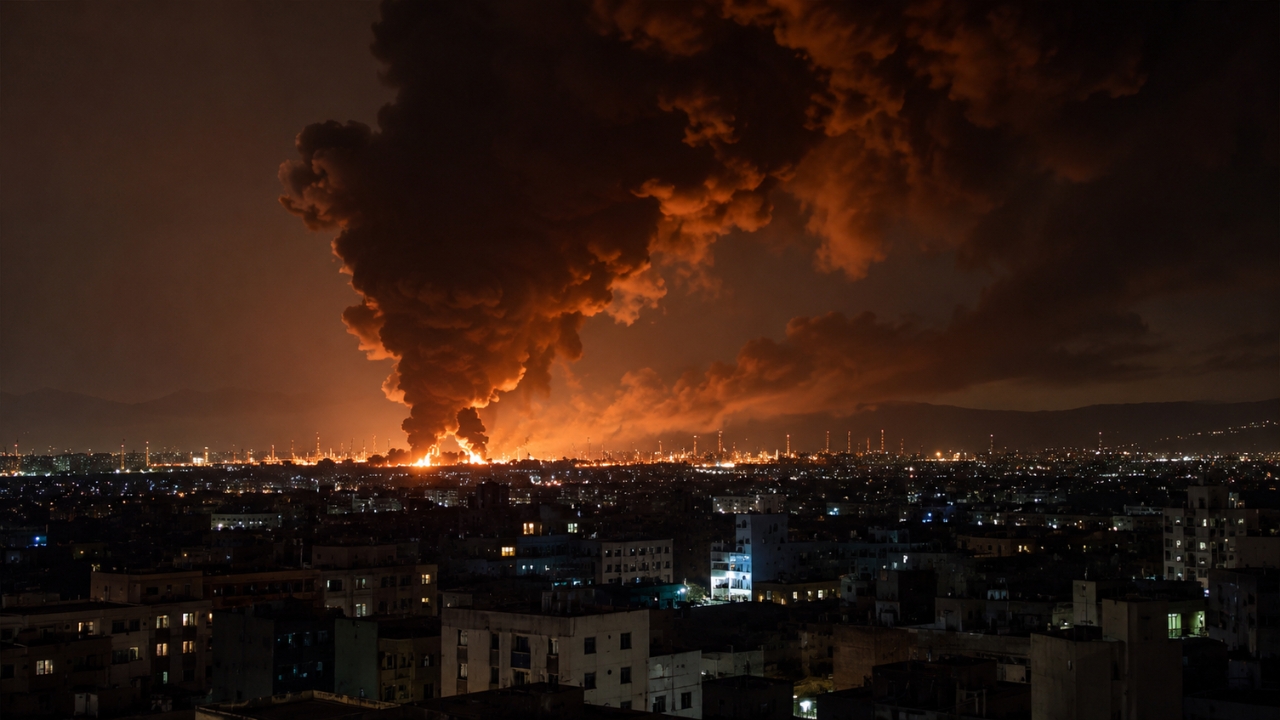
An analysis revealed that the March 7 attacks on Iranian refineries released a mass of sulfur dioxide comparable to a volcanic eruption, with impacts reaching as far as East Asia
A single day of attacks on refineries and oil depots in Iran released about 33,000 tons of sulfur dioxide into the atmosphere, a volume comparable to a major volcanic eruption. The toxic cloud spread rapidly and reached about 2,000 kilometers away in just two days.
The findings come from an analysis published by livescience.com, based on images from Chinese and European satellites. According to the researchers, the fires caused by the airstrikes on March 7 at the Fardis, Shahran, Aghdasieh facilities, and the Tehran Refinery sharply increased the presence of the gas over the Iranian capital the following day.
The study draws attention not only for the amount emitted but for the speed at which the plume spread. By March 9, it had already advanced to East Asia, although it began to dissipate by the end of that same day.
-
British Lawyer Faces Up to Two Years in Prison After Organizing Volunteers to Clean Polluted River in Brazil

-
Unable to Afford a Traditional Home, Brazilian Woman Builds a Compact Mobile House Using Recycled Materials

-
Women in a Brazilian Community Empowered to Renovate Homes Independently Through Design and Planning Skills
-
Man Builds Solar-Powered Tiny Home to Escape Rent, Faces Demolition Order in Expensive Australian Region




Pollution volume was compared to a volcanic eruption

The study’s authors estimate that the fires released about 29,800 metric tons of sulfur dioxide, or 33,000 tons in total, by March 8. This level, according to the analysis, approaches that recorded in large-scale volcanic events.
For comparison, the Eyjafjallajökull eruption in Iceland in 2010 expelled approximately 22,000 tons of sulfur dioxide over three days. In that case, the ash and gas cloud caused widespread disruptions, including impacts on European aviation.
In the Iranian episode, the scale is noteworthy because the emission occurred in just one day. The researchers describe the event as a “major emission” that should not be underestimated precisely because of its short duration.
Toxic cloud traveled 1,240 miles and reached an area of 300,000 km²
The plume’s movement was tracked by high-resolution ultraviolet and infrared sensors on China’s FengYun 3 satellites and the European Space Agency’s Sentinel-5 Precursor. The combination of these images allowed mapping of the material’s extent released into the atmosphere.
According to the analysis, the cloud spread over an area of about 185,000 square miles, equivalent to 300,000 square kilometers. Northeastern winds pushed the material out of Tehran and carried it a distance close to 1,240 miles, or 2,000 kilometers.
Even with the dispersion in a short time, scientists warn that environmental effects cannot be ignored. Sulfur dioxide is one of the main precursors of acid rain and can affect soil, water, and ecosystems around the affected areas.

“Black rain” and symptoms reported by Tehran residents
In addition to the gas, the fires also released other pollutants into the atmosphere. According to researchers, the contaminants mixed with precipitation and formed a type of “black rain,” loaded with toxic particles like hydrocarbons.
The study reports that some Tehran residents experienced headaches, a bitter taste in the mouth, eye and skin irritation, and difficulty breathing. The authors state that these effects deserve attention, although further studies are needed to accurately measure the impact on public health.
Sulfur dioxide pollution is also associated with mental health issues, such as depression and anxiety, as well as respiratory effects. The analysis does not calculate the total human damage, but emphasizes that exposure can have consequences far beyond the moment of the attacks.
War had already been increasing the greenhouse gas load
The episode adds to other emissions linked to the ongoing conflict between the United States, Israel, and Iran. A recent analysis cited in the study pointed out that, between February 28 and March 14, the war emitted more carbon dioxide than Iceland did in the entire year of 2024.
This places the attacks on refineries within a broader sequence of environmental pressure caused by the conflict. In the case of sulfur dioxide, the effects are more immediate and localized, but can spread over thousands of kilometers, as shown by the cloud’s trajectory.
Researchers state that further investigations are needed to measure the specific impacts on health and the environment after the March attacks. What is already clear is that, in a single day, the fires at the Iranian oil facilities produced emissions of an unusual scale with international reach.
If you want to follow the upcoming developments of this type of environmental impact in conflict zones, share this report and leave your opinion in the comments.






Be the first to react!