Portuguese
  Spanish


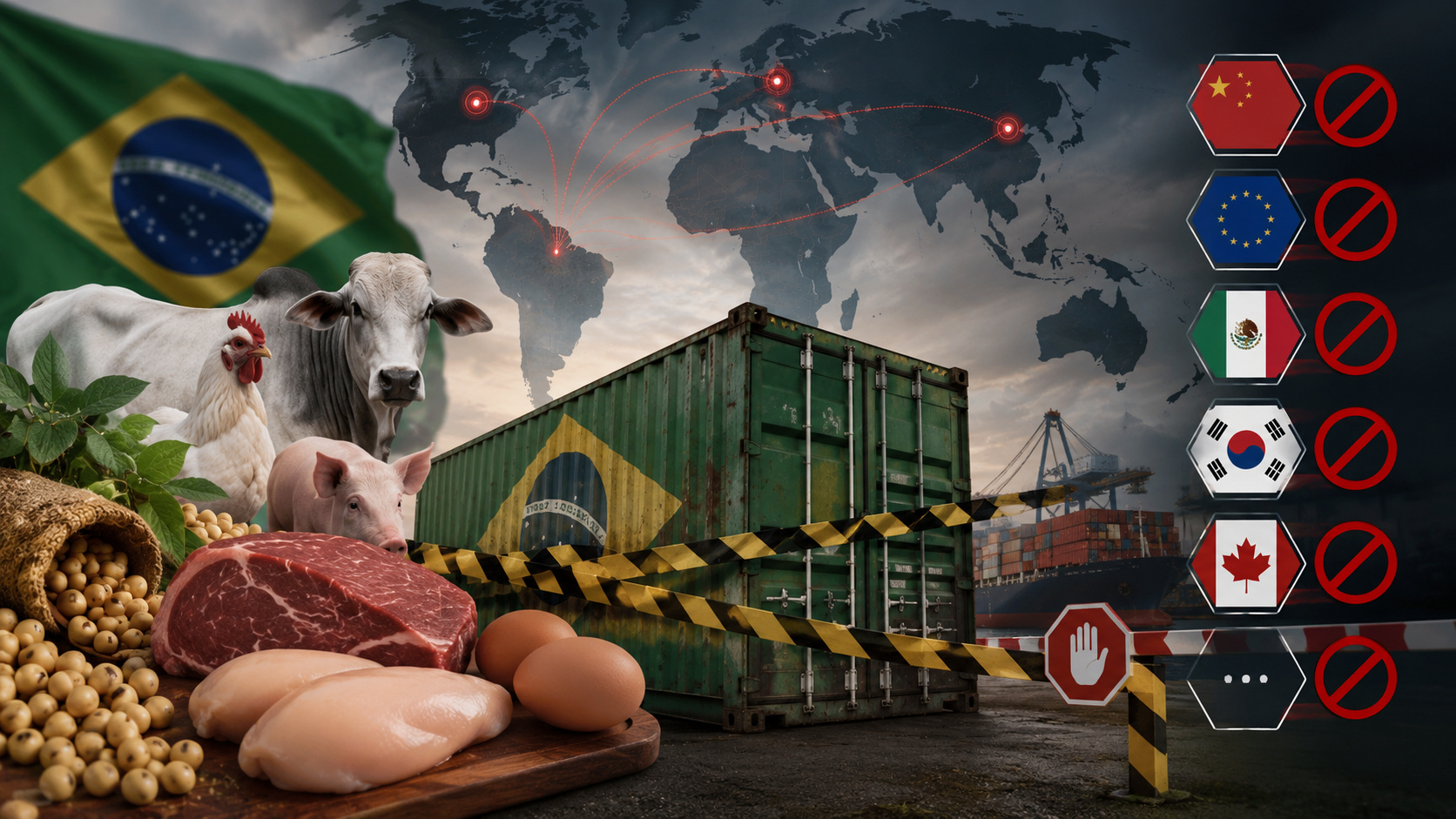

China, European Union, and other markets impose pressure on Brazilian soy, meats, and eggs with sanitary barriers and new requirements.
The Brazilian agribusiness has entered a phase where producing a lot is no longer enough. The threat now comes from outside the gates of farms, slaughterhouses, and ports: China, European Union, Mexico, South Korea, Canada, Chile, Uruguay, and other markets have started using sanitary, environmental, phytosanitary, and commercial rules as a direct filter on Brazilian products.
Brazil remains a global powerhouse in soy, beef, chicken, eggs, cotton, and other commodities. But the same scale that transformed the country into a strategic supplier also created a dangerous dependency: when a major buyer changes a rule, suspends a plant, tightens an inspection, or temporarily closes the market, the impact cascades down to the rural producer.
The most sensitive case is in China. In May 2026, Beijing suspended beef imports from three Brazilian slaughterhouses after identifying synthetic veterinary hormones prohibited by Chinese rules, according to Reuters. The affected plants belong to JBS, Prima Foods, and Frialto, at a time when Brazil was trying to expand approvals to sell more meat to the sector’s largest client.
-
U.S. Dismisses Brazilian Foreign Ministry’s Military Risk Warning as “Absurd,” Cites Brazilian Criminal Gangs Operating in the U.S. Since May 2026

-
Ukraine War Impacts Brazilian Fuel Supply: Russian Diesel Imports Drop 65% in June, Brazil Turns to US and India Amid Market Concerns

-
Chinese Nuclear Submarine Launches Simulated Warhead Missile in Pacific, Heightening Regional Tensions Amid Naval Drills with Russia Near Qingdao; New Zealand and Papua New Guinea Warn of Persistent Chinese Military Presence
-
Ayatollah Ali Khamenei’s Funeral Draws 15 to 20 Million in Tehran, Calls for Revenge Against Trump After Joint Israel-U.S. Attack



China pressures Brazilian beef and shows that the biggest client is also the biggest risk
China is the most important buyer for Brazilian agribusiness. In the first two months of 2026, the Asian country remained the main destination for Brazilian agribusiness exports, with US$ 5.79 billion, equivalent to 25.5% of the total exported by the sector in the period, according to a note from the Ministry of Agriculture.


This number explains why any Chinese movement becomes a national alert. When Beijing suspends slaughterhouses, increases inspections, or changes requirements, the problem is not restricted to one company. It affects a chain involving ranchers, slaughterhouses, transport companies, ports, trading companies, banks, insurers, and state governments.
In beef, the suspension in May 2026 is symbolically significant because it occurred precisely during negotiations between Brazilian and Chinese agricultural authorities. Brazil was seeking approval for new exporting plants, while China demonstrated that access to its market depends on strict compliance with its sanitary protocols.
Brazilian Soy Faces Tougher Inspections from China and Delays in Shipments Amid Record Harvest
Soy, the biggest symbol of the Brazil-China trade relationship, has also entered the tension zone. In March 2026, Reuters reported that Brazilian soy exports to China faced interruptions due to stricter phytosanitary inspections requested by Beijing, following complaints about grains treated with pesticides, live insects, and heat damage in Brazilian shipments.
The Ministry of Agriculture intensified inspections, exporters had to check shipments more rigorously to avoid rejections upon arrival at Chinese ports, and companies like Cargill even paused shipments.

Reuters also reported an increase in port costs, delays, and rising freight rates, with Panamax ship tariffs rising 24% in March.
Regarding the claim that China “returned almost 20 Brazilian ships with soy,” I cannot confirm this in any official Brazilian or Chinese source or in a primary Reuters report. What I can confirm is that there was a tightening of Chinese inspections, delays in shipments, phytosanitary complaints, and negotiation of a new inspection protocol between Brazil and China.
China Wants to Depend Less on Imported Soy and This Threatens the Engine of Brazilian Agribusiness
The Chinese pressure is not just a one-time occurrence. It is also part of a larger food security strategy. China has been seeking to reduce the share of soy meal in animal feed to decrease dependency on imports, according to an analysis by the University of Illinois published in 2025.
The study points out that reducing the use of soy meal is one of the ways China is trying to decrease its external exposure.
At the same time, the analysis highlights that the policies already adopted have not yet produced a substantial drop in demand for meal, and the share of the ingredient in Chinese feed production has only fallen modestly and irregularly.
This means that the risk exists, but should not be treated as an immediate collapse. Brazil remains highly relevant for Chinese supply, but Beijing is trying to reduce vulnerabilities. For the Brazilian producer, the message is clear: relying on a buyer who is trying to rely less on you is a structural vulnerability.
European Union Prepares to Block Brazilian Animal Products Starting September 2026
The second pressure front comes from the European Union. In May 2026, Reuters reported that the bloc decided to exclude Brazil from the list of countries authorized to export certain animal-origin products starting from September 3, 2026, citing European rules on the use of antimicrobials in food-producing animals.
The measure could affect beef, poultry, eggs, live animals, and other animal-origin products. The Brazilian government reacted with surprise and concern, stating that it would take measures to try to reverse the decision and seek clarifications from European authorities.

Agência Brasil also reported that, in addition to beef, the measure could affect poultry, eggs, honey, fish, horses, and animal-derived products. The European Union argues that exports can resume when Brazil demonstrates full compliance with the requirements on antimicrobials throughout the animals’ lives.
Europe combines sanitary requirements, trade disputes, and environmental pressure against Brazilian agribusiness
The European case is broader than an isolated sanitary barrier. It occurs in an environment of strong political pressure against agricultural products coming from Mercosur, with European farmers complaining about competition, price, and production standards.
Associated Press reported that the European move came just days after the provisional entry of a trade agreement between the European Union and Mercosur, while European producers and environmental groups questioned competition, environmental standards, and sanitary rules related to South American agribusiness.

For Brazil, the problem is twofold. On one hand, the country needs to prove sanitary compliance to maintain market access. On the other, it faces an increasingly sensitive Europe to issues such as deforestation, traceability, emissions, and the use of veterinary inputs.
Avian flu showed how a single outbreak can close markets in a chain
Brazilian poultry farming experienced in 2025 a harsh example of how agribusiness can be hit in days by international sanitary barriers.
After the confirmation of a Highly Pathogenic Avian Influenza outbreak in a commercial farm in Montenegro, Rio Grande do Sul, dozens of countries imposed restrictions on Brazilian poultry meat.
On May 28, 2025, the Ministry of Agriculture reported that 24 markets had adopted a total suspension of poultry meat exports from Brazil, including China, European Union, Mexico, Iraq, South Korea, Chile, Philippines, South Africa, Jordan, Peru, Canada, Dominican Republic, Uruguay, Malaysia, Argentina, East Timor, Morocco, Bolivia, Sri Lanka, Pakistan, Albania, India, North Macedonia, and Kuwait.

This episode revealed the speed of commercial contagion. Even with the focus located in a municipality in Rio Grande do Sul, several buyers applied a national suspension, affecting exporters from other regions without direct relation to the sanitary case.
Mexico, Chile, Uruguay, Canada, and South Korea joined the list of restrictions on Brazilian chicken
The avian flu crisis exposed how different markets react with varying levels of severity. Mexico, Chile, and Uruguay suspended imports of chicken and eggs from Brazil after the confirmation of the focus in Rio Grande do Sul, according to the Associated Press.
The Ministry of Agriculture detailed that, in different updates, countries such as Canada, Chile, South Korea, Mexico, Uruguay, Peru, Argentina, Malaysia, Pakistan, and the European Union adopted total or regional suspensions. In some cases, the restrictions were reduced to Rio Grande do Sul; in others, they remained national for a longer time.
In August 2025, even after advances in lifting the restrictions, there was still a total suspension of poultry meat from Brazil by Canada, China, Malaysia, Pakistan, East Timor, and the European Union, while other markets maintained regional or specific zone restrictions.
External dependence turns sanitary protocol into a national economic risk
The central point is that sanitary barriers do not only affect exporters. They impact internal prices, slaughter scale, production planning, future contracts, freight, storage, rural credit, and investment decisions.
When China suspends slaughterhouses, the cattle rancher may feel pressure on beef prices. When the European Union announces a blockade on animal products, slaughterhouses need to redirect shipments or renegotiate contracts. When countries close the market for chicken, the poultry chain needs to reorganize production, stocks, and export destinations.
Brazil is competitive because it produces on a large scale. But scale also creates exposure. The greater the dependence on concentrated markets, the greater the effect of a decision made in Beijing, Brussels, Mexico City, Seoul, Ottawa, or Santiago.
Brazilian agribusiness faces a new era of demand: it is not enough to produce, it is necessary to prove origin, health, and compliance
The message from buyers is increasingly clear: Brazilian products need to come with proof. In soy, this involves phytosanitary standards, absence of prohibited seeds, impurity control, and traceability. In meat, it involves animal health, control of veterinary substances, traceability, and specific protocols for each market.
In the European case, the requirements also extend to antimicrobials and environmental rules. In the Chinese case, control involves plant certification, cargo inspections, phytosanitary inspections, and proprietary food safety standards.
This changes the game for the national agribusiness. The Brazilian advantage will not only be in producing cheaper or in greater volume. It will be in proving, batch by batch, that it can meet different rules in different markets, often more demanding than domestic legislation.
China and the European Union are not equal threats, but they pressure Brazil at the same time
China pressures as a dominant buyer. It buys gigantic volumes, negotiates strongly, and can alter the global flow of soy, meat, and chicken with administrative decisions. When it tightens inspections or suspends plants, the market reacts immediately.
The European Union pressures in another way. The bloc buys less volume than China in some chains but has enormous regulatory influence. Its environmental, sanitary, and traceability rules tend to become a reference for other premium markets.
Therefore, the combination is dangerous. China represents volume. Europe represents regulatory demand. Mexico, Chile, Canada, South Korea, Uruguay, and other markets show that sanitary crises can spread through automatic import protocols.
Brazilian agribusiness has become too large to operate with small vulnerability
Brazil is not facing an immediate collapse of agribusiness. That would be an exaggeration. The country remains among the largest exporters on the planet and continues to be indispensable for the global food supply.
But the sector is facing a tough warning. The era when it was enough to ship commodities on a large scale is coming to an end. The new exporting agribusiness needs to deal with stricter inspection, more demanding buyers, environmental barriers, geopolitical disputes, digital traceability, and permanent sanitary risk.
The strength of Brazil remains in the field. The fragility now lies in the dependence on those who decide whether to buy, how much to buy, from where to buy, and under what rules.
Brazilian agribusiness conquered the world through scale. Now it will have to prove, load by load, that it can continue in it.