Portuguese
  Spanish




French Researchers Suggest The Step Pyramid Was Built With Hydraulic Engineering, Using Water As The Main Elevation Tool
For a long time, the most accepted idea was that the ancient Egyptians used giant ramps to build the pyramids. Thousands of workers, dragging heavy blocks over mud structures, would shape the monuments that continue to fascinate the world.
But new research is changing this narrative. A group of French researchers, led by Xavier Landreau, proposed a theory that could rewrite the understanding of pyramid construction.
According to the study published in the journal PLOS ONE, the team believes that the Step Pyramid of Djoser, built around 2680 B.C., may have been erected using hydraulic engineering.
-
Why did a company that was already earning US$ 1 million decide to completely change its strategy? The answer begins with used bottles, worms, and an unexpected decision.

-
Where it almost never rains, residents hung giant nets in the desert mountains and started to ‘fish’ drinking water from the fog: the nets can collect thousands of liters per day directly from the mist.

-
Young people from Minas created a robot without screws or metal parts, betting on a strong and flexible structure to compete against a thousand teams in Houston and took Brazil to the top of world robotics for the first time; Sofia, 15, also made history with an unprecedented leadership award.

-
Detectorist found a 900-year-old silver coin


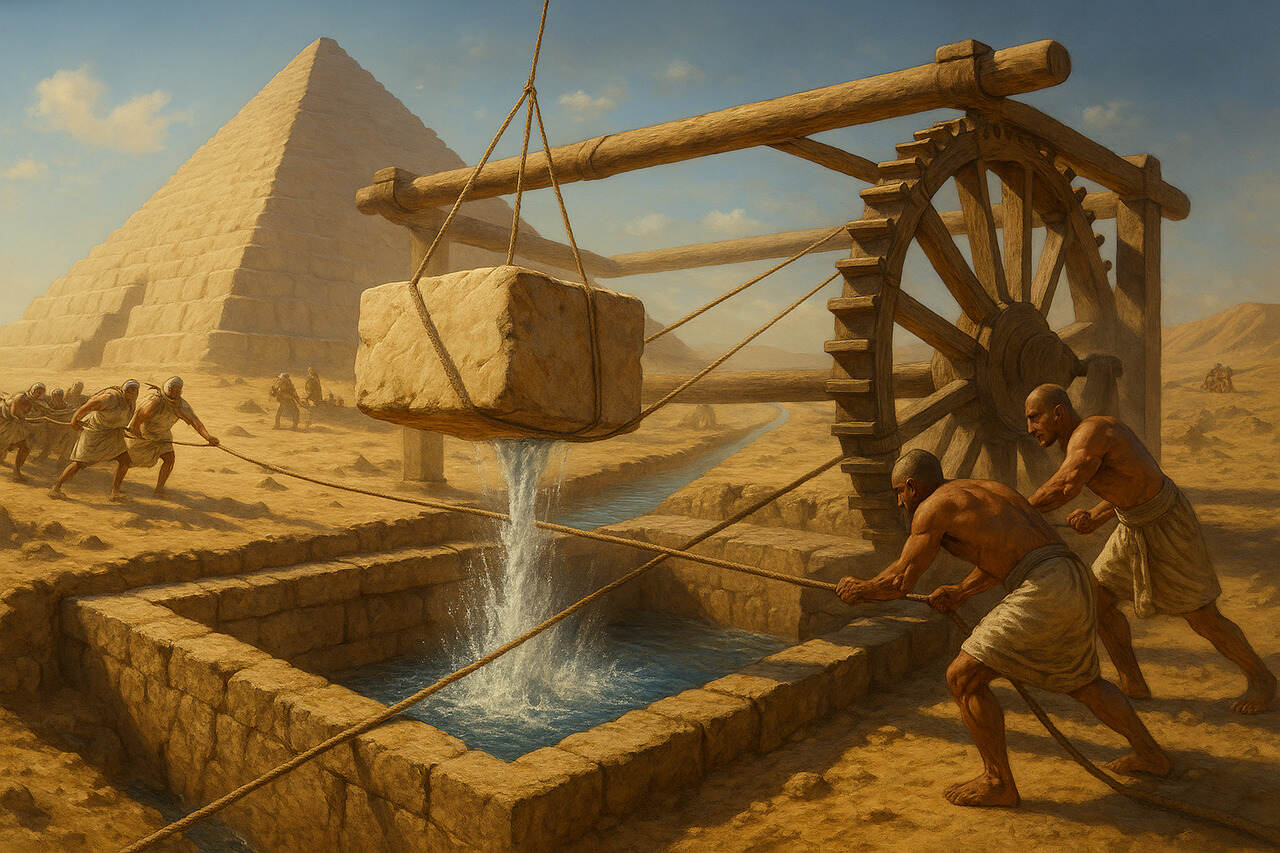
Instead of just ramps, the Egyptians would have used water as the main tool to elevate the stone blocks with precision.
Water-Powered System Instead Of Traditional Ramps
For over a hundred years, archaeologists have pointed to ramps as the solution for transporting the blocks.
These structures, made of mud bricks, would allow the stones to be moved to the upper levels. However, Landreau’s team suggests something different: a water-powered lifting system.
The new theory argues that the Egyptians would have created hydraulic pressure to lift the blocks. This process, dubbed “volcanic construction” by the researchers, would use buoyancy to move the stones through the central axes of the pyramid.
The proposal impresses with the precision this system would allow, surpassing the effectiveness of ramps.
Saqqara And The Intelligent Use Of Water
The investigation focused on the Saqqara Plateau, the location where the Step Pyramid was built. The team analyzed various aspects of the area, such as topography, hydrology, and even satellite images.
Based on these studies, the researchers concluded that seasonal streams, called wadi, could have been used as a water source for the hydraulic system.
One of the key points of the theory is related to a structure called Gisr el-Mudir. This enormous enclosure, located to the west of the pyramid, has puzzled archaeologists for years.
The new hypothesis claims that it functioned as a dam. Its role would be to retain sediments and control the flow of water. Thus, the resource coming from the Abusir Wadi would be directed precisely to the lifting system.
Dry Moat May Have Essential Role In Water Filtration
Another important element of the theory is the dry moat that surrounds the Step Pyramid. For a long time, this moat was considered merely symbolic.
But the researchers point out that it may have served as a filtration system. The water would be purified before flowing to the central axes of the pyramid.
By observing the structure of the moat and the presence of deep compartments carved into the rock, the team concludes that it may have been part of a larger water control mechanism.
This network would allow for managing both the volume and quality of the water used in construction.
Together, these two structures — Gisr el-Mudir and the dry moat — reinforce the idea that water was more than a natural resource in Ancient Egypt. It would be an essential technical ally for erecting large constructions.
Advanced Technology For The Time
The Egyptians were already using water in various ways. Irrigation, transportation by barges, and moving blocks in canals are well-documented practices.
But the new theory goes further. Landreau and his colleagues assert that the use of a hydraulic system for elevating stones may prove that the Egyptians mastered techniques far more advanced than previously thought.
If the hypothesis is confirmed, it would indicate that Egyptian engineering was sophisticated enough to surpass, by thousands of years, other known water-lifting systems.
The researchers highlight that this technology would have allowed for an impressive level of precision. The blocks used in the Step Pyramid show careful fittings, and the internal tunnels reveal exact alignments. This perfection could have been achieved with the help of an efficient hydraulic system.
Doubts Remain And Excavations Must Continue
Even with the evidence found, the theory is still not definitive. The remains of Pharaoh Djoser have never been located inside the pyramid.
Moreover, there are no inscriptions typical of funeral rituals. This raises the possibility that the pyramid may have served a different purpose than previously imagined.
Landreau’s team advocates for new excavations. Areas around the dry moat, Gisr el-Mudir, and the internal wells of the pyramid should be analyzed more deeply.
The expectation is to find material evidence that reinforces the role of water as a construction tool.
As new discoveries do not emerge, the hydraulic system theory offers an alternative and bold view.
It proposes that the pyramids were not only erected with human strength and dedication, but also with the intelligent use of one of the most valuable elements of Ancient Egypt: water.
With information from Daily Galaxy.