Portuguese
  Spanish


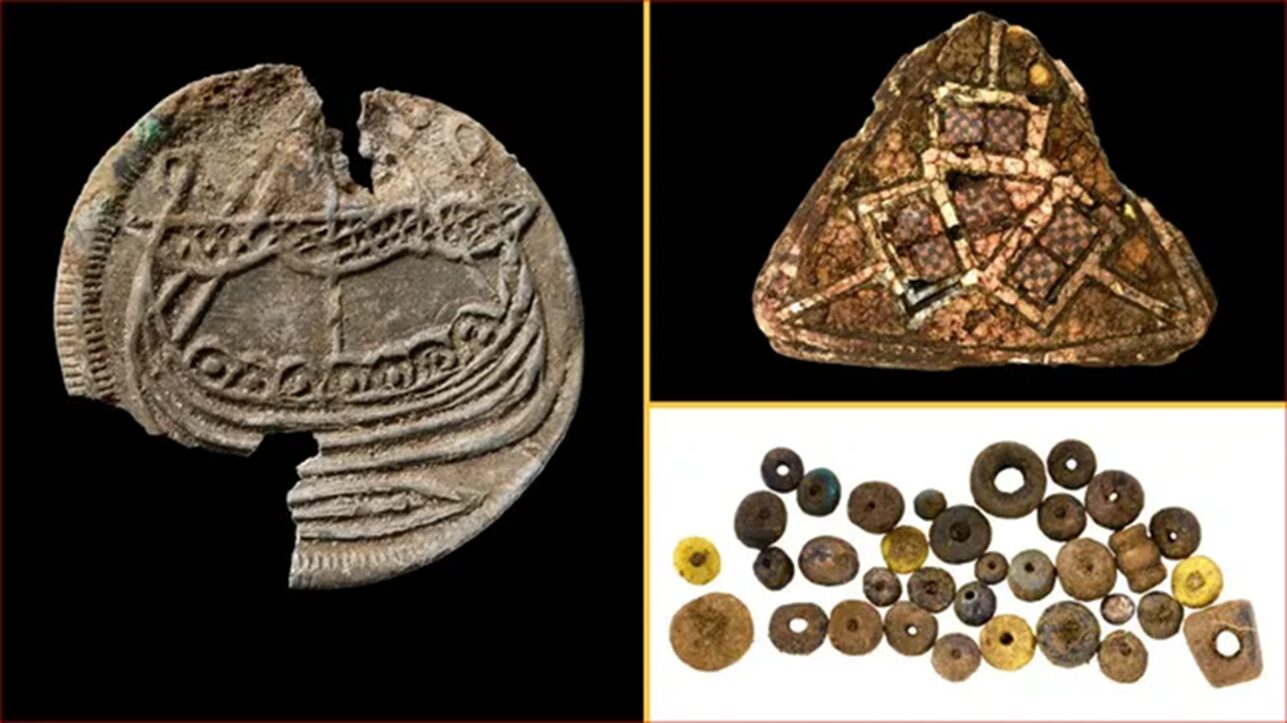

Archaeological Find in Skumsnes Reveals Three Female Viking Age Graves with Foreign Coins, Textiles, and a Symbolic Stone in the Shape of a Vulva, Indicating Prestige and International Connections.
On the west coast of Norway, archaeologists uncovered three female graves dating back to the early 9th century AD during the Viking Age.
The burials took place in Skumsnes, in the municipality of Fitjar. Among the artifacts were coins from distant lands, jewelry, and a stone carved in the shape of female genitals.
Find Made by Metal Detectors
The discovery was made possible through the use of metal detectors. Archaeologist Søren Diinhoff from the University Museum of Bergen stated to the website sciencenorway.no that the graves represent “a small treasure”.
-
U.S. Attempted to Tame Hurricanes with Silver Iodide and Aircraft for Nearly 20 Years

-
Teen Inventors Win $50,000 for Pen-Sized Device Using Ultrasound to Remove 94% of Microplastics from Water

-
Ultra-Black Car Paint Absorbs 99.9% of Light, Making Vehicles Look Like “Black Holes” on Wheels

-
Ancient Maya City Discovered in Remote Mexican Area with 12-Meter Pyramid, Palaces, Canals, and 14 Preserved Monuments



Although the bones have disintegrated over time, the artifacts buried with the women were preserved.
Brooches, glass beads, coins, and stones forming the silhouette of a boat were found.
The coins and jewelry came from distant places such as Ireland, England, and the Frankish Empire, which occupied much of Western Europe.
One of the rarest items was a coin from southern Denmark, featuring a Viking ship on one side and a deer on the other.
Connection with Europe and Local Life
According to Diinhoff, these women had some connection to continental Europe. “They may have come from overseas and married members of the local community,” he suggested.
At the time, Skumsnes was a farm that probably belonged to a local king. It was close to the coast and may have served as a stopping point for travelers.
Grave in the Shape of a Boat and Vulva Stone
One of the women was buried with stones arranged in the shape of a 4-meter-long boat. At the location where the mast would be, archaeologists found a stone shaped like a vulva.
For Diinhoff, this element may symbolize the honored woman.
It is also possible that no body was present, making the grave a cenotaph—a empty memorial. Due to the acidity of the local soil, organic materials rarely preserve.
Signs of Prestige and Female Leadership
In addition to the symbolic objects, the grave contained textile tools such as wool scissors, a comb for fibers, a spindle, and a weaving sword, as well as a bronze key.
The presence of these items indicates that the woman was of high status. The production of textiles was a valued activity, and the key pointed to leadership in the household.
Archaeologist Unn Pedersen from the University of Oslo stated that textile production was a pathway to wealth and security for women during the Viking Age. “If they were not from the elite, these women were certainly in a high position in the social and economic hierarchy,” she declared.