Portuguese
  Spanish


Project by Victoria Ou and Justin Huang was born after a visit to a treatment plant in the United States, where the teenagers realized that microscopic plastic particles still escape common filtration methods
Two 17-year-old students from Texas, United States, drew attention by creating a compact device capable of removing microplastics from water using ultrasonic waves. The project was developed by Victoria Ou and Justin Huang and won one of the top awards at the Regeneron International Science and Engineering Fair, the ISEF 2024.
The equipment is shaped like a pen and uses electric transducers to generate high-frequency sound waves. In laboratory tests, the system managed to remove between 84% and 94% of suspended particles in a single pass of water through the device.
The duo received the Gordon E. Moore Award for Positive Outcomes for Future Generations, worth US$ 50,000, an amount reported in Brazil as about R$ 250,000. The achievement placed the project at the center of a larger discussion about water treatment, plastic pollution, and technologies that still need to move from the bench to scale up.
-
U.S. Attempted to Tame Hurricanes with Silver Iodide and Aircraft for Nearly 20 Years

-
Ultra-Black Car Paint Absorbs 99.9% of Light, Making Vehicles Look Like “Black Holes” on Wheels

-
Ancient Maya City Discovered in Remote Mexican Area with 12-Meter Pyramid, Palaces, Canals, and 14 Preserved Monuments
-
Indigenous 8-Year-Old Girl Wins National Science Award for Solar-Powered Water Heater Invention Using Recycled Materials



The idea touches on a difficult problem for treatment plants, household filters, and industrial systems, as microplastics are small, varied, and can pass through conventional separation stages.
The problem appeared when the students visited a treatment plant
The idea arose after Victoria Ou and Justin Huang visited a water treatment plant and asked how microplastics were removed. According to a report published by Business Insider, the response they heard was direct: that type of particle was not treated as a primary target of the process.
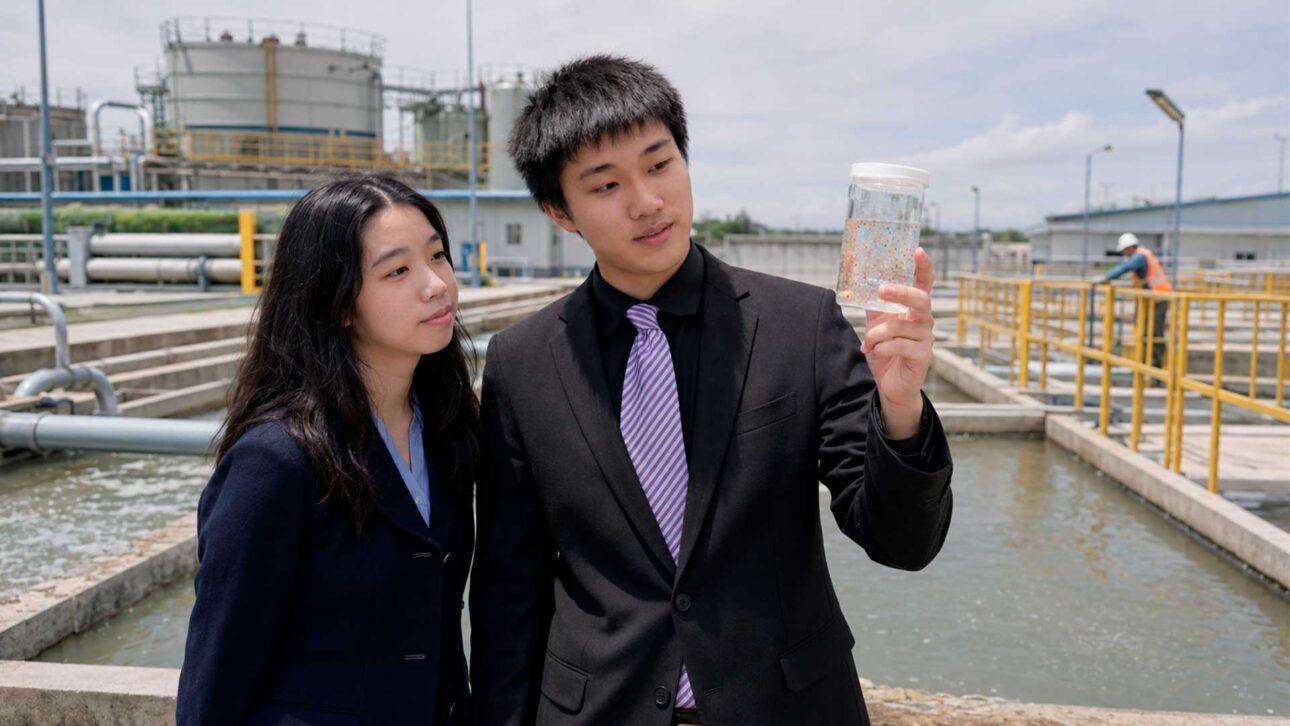
This point helped define the project. Instead of trying to create another physical filter, which can clog with use, the students sought a solution that would push particles away from the main water flow without relying on fine screens or chemicals.
How the ultrasonic filter separates microscopic plastic without blocking water flow
The device created by the teenagers works with two stages of acoustic filtering. Water enters through one end of the tube, passes through regions where transducers emit ultrasound, and exits the other end with a lower concentration of plastic particles.
The sound waves generate pressure inside the channel through which the water circulates. This acoustic force displaces the microplastics to a retention area, while the water flow continues onward.
According to the Society for Science, tests conducted for the ISEF indicated the removal of 84% to 94% of suspended microplastics in a single pass. The evaluation included particles of polyurethane, polystyrene, and polyethylene, three common materials in plastic products.
The point that makes the project appealing is the absence of a traditional physical barrier. In common filters, the smaller the particle to be blocked, the higher the risk of clogging, loss of flow, and frequent maintenance.
Even so, the prototype should not be confused with a product ready for domestic or municipal use. The students themselves stated that the system needs better equipment, new tests, and adaptation to work with larger volumes of water.
Microplastics are in water, soil, air, and still challenge measurement
Microplastics are plastic fragments smaller than 5 millimeters, according to the definition used by NOAA, the United States oceanic and atmospheric agency. They can arise from the degradation of packaging, synthetic fabrics, tires, paints, hygiene products, and industrial waste.
The problem is that these particles do not have a single size, weight, or composition. Some float, others sink, some break into even smaller pieces and can reach the scale of nanoplastics, which are more difficult to detect.
The World Health Organization has already pointed out significant gaps in research on microplastics in drinking water. The entity’s report does not treat the issue as a closed case but calls for better monitoring methods and more studies on human exposure.
In the United States, the EPA states that researchers are still working to standardize ways of collecting, extracting, quantifying, and identifying these materials. In 2026, the agency included microplastics on the list of candidate contaminants for drinking water, but inclusion does not, by itself, mean a mandatory concentration limit.
Why Removing Microplastics from Water is Still So Complicated
The methods already studied include chemical coagulation, membranes, physical filters, flotation, biological treatments, and combinations of technologies. Each approach has a practical hurdle, whether it’s cost, waste generation, clogging, energy consumption, or difficulty operating on a large scale.
Very fine physical filters can hold small particles but tend to require constant maintenance. Chemical coagulants help group particles but can alter water characteristics and generate waste that needs to be treated afterward.
The teenagers’ proposal fits into this space because it tries to separate plastic by acoustic force, not just by pore size. If the technique advances, it could be studied for treatment plants, industrial wastewater, washing machines, and smaller water circulation systems.
Even with the good initial results, there are still unanswered questions. The device needs to be tested with real water, which contains mud, organic matter, salts, microorganisms, and mixtures of contaminants, not just controlled laboratory samples.
The $50,000 Prize Helps, but the Next Test Will Be Outside the Fair
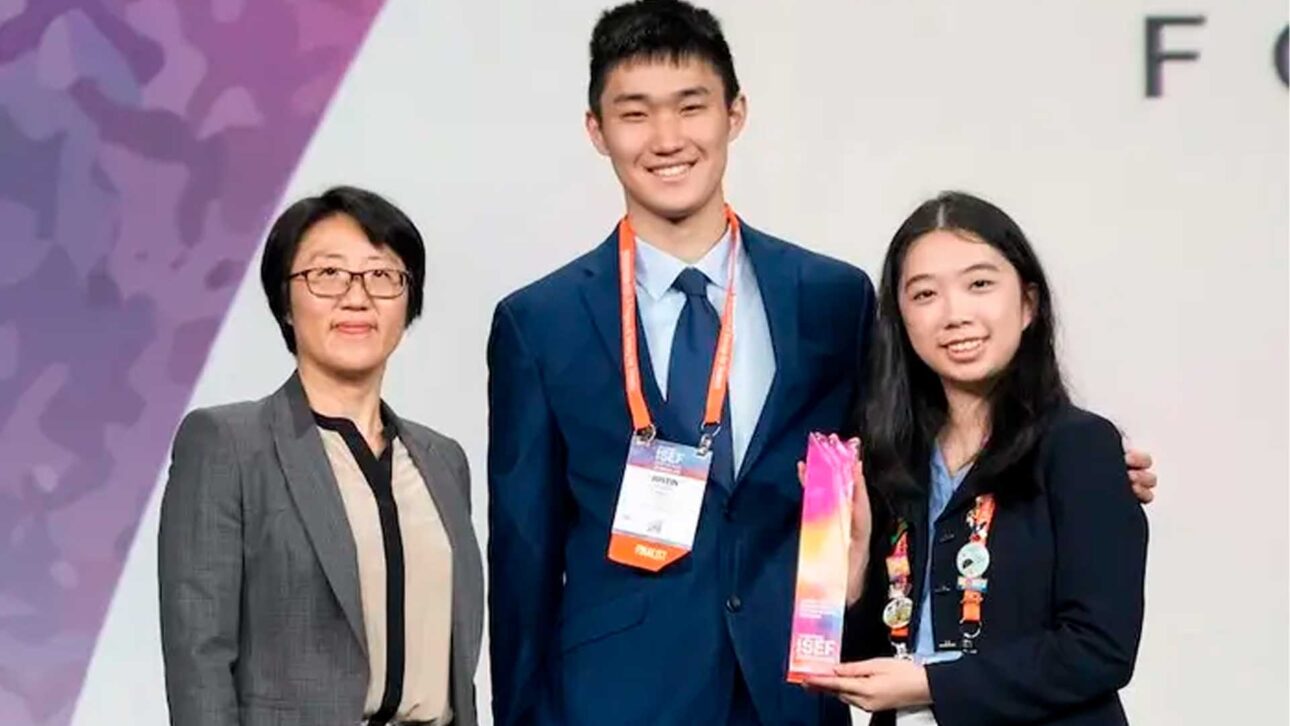
Victory at ISEF gave visibility and resources for Victoria Ou and Justin Huang to continue the project. The prize also showed how low-volume solutions, made in a school environment, can point the way to problems that still challenge laboratories and companies.
The challenge now is to prove that the system works outside the prototype. To move from the scale of a pen to a treatment plant, the ultrasonic filter would need to handle high flow, energy consumption, durability, cleaning, manufacturing cost, and operational safety.
The idea of the two students does not solve plastic pollution alone. But it shows an intriguing technical route: using sound to push invisible particles out of the water, without relying solely on a microscopic sieve.
Do you think a technology like this could reach homes, washing machines, or treatment plants first? Leave your opinion in the comments and say where this type of filter would have the most impact in daily life.