Portuguese
  Spanish




Project STORMFURY tried to weaken hurricanes with silver iodide, but NOAA ended the program after discovering flaws in the hypothesis.
In the tensest phase of the Cold War, the United States made a bet that seemed straight out of science fiction: trying to reduce the strength of hurricanes before they reached populated areas. The plan took research planes into tropical storms, where teams released silver iodide in an attempt to alter the internal structure of cyclones. This effort became known as Project STORMFURY.
The AOML, NOAA’s laboratory, describes the program as a hurricane modification research initiative conducted between 1962 and 1983, based on the hypothesis that seeding with silver iodide could stimulate a new, wider eye wall, thus reducing the strongest winds.
How Project STORMFURY attempted to weaken hurricanes with silver iodide
The scientific logic of the time seemed consistent. If the seeding strengthened convection outside the original eye wall, a new structure could form at a larger radius. With this, the more intense circulation would lose strength and the maximum winds would tend to decrease.
-
Teen Inventors Win $50,000 for Pen-Sized Device Using Ultrasound to Remove 94% of Microplastics from Water

-
Ultra-Black Car Paint Absorbs 99.9% of Light, Making Vehicles Look Like “Black Holes” on Wheels

-
Ancient Maya City Discovered in Remote Mexican Area with 12-Meter Pyramid, Palaces, Canals, and 14 Preserved Monuments
-
Indigenous 8-Year-Old Girl Wins National Science Award for Solar-Powered Water Heater Invention Using Recycled Materials


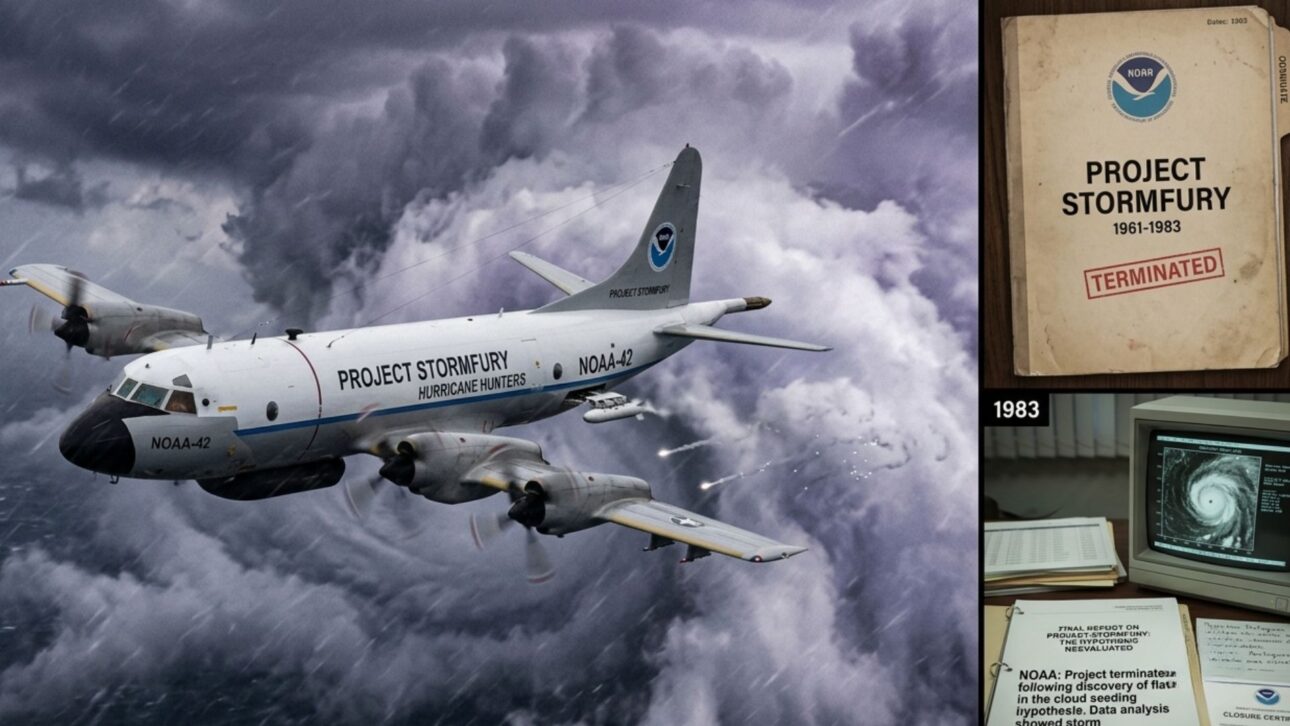
To test the hypothesis, aircraft entered the hurricanes and released silver iodide in specific regions of the storm. AOML’s history shows that the line of experiments went through cases like Esther, Beulah, Debbie, and Ginger, always with strong aerial monitoring to try to separate natural change from the effect caused by the intervention.
NOAA states that the modification was attempted in four hurricanes, over eight different days. On half of these occasions, the winds dropped by 10% to 30%, something that at the time was treated as a promising sign, although the researchers themselves recognized the difficulty of interpreting the results with certainty.
Hurricane Debbie in 1969 was the episode that most excited scientists
The most famous case of the program was Hurricane Debbie in 1969. According to the AOML, the seeding missions on August 18 and 20 were the most extensive ever conducted by STORMFURY and produced the most encouraging results of the entire initiative.
After the first operation, the team observed a drop in maximum winds from 98 knots to 68 knots. In the second round, the system weakened again, going from 99 knots to 84 knots. These numbers helped fuel the idea that the technique could indeed alter the dynamics of a hurricane.


Even at that moment of enthusiasm, scientists already warned that Debbie was just a set of tests and that many other campaigns would be needed to distinguish human effect from natural behavior. This methodological caution would prove decisive years later.
The scientific discovery that dismantled the STORMFURY hypothesis
The hardest blow to the project came from meteorological research itself. The AOML concluded that unmodified hurricanes also exhibited concentric eyewalls, exactly the type of structural change that had previously been interpreted as evidence of successful seeding.
Furthermore, observations showed that many hurricanes contained little supercooled water and too much natural ice for silver iodide to produce the expected effect. In other words, the physical basis of the hypothesis was much more fragile than it seemed when the program began.
The last seeding experiment occurred with Hurricane Ginger in 1971. Still, NOAA continues to describe STORMFURY as a program conducted between 1962 and 1983, because the initiative survived institutionally for longer, even after losing strength as an operational experiment.
Why NOAA abandoned the idea of modifying hurricanes
With the original hypothesis weakened, the project ceased to make sense as a practical solution. NOAA’s own historical page on hurricane modification states that there is no solid physical hypothesis to modify hurricanes, tornadoes, or destructive winds in general, and notes that no federal agency currently maintains active research in this direction.

The reading that remained was tough for STORMFURY. What seemed to be a path to “tame” tropical storms ended up revealing the opposite: the physics of a hurricane is too complex, too powerful, and too variable to be controlled with a relatively simple intervention in the clouds. This conclusion is consistent with NOAA’s official assessment of the limits of artificial modification of these systems.
The final result was the closure of one of the most daring meteorological attempts of the 20th century. The promise to reduce extreme winds before landfall was never scientifically robustly confirmed.
The real scientific legacy of Project STORMFURY for the study of hurricanes
Although it failed as a control technology, STORMFURY did not disappear without leaving traces.
The historical pages of AOML record an intense aerial operation, with radar monitoring, observation aircraft, and a sequence of scientific works produced from these campaigns, especially after Debbie.

From this set of records, it is reasonable to infer that the project helped expand knowledge about the eye wall, internal structure, and natural behavior of tropical cyclones, even without delivering the central objective of artificially weakening them.
The very subsequent review of the results was only possible because there was enough data to challenge the initial hypothesis.
In the end, Project STORMFURY left a lesson that is both uncomfortable and valuable. It showed that the technological ambition to control hurricanes encountered hard physical limits, but it also helped atmospheric science better understand why these giants remain among the most difficult natural phenomena to predict in detail and, even more so, to control.