Portuguese
  Spanish


Xóchitl Cruz López created a solar heater with recycled materials, won a UNAM award, and brought low-cost science to Chiapas.
In 2018, the Mexican Xóchitl Guadalupe Cruz López, from San Cristóbal de las Casas, in Chiapas, made history by becoming the first girl to receive the ICN Recognition for Women, awarded by the Institute of Nuclear Sciences of UNAM, the largest university in Mexico. The award was given for a project with a strong social impact: a solar water heater built with recyclable materials and designed for low-income families.
The achievement drew attention not only because of the inventor’s age, who was 8 years old, but because of the problem she decided to tackle. In a region where many families still relied on firewood to heat water, Xóchitl conceived a simple, cheap, and environmentally cleaner solution, turning scrap into useful technology for the community.
Xóchitl Cruz López’s solar heater combined science, recycling, and social impact
The project that made Xóchitl known became associated with the name “Baño Calientito” and was born with a direct goal: to provide hot water to low-income families without increasing the cutting of trees for firewood production. In a text released by UNAM itself, the case was presented as an example of science applied to solving real community problems.
-
14-Year-Old Girl Develops Solar-Powered Water Purification System for India, Eliminating Need for Electricity or Chemicals

-
Forgotten Canadian Machine Harnessed Waterfall Power to Supply Mines with Compressed Air for 70 Years Without Motors or Electricity
-
Berries, Strawberries, and Blueberries Could Transform Agriculture in Northeastern Brazil, New Tests Reveal

-
Danish Resident Discovers Six Viking Gold Bracelets Weighing 762.5 Grams, Third Largest Gold Treasure in Denmark
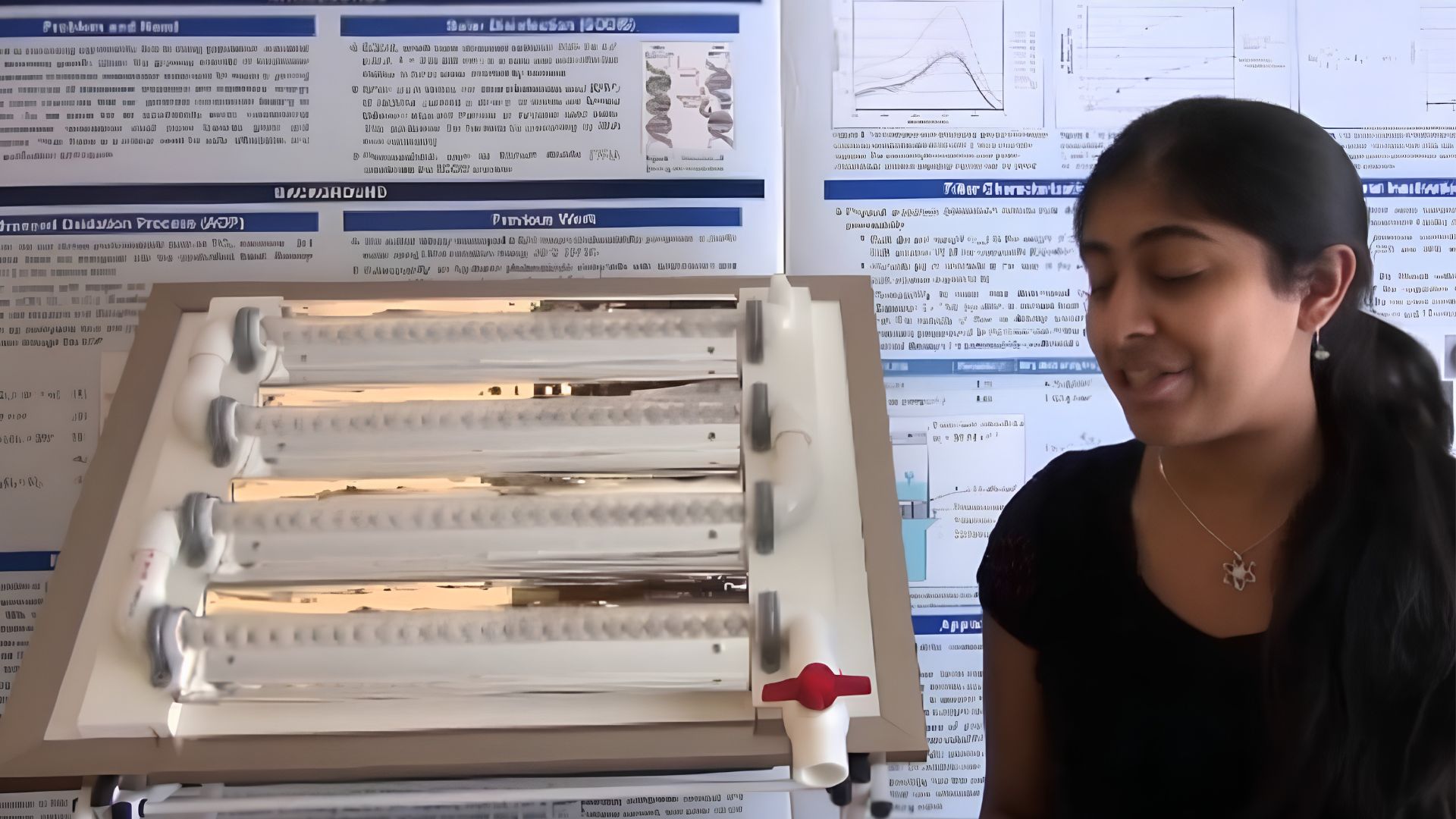


The invention was built with reused items and solar energy. According to an interview with Xóchitl by La Jornada, the system used glass doors from a broken refrigerator, 10 PET bottles, a hose, and pieces of wood, a combination sufficient to form a functional low-cost heater.
More than a school experiment, the equipment showed concrete usability. The report states that the heater had a capacity for up to 50 liters of water, something significant for a domestic project created by a child and installed with the support of her own family.
How the solar heater made with PET bottles, hose, and recycled glass worked
The logic of the heater developed by Xóchitl was simple and efficient. The structure took advantage of solar incidence on reused materials to heat the water, transforming discarded elements into a system for everyday use on the house roof.
The refrigerator glass helped retain heat, while the hose and bottles integrated the circuit through which the water passed before being used. The scientific value of the project was precisely in this combination of basic physical principles, reuse of waste, and practical application in a context of real need.


This type of solution drew attention because it did not depend on a sophisticated laboratory or expensive equipment. The project started from observing the problem, the intelligent use of accessible materials, and the attempt to build a viable alternative for those who could not afford conventional heaters.
Problem in Chiapas inspired invention to heat water without cutting trees
The origin of the idea was in the community’s daily life. In an interview with La Jornada, Xóchitl explained that she saw low-income families cutting down trees to get firewood, heat water, and prepare food, something that affected the environment and also people’s health.
This perception gave the project a much broader scope than just a simple children’s experiment. The heater tried to address the difficulty of accessing hot water, the cost of traditional fuels, and the environmental impact caused by the constant use of firewood.
It was this combination of social sensitivity and scientific reasoning that made the invention so powerful. Xóchitl did not just create a curious object: she presented a solution designed to improve the lives of real families in a region marked by structural deficiencies.
Xóchitl started in science at a young age with support from the PAUTA program of UNAM
The young inventor’s journey began early. UNAM reports that Xóchitl participated in the Adopt a Talent Program, or PAUTA, an initiative aimed at children and young people with interest and ability in mathematics and sciences. Another publication from the university notes that the program supports students from early childhood education to high school.

The university also reported that Xóchitl had been investigating topics related to science since the age of 4. Supported by her family, she found in PAUTA an environment to develop projects with mentorship and turn curiosity into experimental practice.
UNAM Award turned girl from Chiapas into a reference for young scientists
The recognition received in 2018 had enormous symbolic weight. The UNAM’s own coverage highlighted that Xóchitl was the first girl to receive the honor, normally associated with more established female trajectories in science.
At the same time, the award increased the visibility of a story that defied several standards. A girl from southern Mexico, still in elementary school, managed to turn everyday observation, environmental awareness, and inventiveness into a project capable of gaining national prominence.
Xóchitl’s invention showed that science can be born outside major laboratories
The strength of Xóchitl’s story also lies in the place from which it emerged. Her heater was not born in a sophisticated technological center, but in the domestic environment, with support from her parents, guidance from teachers, and the use of materials that would normally be discarded.
According to La Jornada, after about three weeks of work, the heater was installed in the family’s home and began providing hot water not only for them but also for other families. This reinforced the practical and community nature of the invention.
Xóchitl Cruz López’s legacy goes beyond the solar heater created at age 8
Over the years, the invention ceased to be just a curiosity about precocity. Xóchitl’s trajectory came to symbolize the potential of science as a tool for social transformation, especially when it reaches the lives of children early, who would normally be outside this circuit.
In an interview published in 2024 by the portal la jornada, Xóchitl stated that the recognition gained with the heater opened doors and reinforced her decision to continue in science. In the same article, she says she dreams of studying medicine and continuing to help people, a vision that preserves the same social logic that motivated her original creation.
The story of Xóchitl Guadalupe Cruz López remains powerful precisely for this reason. It shows that great ideas can arise early, in peripheral territories and with simple materials, as long as there is curiosity, education, and willingness to turn a collective problem into a real solution.