Portuguese
  Spanish


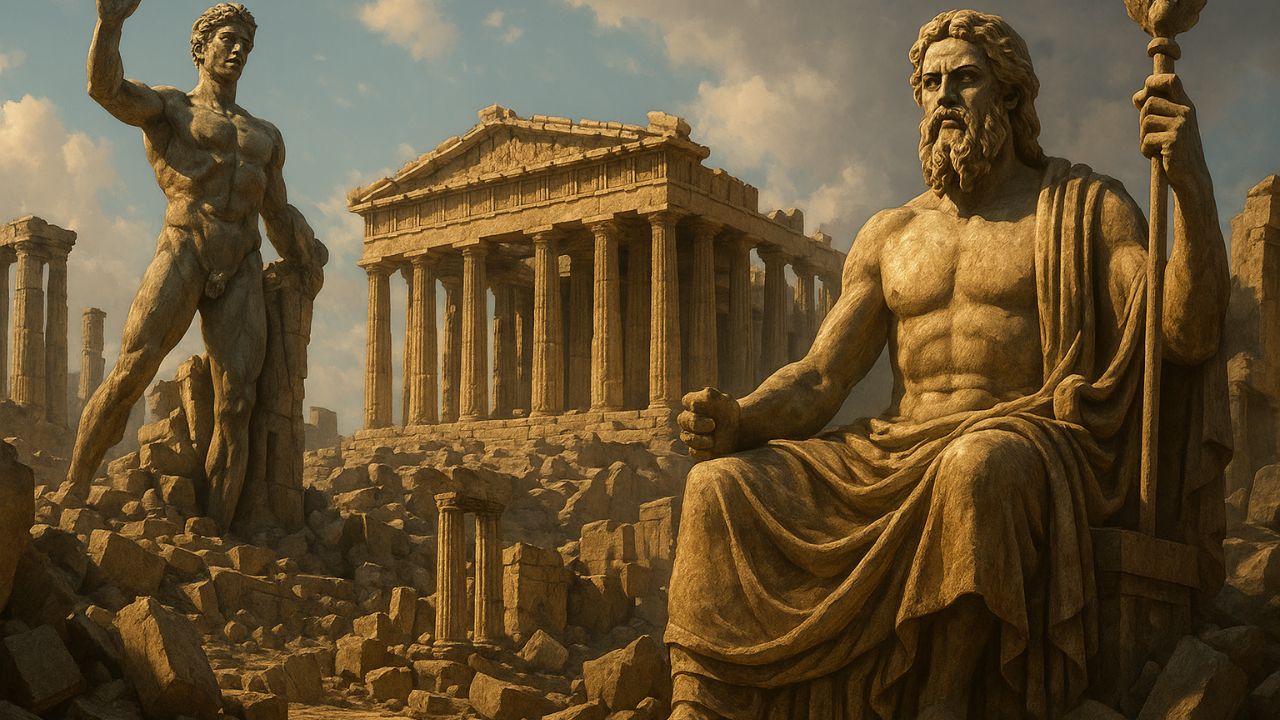

Discover The Mysteries Of The 7 Lost Wonders Of The Ancient World, Including Temples, Colossal Statues, And Impossible Works That History Erased.
Imagine visiting the city of Olympia and coming back with a selfie in front of the gigantic statue of Zeus. That could happen if it still existed. Unfortunately, the 7 lost wonders simply no longer exist and had tragic ends over the centuries. Today, we will explore what happened to these legendary constructions.
Unlike the Great Pyramid of Giza, which has endured, most of these monuments succumbed. In this article, you will learn the story behind colossal statues, great temples, and other impossible works of the ancient world that defined the limits of human engineering.
The Imposing Statue Of Zeus In Olympia

Zeus was the most important of the Greek gods, and although he had several sanctuaries, none surpassed his colossal statues. The one in Olympia measured between 12 and 15 meters, the equivalent of a five-story building. Made by Phidias, it was one of the jewels of the ancient world, covered with plates of ivory and gold.
-
Brazilian Researchers Develop Plant Fiber Cement Absorbing 100 kg of CO2 per Cubic Meter, Aiming for Low-Carbon Construction

-
Brazil’s Largest Sewage Plant Boosts Capacity with New High-Performance Pumps, Treating Over 1 Billion Liters Daily
-
Brazilian Mother and Homemaker Becomes Bioconstructor, Builds 24-Ton Earth Dome and Teaches Technique Across Argentina
-
Manchester Builds 40 Furnished Homes for the Homeless Under Railway Arches, Complete with Community Hall, Laundry, Garden, and Sports Court


The work remained in one of the most sacred temples in Greece until the 4th century. Unfortunately, like many of the 7 lost wonders, its end is uncertain, likely destroyed in a fire that consumed the site, leaving only the legend.
The Temple Of Artemis And The Fire Of Herostratus

The Temple of Artemis in Ephesus is a classic example of the grandeur of temples of antiquity. It had three versions, but the second had a fate marked by vanity: it was set on fire by Herostratus in 356 BC, on the same night Alexander the Great was born.
The third version emerged later, even more imposing. However, attacks from invaders and demolition by Christians transformed this structure into ruins. Today, what remains of this fundamental piece of the 7 lost wonders is just a rebuilt column, a shadow of the impossible works of yore.
The Mausoleum Of Halicarnassus

Built in present-day Turkey, the Mausoleum was erected for the ruler Mausolus. Standing 45 meters tall, the construction was one of the most beautiful of the ancient world, adorned with hundreds of sculptures. At the top, a pyramid crowned by a bronze chariot defied gravity, categorizing it among the impossible works of the time.
The structure resisted invasions, but a series of earthquakes destroyed the monument. Its stones were reused to build a castle, a common fate for the materials of temples and palaces that fell into oblivion.
The Practical Lighthouse Of Alexandria

Unlike other religious wonders, the Lighthouse of Alexandria had a practical function: to guide ships. Over 100 meters tall, it was one of the true impossible works of engineering, taking twelve years to complete. It illuminated the path to the harbor, serving as a lighthouse of progress in the ancient world.
Unfortunately, earthquakes in the 14th and 15th centuries brought down the structure. Today, fragments of this giant rest submerged, reminding us that even the greatest constructions can enter the list of the 7 lost wonders.
The Mystery Of The Hanging Gardens Of Babylon

This is the wonder that may have never existed. It is said that Nebuchadnezzar II built a suspended paradise with exotic trees and complex irrigation. If real, it would be the peak of impossible works in landscaping, but there is no concrete archaeological evidence, unlike the temples of the region that left traces.
Without solid records, some believe the legend is a confusion with gardens in Nineveh. Real or not, the idea of the gardens remains alive in the memory of the ancient world as a symbol of unattainable beauty.
The Giant Colossus Of Rhodes


Among the colossal statues, none sparks the imagination quite like the Colossus of Rhodes. The bronze figure of the god Helios stood 33 meters tall and celebrated a military victory. Its construction was financed with abandoned weapons, but its glory was short-lived.
Only 54 years after it was completed, an earthquake caused the statue to collapse. The Rhodians did not rebuild it, fearing divine wrath. Thus, the Colossus permanently joined the group of the 7 lost wonders, leaving a legacy that inspired art for centuries.
The Survivor Great Pyramid

The Great Pyramid of Giza is the only one of the ancient wonders still standing. Built around 2500 BC, it lost its polished limestone casing and golden top due to looting and natural wear, leaving only the raw stone exposed. Even so, it remains one of the most recognizable structures on Earth, witnessing the power of the pharaohs for over 4,000 years.
Which of these 7 lost wonders would you like to have seen in person? Leave your answer in the comments!