






 Portuguese
  Spanish


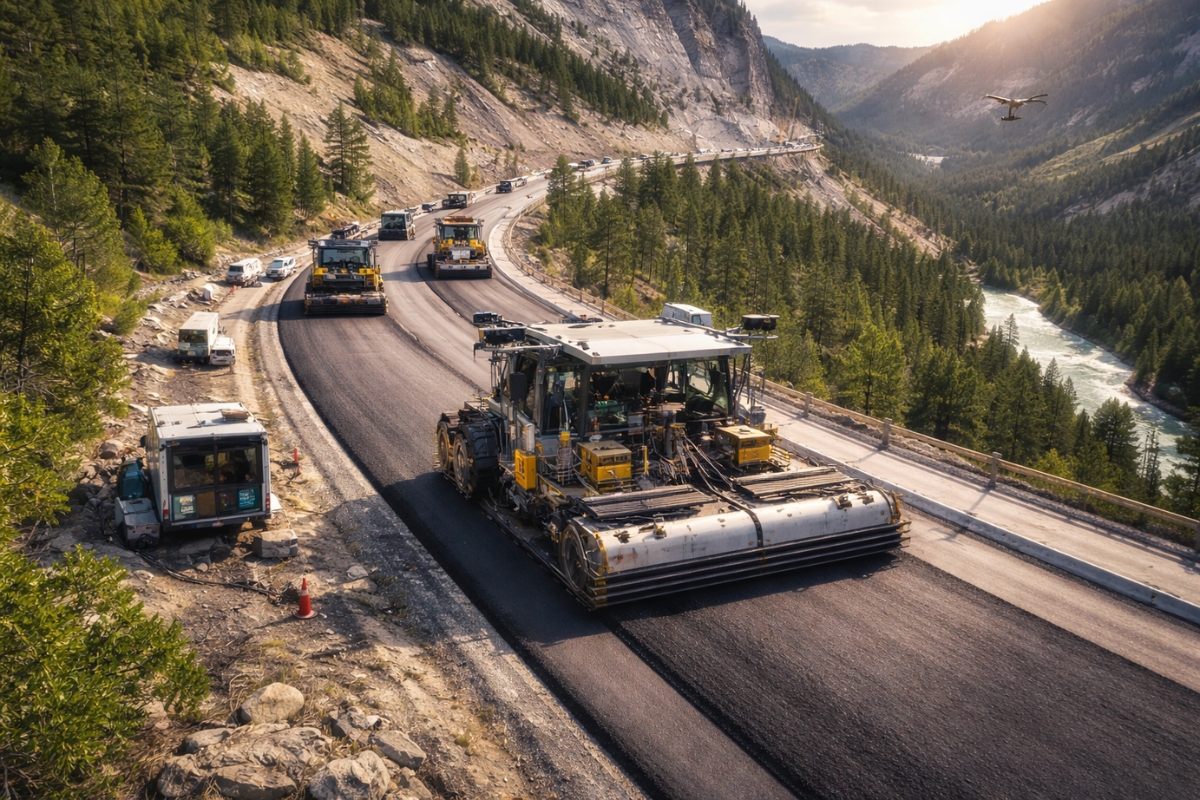


Robots Take to the Asphalt in Real Projects, Paving Miles with Millimeter Precision via GNSS and 3D Sensors, Reducing Risks on Job Sites and Pushing Highway Construction into a Digital Control Era That Europe Still Hesitates to Release
For decades, highway construction has been synonymous with large teams spread across the site, experienced operators inside heavy machines, and a routine marked by intense heat, constant noise, and tight deadlines. Today, this scenario is beginning to change silently — and technologically.
In different parts of the world, pavers, compactors, and trucks are being integrated into autonomous systems capable of executing tasks with millimeter precision. It is not just assisted automation. In some cases, machines practically “decide” on their own how to perform the work, adjusting parameters in real time based on sensors and digital models.
What is at stake is not just productivity. It is a structural transformation in the way large infrastructure projects are planned and executed.
-
Engineers Develop Fridge-Sized Machine to Produce 95-Octane Synthetic Fuel from Air and Water, Aiming to Sustain Combustion Engines Without Oil

-
Two-Armed Robot Uses AI to Reassemble Destroyed Pompeii Frescoes, Solving an “Impossible” Puzzle
-
New Law in Brazil Requires Breaks for Type 1 Diabetes Management at Work, School, and Public Exams

-
Scientists Confirm “Greening” of Antarctica: Ice on the World’s Coldest Continent Turns Green as Mosses Multiply Over Tenfold in Four Decades


China Accelerates and Tests Maximum Scale
China has become the world’s leading laboratory for this revolution. In one of the most emblematic projects, a 158-kilometer stretch of highway was paved using extensive autonomous machines, drones, and intelligent monitoring systems.
The pavers operated with high-precision GNSS positioning technology, combined with inertial sensors and 3D control systems capable of maintaining leveling variations below a few millimeters. Autonomous compactors automatically adjusted the vibration and compaction frequency based on the detected density of the freshly applied asphalt.
Drones flew over the site capturing thermal images to monitor the temperature of the asphalt mixture, a critical factor for ensuring adherence and durability. The process generated a continuous flow of data sent to remote control centers, where engineers monitored real-time performance.
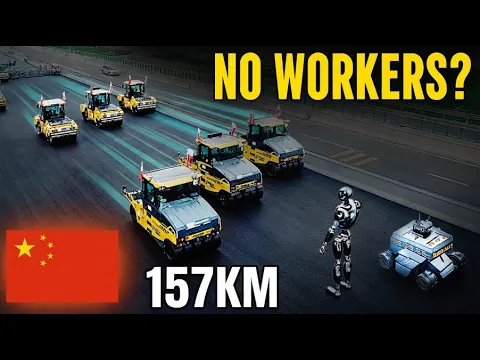

According to a report by the Spanish newspaper El País, the advancement of robotic construction in China shows how the integration of artificial intelligence, sensors, and digital project models is allowing machines to perform tasks traditionally dependent on human skill, with clear gains in precision and efficiency.
The scale is impressive, but what really stands out is the level of technological integration. Each applied layer can be tracked digitally. Every centimeter of the roadway has technical documentation. The highway becomes more than just physical infrastructure; it acquires a complete “digital history.”
Canada Bets on Autonomous Paving on Strategic Highway
In North America, Canada has also begun to advance. A section of the Trans-Canada Highway was paved using technology considered fully autonomous in asphalt application, utilizing 3D control systems integrated with satellite positioning.
The paver operated with software that automatically adjusted the width, thickness, and alignment of the asphalt layer according to the digital model of the project. The margin of error was drastically reduced, and the uniformity of the pavement exhibited rates superior to conventional methods.
Instead of operators controlling each movement manually, professionals acted as technical supervisors, monitoring execution data and intervening only when necessary. This change in role is one of the central points of transformation: work does not disappear but shifts to more analytical and strategic areas.
In addition to precision, another decisive factor is safety. Road work is among the most hazardous occupational activities. Reducing human presence in the most critical areas can decrease accidents and exposure to extreme conditions.

Europe Hesitates Before Regulatory Barriers
While China and Canada display practical examples, Europe adopts a more cautious stance. European companies are already testing intelligent pavers and compactors with advanced automation, but large-scale expansion faces regulatory obstacles.
The main issue is legal: who is responsible in the event of a failure of an autonomous system? The machine manufacturer? The software company? The construction company? The insurer? The absence of a harmonized regulatory framework among European Union countries creates an environment of uncertainty.
There are also challenges related to technical standardization. For autonomous systems to operate efficiently, it is necessary for BIM models, sensors, software, and equipment from different manufacturers to communicate with each other. Without clear interoperability, implementation costs rise.
This is not about technological delay. Europe has the technical and industrial capacity to advance. What weighs heavily is the need to ensure legal security and clearly defined responsibility before allowing operations with a high degree of autonomy on open roads.
The Road of the Future Is Already Being Designed
Robotic construction does not mean that we will see completely empty job sites. What is emerging is a hybrid model, where machines perform repetitive and high-precision tasks while humans take on supervision, data analysis, and strategic decision-making.
The combination of artificial intelligence, LiDAR sensors, centimeter-precision GNSS systems, 5G connectivity, and three-dimensional digital models is creating a new logic of construction. The highway is being built as if it were a mobile production line, guided by data.
Experts point out that in the coming years, we will see three clear stages: total digitalization of the project, consolidated semi-autonomy in critical tasks, and finally, expanded autonomy in controlled environments, such as nighttime work or isolated stretches.
The first miles have already been paved. The machines have already proven that they can execute with impressive precision. The question now is no longer whether robotic construction will spread, but when.
And, it seems, the asphalt of the future will have algorithms as part of its structural foundation.








Eso es progreso. La tecnología no debe usarse solo para producir armas más mortíferas. La tecnología debe estar al servicio de la Humanidad. Los sistemas legales también. No deben dar lugar a discusiones inútiles, que limiten obras de beneficio social,por el contrario facilitar el acceso de las mayorías a los beneficios de la Ciencia.