






 Portuguese
  Spanish


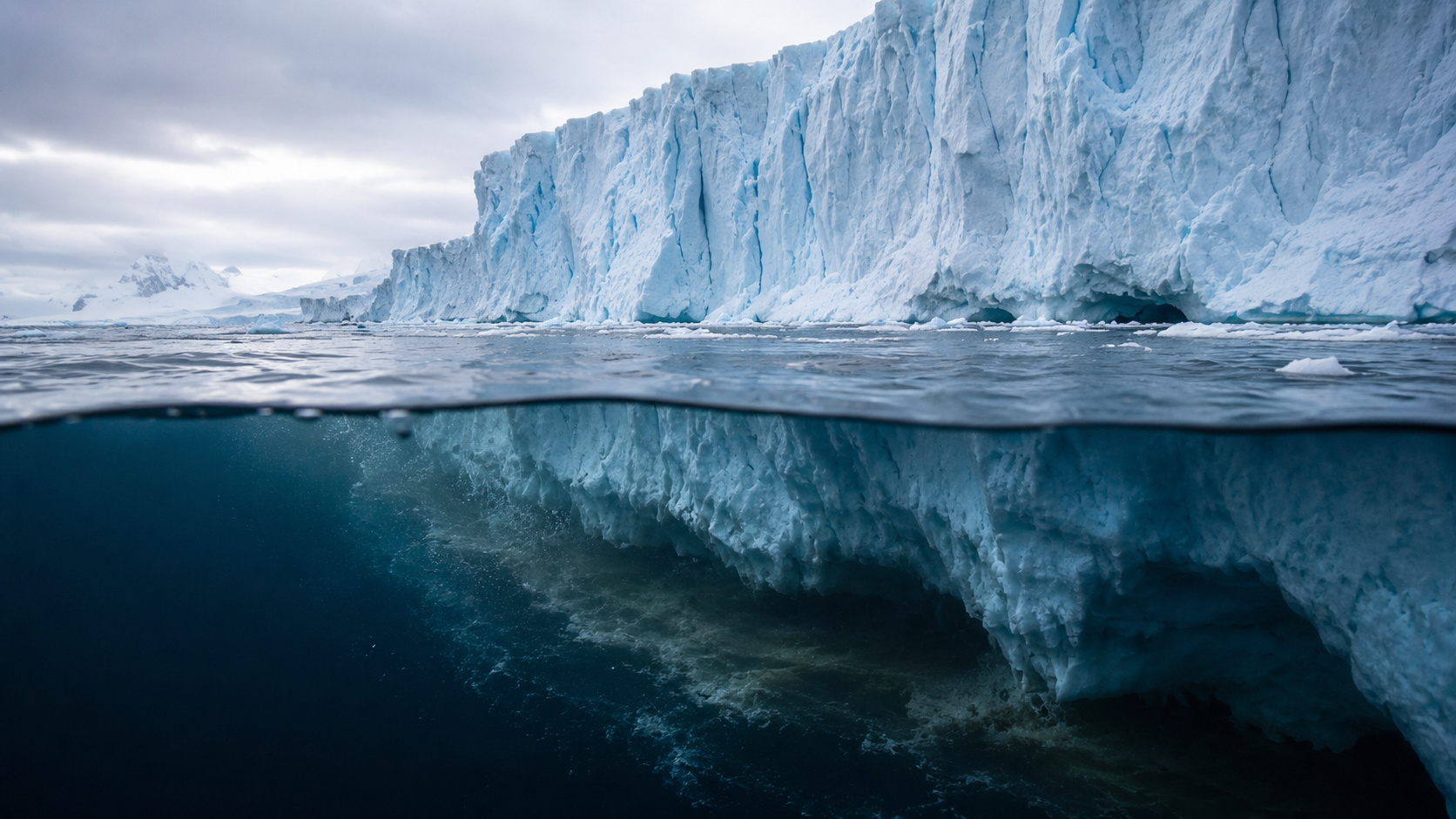


Warm water in the Amundsen Sea accelerates basal melting, glacier retreat, and risk of sea level rise in Antarctica.
In 2026, an analysis led by the University of California, Irvine, in the United States, placed the Amundsen Sea, in West Antarctica, at the center of one of the biggest concerns of modern glaciology. According to a statement published on March 2, 2026 by the university, the study used three decades of satellite data and showed that Antarctica lost 12,820 km² of grounded ice between 1996 and 2025, with the most dramatic retreats concentrated in the Amundsen Sea and Getz sectors.
The region includes glaciers such as Thwaites, Pine Island, and Smith, names that repeatedly appear in scientific studies because they function as exit doors for ice from West Antarctica to the ocean. In the same survey, Pine Island retreated 33 km, Thwaites retreated 26 km, and Smith reached a retreat of 42 km, while the grounding line of the Antarctic ice sheet receded by an average of 442 km² per year.
The central point is simple and worrying: the problem is not just the warmer air, but the relatively warm ocean water that enters beneath the ice shelves and melts the structure from the base. It is this mechanism, invisible to those who look at Antarctica only from above, that transforms the Amundsen Sea into one of the most sensitive areas for sea level rise projections.
-
Chinese Student Builds Humanoid Robot for $2,100 at Age 20, Now Leads Robotics Startup in China

-
Sumatran Rhino: The Rare “Prehistoric Survivor” with Fewer Than 50 Left and a Fascinating Natural History

-
Chinese Humanoid Robots Transition from Labs to Real Factories to Assemble Tablets: AgiBot Deploys G2 Machines at Longcheer, Aiming for 100 Robots in Electronics, Cars, Chips, and Energy by 2026

-
Shopkeeper Buys Notebook at English Bazaar, Discovers Rare 1915 WWI Record Listing 900 Volunteers, 140 Fallen




Amundsen Sea concentrates some of the most vulnerable glaciers in West Antarctica and has become a global reference for understanding basal melting
The Amundsen Sea is located in the sector of West Antarctica facing the South Pacific and houses a sequence of glaciers and floating shelves that drain a significant part of the continental ice sheet.
The difference between an ice shelf and grounded glacier is decisive: the shelf floats on the ocean, while the grounded ice is still supported by the rocky bed. When warm water erodes the base of the shelf, it loses the ability to hold back the ice coming from behind, as if a natural barrier begins to weaken.


The grounding line is the boundary where the ice stops being supported by the continent and starts to float. When this line retreats inland, the system can allow more ocean water to reach previously protected areas, increasing basal melting and accelerating the flow of ice towards the sea. This is why measuring this boundary by satellite radar has become one of the main tools for assessing the stability of Antarctica.
In the Amundsen Sea, this process is especially sensitive because several glaciers are settled on land below sea level and with unfavorable geometry.
When the grounding line shifts to deeper regions, water can advance beneath the ice, reducing the resistance that held back the glacial flow. The study published in The Cryosphere on March 16, 2026 describes the region as an area of special interest precisely because of its rapid retreat in deep basins and its potential for future instability.
Satellites revealed a loss of 12,820 km² of grounded ice and extreme retreats in the Pine Island, Thwaites, and Smith glaciers
The study led by Eric Rignot from the University of California, Irvine, analyzed data from various satellite missions to map the migration of the grounding line around the entire Antarctic. The research showed that 77% of the Antarctic coast showed no grounding line migration since 1996, but the vulnerable sectors lost a huge area of grounded ice, equivalent to almost 5,000 square miles, or about 12,820 km².
The strongest information for the Amundsen Sea lies in the distribution of this loss. According to UC Irvine, the most dramatic changes occurred in the Amundsen Sea and Getz sectors, where glaciers retreated between 10 km and about 40 km.

The individual retreat of Smith reached 42 km, Pine Island retreated 33 km, and Thwaites retreated 26 km, numbers that help explain why the region is treated as one of the most critical fronts of West Antarctica.
The European Space Agency also highlighted that the largest detected retreat of the grounding line occurred along the coast of the Amundsen Sea, where the ice retreated in some points up to 42 km between 1996 and 2025. The ESA also pointed out that the most affected areas are near the East Getz, Smith, Thwaites, and Pine Island glaciers, all linked to sectors where warm ocean currents reach deep glacial beds through submarine channels.
Deep Circumpolar Water enters under ice shelves and transforms basal melting into a driver of instability
The physical mechanism behind this retreat involves the so-called Deep Circumpolar Water, a relatively warm and salty water mass that can be transported to the continental shelf and reach cavities under the ice shelves. The British Antarctic Survey describes the Dotson ice shelf in the Amundsen Sea sector as part of a region of rapid glacial mass loss due to ocean-driven basal melting.

In a publication from December 15, 2025, the British Antarctic Survey reported that researchers collected data over more than 100 km of underwater paths beneath the Dotson ice shelf using the AutoSub Long Range autonomous vehicle.
The measurements observed ocean speed, turbulent energy dissipation, and heat flows, precisely to understand how warm water moves within cavities that remain inaccessible to traditional direct observation.
This type of data is essential because basal melting does not occur uniformly. The BAS pointed out that turbulent mixing is greater in regions of fast flow entry and over irregular topography, with vertical heat flows reaching maximums of 52 W/m² in the observations, although higher values are still needed in unaccessed areas to sustain the average melting rates observed on the Dotson ice shelf.
NASA shows how warmer currents circulate under the ice and erode the base of floating platforms
A scientific visualization by NASA, released on August 24, 2021, helps to understand the geometry of this process.
The simulation shows how ocean circulation in the Amundsen Sea moves around and under ice shelves and glaciers, with cooler currents near the surface and relatively warmer waters at depth.
In the visualization, NASA describes the movement along the coast of the Amundsen Sea, passing by the Getz ice shelf, the Dotson ice shelf, Pine Island Bay, and the floating tongue of the Thwaites glacier.
The temperatures represented in the model range from about -1.25 °C to +1.25 °C, a difference that seems small for everyday life but is enormous in an environment where ice is in direct contact with saltwater under high pressure.
Thwaites and Pine Island act as drainage gates of West Antarctica and are concerning due to their unstable geometry
Concern about the Amundsen Sea did not begin in 2026. On May 16, 2014, NASA’s Earth Observatory already highlighted two studies pointing to an apparently irreversible decline in a part of the West Antarctic ice sheet.
According to NASA, the Amundsen Sea segment had begun a loss process that could result in collapse over the coming centuries.
NASA described the region as composed of several fast-flowing glaciers, including Pine Island, Thwaites, Haynes, Pope, Smith, and Kohler.
The most delicate physical point is that there is little fixed ice platform in the Amundsen Sea sector to act as a barrier, allowing these glaciers to flow with less containment into the ocean. According to the agency, these ice rivers drain one-third of the West Antarctic ice sheet.
Another historical data point helps to size the problem. NASA reported that between 1992 and 2011, the grounding line of the Pine Island Glacier had retreated 31 km, while Smith/Kohler retreated 35 km, Thwaites retreated 14 km, and Haynes retreated 10 km.
The central explanation was the same observed in the most recent studies: most of the melting occurs from below, when warm ocean currents corrode and thin the ice base.
Study in Nature Climate Change indicates that ocean warming in the Amundsen Sea may be three times faster than historical
On October 23, 2023, a study published in Nature Climate Change by Kaitlin A. Naughten, Paul R. Holland, and Jan De Rydt reinforced the severity of the scenario.
The article states that ocean-driven ice shelf melting in the Amundsen Sea is currently the main process controlling Antarctica’s contribution to sea level rise.

The study used a regional ocean model to project future ice shelf melting in the Amundsen Sea and concluded that a rapid warming, approximately three times the historical rate, is likely already committed throughout the 21st century. The authors also indicated widespread increases in basal melting, including in regions crucial for the stability of the ice sheet.
This result does not mean that reducing emissions has ceased to matter for the global climate system. What the study indicates is more specific: considering the internal climate variability, intermediate emission scenarios, and the most ambitious goals of the Paris Agreement did not show a significant difference in the projected warming for the Amundsen Sea in the 21st century.
In other words, part of the regional ocean warming may already be embedded in the physical trajectory of the system.
The Amundsen Sea is already experiencing the warm regime that scientists fear for giant platforms like Ross and Filchner-Ronne
On September 20, 2024, another study in Nature Climate Change, led by Emily A. Hill, G. Hilmar Gudmundsson, and David M. Chandler, analyzed the risk of transitioning from a cold ocean regime to a warm regime under the Filchner-Ronne and Ross ice shelves, the two largest ice shelves in Antarctica. The study concluded that this change could destabilize some areas and lead to the irreversible retreat of the grounding line.
The point that connects this study to the Amundsen Sea is straightforward. The authors state that when this change to a warm state occurs, conditions begin to resemble those of the current Amundsen Sea sector, responsible for most of the observed Antarctic ice loss today.
In other words, the Amundsen Sea is not just an area in crisis but a real example of what can happen if other currently colder sectors undergo a similar transition.
According to the study, the temperature change under ice shelves can increase melt rates from a few meters to tens of meters per year, reducing the buttressing effect of the shelves, accelerating ice flow through the grounding lines, and paving the way for unstable retreat. This is the type of process that makes continuous observation of the Amundsen Sea so relevant for global risk models.
Grounding line, deep bed, and inclined topography create a feedback loop difficult to interrupt
The study published in The Cryosphere in 2026 helps explain why the retreat in the Amundsen Sea is so concerning. The research points out that glacial acceleration is linked to the weakening of ice shelves, caused by the intrusion of warm, salty water beneath the floating structures. Melting tends to reach greater intensity near the grounding line, precisely where the transition between grounded ice and floating ice controls the system’s stability.
The same research reports that the mass loss of West Antarctica increased from 39.5 ± 19 gigatons per year between 1992 and 2001 to 103.6 ± 10.8 gigatons per year between 2002 and 2020. These numbers show that the problem is not an isolated event but a trend of acceleration in a sector where ice discharged into the ocean has a direct impact on sea level.
The strongest data point in the article is the potential sea level rise associated with the region. According to the publication, the Amundsen Sea Embayment contains ice equivalent to 1.26 ± 0.02 meters of potential sea level rise, which explains why small changes in the grounding line are closely monitored by the scientific community.
What the Amundsen Sea reveals about the future of Antarctica and sea level rise
The Amundsen Sea shows that the future of Antarctica depends less on superficial images of ice and more on the physics hidden beneath the floating shelves.
The hot water reaching deep cavities can thin the ice base, reduce the mechanical support of the platforms, accelerate grounded glaciers, and push grounding lines into deeper basins, creating a feedback loop that climate models are trying to represent with increasing accuracy.
The most recent studies do not allow us to state that the entire collapse of West Antarctica will occur in the short term, nor that all sectors will respond in the same way.
What they show, based on satellites, ocean measurements, and modeling, is that the Amundsen Sea already exhibits strong signs of instability, with extreme retreats in key glaciers and ocean warming projected at a much faster rate than historically observed.
The question that remains is whether the Amundsen Sea will be treated merely as a distant anomaly on the map or as a real warning of how the interaction between warm ocean, deep ice, and weakened platforms can reshape the future of sea level in the coming decades.


