Portuguese
  Spanish


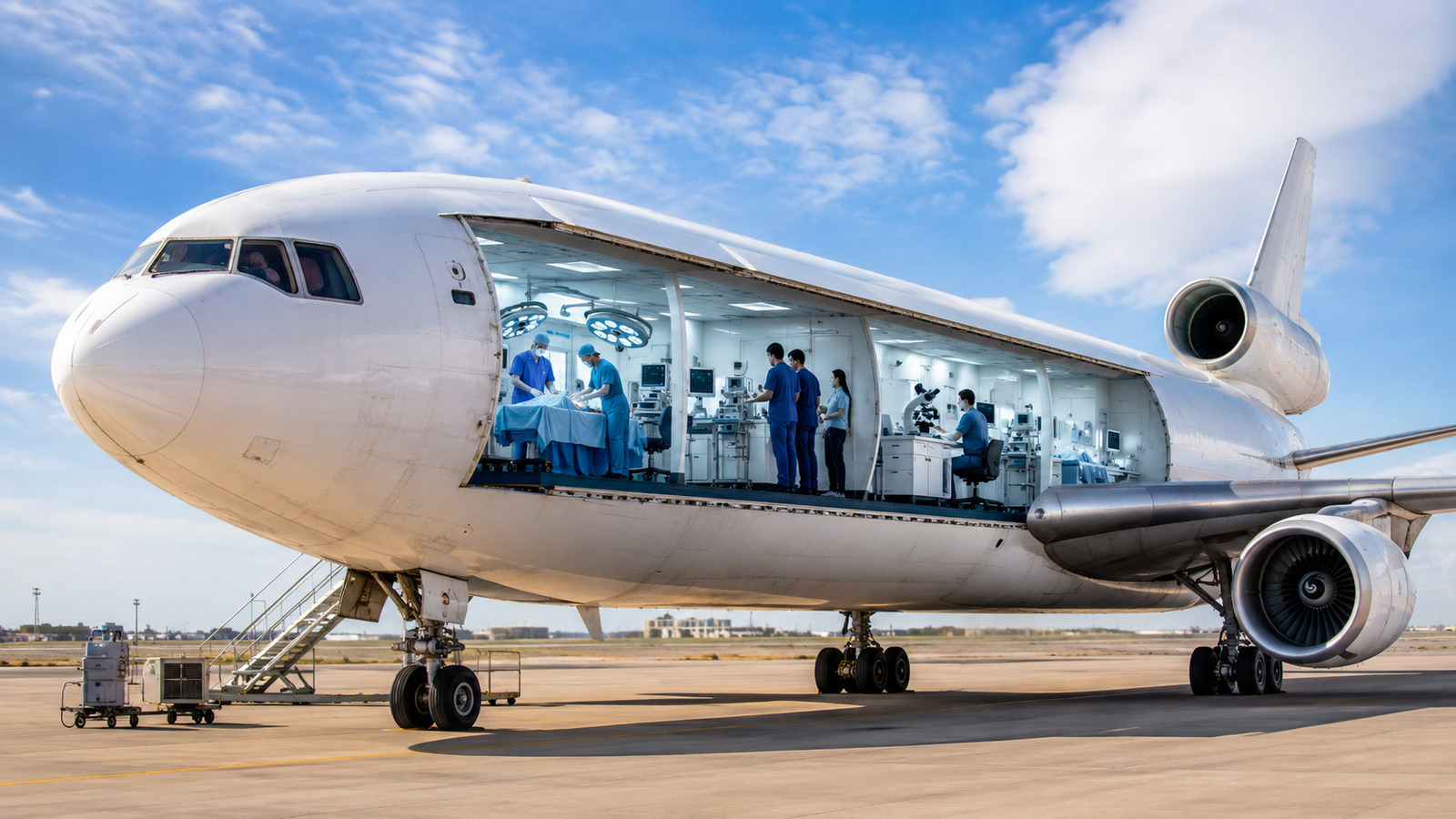

Inside an adapted McDonnell Douglas MD-10, the Flying Eye Hospital brings eye surgery, laser treatment, and medical training to regions with little access to specialists, forming local teams in a room with 3D cameras
With eye surgery, laser, and medical training inside a McDonnell Douglas MD-10, Orbis International’s hospital plane provides specialized care to regions where losing vision due to lack of assistance is still a reality.


Hospital plane was born in 1982 and reached the third generation
Orbis International began its humanitarian missions in 1982, when it started using an old Douglas DC-8 adapted for ophthalmological care. The evolution of the project led to the third generation of the aerial structure.
The model in operation today is a McDonnell Douglas MD-10, officially launched on the runways in 2016. Before that, the aircraft underwent an intense 6-year process of mechanical conversion.
-
Texas Teens Win $50,000 at World’s Largest Science Fair for Developing Non-Surgical Brain-Controlled Bionic Prosthesis with 98% Accuracy

-
Samsung Galaxy A27 Launches with 6.7-inch Super AMOLED Display, Full HD+ Resolution, Android 16, Six Years of Updates, Snapdragon 6 Gen 3, and Dust and Splash Resistance; Available for Pre-order in the US for $350

-
Five Brazilian Students Invent Drug Test Pen That Detects Date Rape Drugs in Seconds
-
Viedma Glacier Retreat in Patagonia Uncovers 900-Meter-Deep Basin, Making Viedma the Deepest Lake in the Americas


The version expanded the program’s range. The MD-10 requires only 2 pilots in the cockpit and offers almost double the flight range of the old DC-10 from United Airlines.
The robust plane was donated by FedEx employees themselves. Thus, the organization directed its financial investment towards the medical technology on board, without focusing resources on the purchase.

Internal structure includes surgery, laser, and recovery
The engineering team installed modular hospital units inside the cargo fuselage. This solution allows for updating equipment and restocking supplies without dismantling the main chassis, keeping the structure ready.
The interior houses an operating room equipped for complex procedures, as well as laser treatment rooms aimed at quick, precise, and non-invasive ophthalmological interventions.
The space also features a simulation center, used with artificial eyes, mannequins, and virtual reality. There is also a recovery room with beds for the rest of the patients treated during the day.
Certification reinforces service safety
The Flying Eye Hospital is presented as the only non-terrestrial medical facility on the planet accredited by the American Association for Accreditation of Ambulatory Surgery Facilities International, known by the acronym AAAASFI.
This certification follows the same standard of requirement applied to surgical centers in the United States. It does not function as a decorative seal but as a guarantee of strict standards.
The protocols involve hygiene, anesthesia, and patient recovery. Thus, the local resident treated on board receives a level of sanitary safety equivalent to that found in a traditional reference hospital.

3D technology transforms the airplane into a classroom
Despite the image the project may suggest, the procedures do not happen with the aircraft in flight. The pilot lands in the destination country, and the airplane operates parked on the local airport’s tarmac.
In this condition, the structure functions as a temporary fixed clinical base. The goal of the American NGO is not limited to performing surgeries but to spreading technical knowledge worldwide.
World-renowned volunteer surgeons attend to residents while local doctors and nurses follow everything live. The transmission occurs through 3D cameras installed in the 46-seat classroom.
This format allows regional professionals to observe techniques, routines, and clinical decisions during procedures. Later, they can take the learning to their municipalities, expanding the reach of assistance.
Hospital airplane: Training has already reached 97 countries
Since the beginning of pioneering operations, the program has trained healthcare teams in person in 97 different countries. The desired effect is to maintain the capacity for care even after the jet leaves the location.
The combination of aviation, medical volunteering, and cutting-edge technology gives the project a function greater than transportation. The hospital airplane transforms a heavy freighter into a tool for teaching and humanitarian service.
By training regional professionals within an adapted fuselage, the initiative helps to tackle the cycle of preventable blindness. The cure continues in the community when the visiting surgeon returns to base.
With information from BMC News.