Portuguese
  Spanish


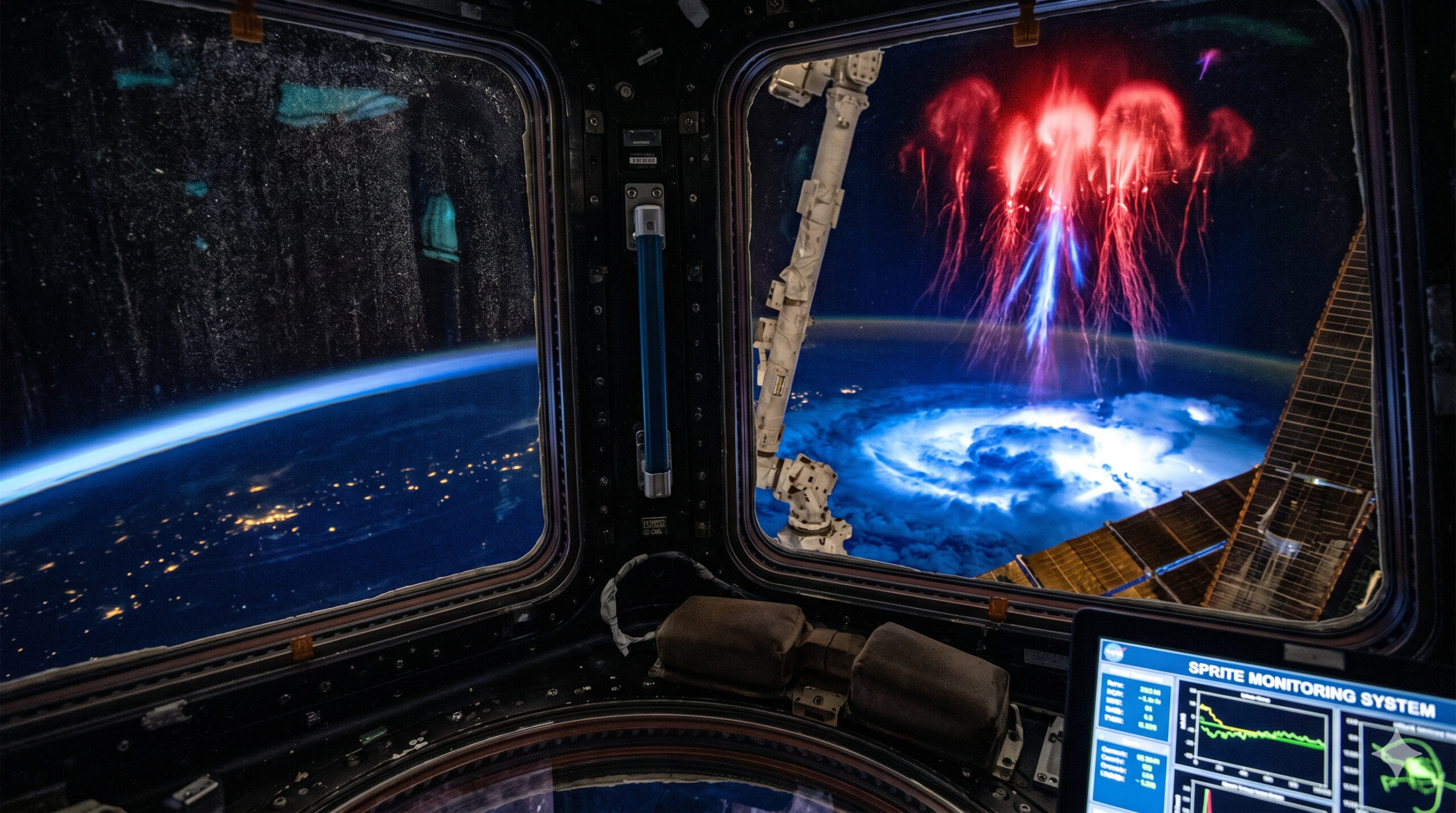

Sprites are red lightning that rise up to 80 km above the clouds and were recorded from the ISS, revealing phenomena that can affect communications.
In 2025, images taken from the International Space Station and released by NASA again recorded sprites, reddish electrical discharges that appear above large storms and can reach the mesosphere, a layer of the atmosphere located between about 50 and 85 kilometers in altitude. The phenomenon falls into the category of transient luminous events and remains one of the most enigmatic chapters of atmospheric electricity.
The images captured from space show giant luminous structures, sometimes resembling jellyfish or branched columns, appearing for fractions of a second above storm systems. In materials from NASA Science and the National Severe Storms Laboratory, sprites appear as rare phenomena, difficult to observe visually and still not fully understood, which helps explain why for decades they circulated more as unusual reports from pilots and observers than as a consolidated object of atmospheric research.
Lightning that rises up to 80 km challenge classical physics of storms
Unlike conventional lightning, which descends from the clouds to the ground, sprites take the opposite path. They originate above storms and propagate upward, reaching altitudes between approximately 50 km and 80 km, according to data from NASA Earth Observatory.
-
Pennsylvania Mine Creates Ice in Summer Heat and Melts in Winter, Turning a Mountain Crevice into a Reverse Natural Refrigerator

-
China Accelerates Global Expansion of Robotics: From Smart Vacuums to Industrial and Humanoid Machines, Millions Exported to Over 150 Markets
-
Polar Air Mass to Hit Brazil: Temperatures to Plummet in Nine States, Near Freezing in the South with Frost Risk Until Monday
-
Chinese “dark factories” produce electric cars 24/7 with minimal human intervention, as Zeekr assembles 800 units daily, raising concerns in Brazil.






This region of the atmosphere, called the mesosphere, has completely distinct physical characteristics from the troposphere. The air is extremely thin, the pressure is low, and electrical conduction occurs differently, allowing for the emergence of broad and diffuse luminous structures.
This inversion of electrical behavior was, for decades, considered unlikely, which explains why pilot reports were discredited for so long.
The phenomenon was treated as a myth until it was officially recorded in 1989
Reports of strange lights above the clouds have existed since the dawn of aviation, but only gained scientific validation in 1989, when researchers from the University of Minnesota recorded the phenomenon with low-light cameras.
Before that, the idea of upward electrical discharges was considered incompatible with classical models of atmospheric electricity.
The scientific recognition of sprites occurred more than a century after the first reports, an interval that highlights how difficult it is to observe and study phenomena that occur outside the human visual field and last only milliseconds.
ISS becomes a strategic platform for observing invisible phenomena
The observation of sprites has advanced significantly with the use of orbital platforms. The International Space Station, which orbits at about 400 km altitude, offers a privileged view above the clouds, allowing direct recording of events in the region where they occur.
From the ground, these phenomena are often obscured by dense clouds or simply go unnoticed due to their short duration. From space, however, high-sensitivity sensors and cameras can capture detailed images of the discharges.

In recent records released by NASA, astronauts documented giant sprites over storm systems in North America, reinforcing the role of the ISS as an advanced atmospheric observatory.
Structures can reach tens of kilometers and last milliseconds
Sprites are not just isolated flashes. They can reach impressive dimensions, with vertical extensions of up to 20 to 30 kilometers and branched structures that spread laterally.
Despite this, their duration is extremely short. Most events last only a few milliseconds, making their observation extremely difficult without specialized equipment.
This combination of large scale and short duration contributes to the rare and fascinating nature of the phenomenon.
Phenomenon is triggered by extremely energetic lightning
The formation of sprites is directly associated with intense electrical discharges between clouds and the ground, especially the so-called positive lightning.
These lightning bolts generate a sudden change in the electric field above the clouds, creating conditions for a discharge in the mesosphere. When this occurs, the sprite emerges.
Even with this understanding, the exact mechanisms that determine when and where sprites appear are still not completely understood, which keeps the phenomenon as one of the most active fields of research in atmospheric electricity.
Invisible lightning can interfere with global communications
One of the most relevant aspects of sprites is their potential impact on technology.
These events occur in the region where long-distance radio signals propagate, especially at the interface with the ionosphere. Electrical changes in this layer can temporarily interfere with signal transmission.
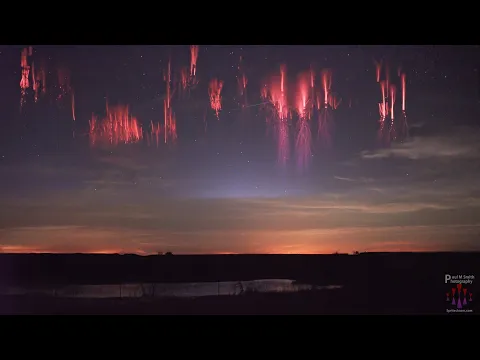

According to studies cited by NASA, sprites can modify the distribution of electric charges in the upper atmosphere, which affects the propagation of electromagnetic waves.
This means that invisible phenomena above storms can have direct effects on communication and navigation systems, albeit in a subtle and temporary manner.
Sprites are part of a larger family of unknown electric phenomena
Sprites are not alone. They are part of a group called transient luminous events, which includes other equally rare phenomena:
- Blue jets, which shoot up from the cloud in a jet shape;
- Elves, which expand like giant rings in the ionosphere;
- Gigantic jets, which can connect the storm directly to space.
These events indicate that a significant part of the planet’s electrical activity occurs beyond the reach of human vision, revealing an invisible and still poorly understood layer of the atmosphere.
A phenomenon that reveals we still know little about Earth’s atmosphere
Even after decades of study, many questions remain unanswered.
- Why do only some storms produce sprites?
- What is the cumulative impact of these events on the global climate?
- To what extent do they interfere with technological systems?
The difficulty of observation, combined with the physical complexity of the phenomenon, means that science is still far from a complete understanding.
Do you believe that invisible phenomena like this can be shaping the planet without us noticing
The sprites show that the planet hosts gigantic, rapid, and invisible processes happening above storms, out of the direct reach of most people.
They transform the idea of lightning into something much broader, revealing that atmospheric electricity goes far beyond what we see during a common storm.
In light of this, an inevitable question arises: how many other unknown phenomena are happening right now in the Earth’s atmosphere without us having the capacity to fully observe them?