Portuguese
  Spanish


Study published on July 7, 2026, found an exceptional concentration of gold in microscopic grains taken from a Japanese underwater caldera, where hydrothermal vents form metal-rich deposits
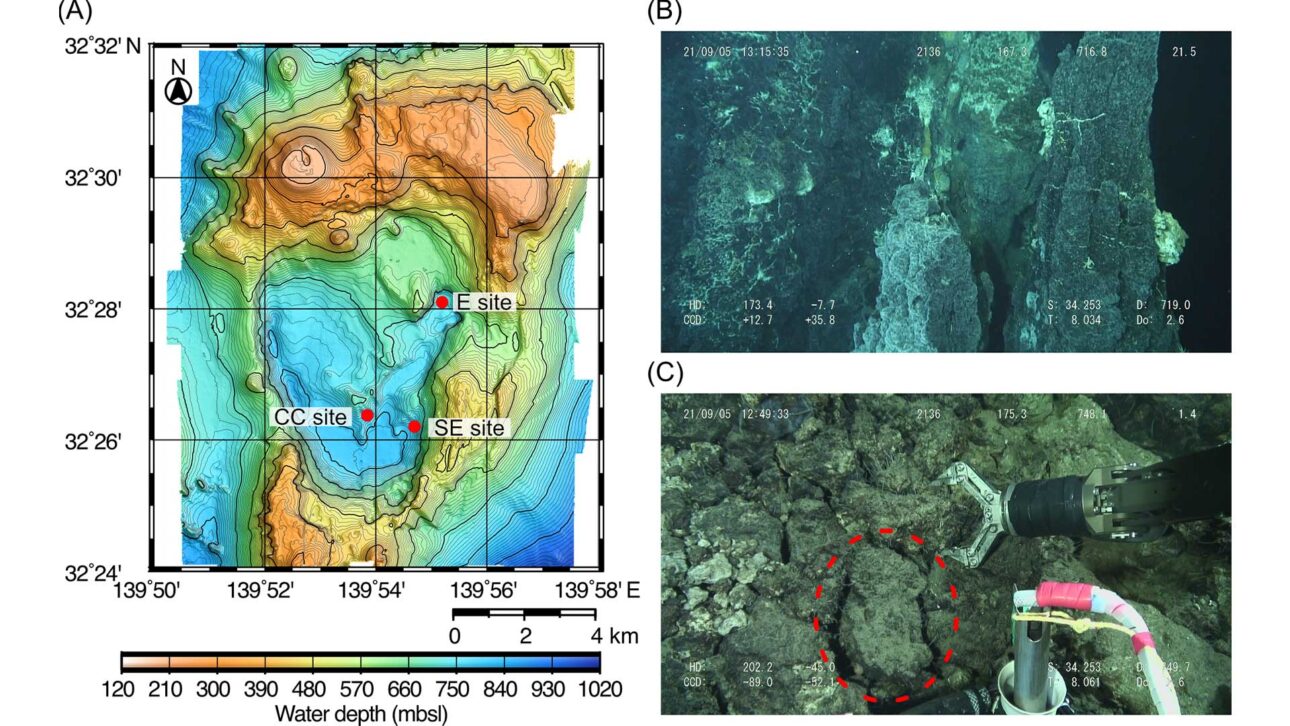
A team of Japanese researchers identified invisible gold in concentrations of up to 1.9% within pyrite grains collected from the hydrothermal field of the Higashi-Aogashima caldera. The site is located in the Izu-Ogasawara volcanic arc, south of Japan, about 750 meters below the sea surface.
The result was published on July 7, 2026, by the scientific journal Scientific Reports. The scientists analyzed pyrite taken from mounds of sulfides and from a hydrothermal chimney known as a black smoker, finding gold incorporated into the mineral’s structure at levels considered exceptionally high.
The discovery, however, does not mean that 1.9% of the entire underwater deposit is made up of gold. The maximum value appeared in specific points of pyrite grains examined on a microscopic scale, and not in a complete assessment of the entire rock or the existing volume on the seabed.
-
Mother discovers she may have won £12 million in the lottery but faces an agonizing wait after the shopkeeper threw the ticket in the trash.

-
A couple bought a house in Sheffield and, when removing the carpet from the hallway, found a trapdoor leading to a secret 23 m² basement with a 2-meter ceiling height, a discovery that eliminated the need for an expensive extension and, according to them, added £70,000 to the property’s value.

-
A nurse bought for 20,000 a 1955 house abandoned by a hoarder in Texas, and months later, rain revealed a buried pool in the backyard valued at $160,000, which he restored himself for about $10,000, a fraction of the cost of building a new one.
-
The United Kingdom is transforming dog feces left on trails into gas to light a streetlamp through an unlikely and surprising project that shows how even one of the most rejected wastes in cities can generate energy.


There is also no published estimate of how many tons of gold could be recovered at the site. Before any commercial exploration, it would be necessary to map the extent of the deposit, drill new areas, calculate reserves, test processing methods and evaluate the damage that an operation would cause to the marine environment.
The gold is inside the so-called fool’s gold and does not appear as nuggets on the sea floor
Pyrite is an iron sulfide popularly known as “fool’s gold”. Its yellowish color and metallic luster can resemble gold, although the two materials have different composition, hardness, density, and chemical behavior.
In the analyzed material, the real gold was not visible as nuggets or large golden particles. It appeared distributed in dimensions so small that it could not be identified by conventional microscopes, hence the use of the expression invisible gold.
The hydrothermal field was identified in 2015, after surveys with autonomous equipment and sediment collection. As reported by the Institute of Industrial Science at the University of Tokyo, the caldera is located approximately 12 kilometers east of Aogashima Island, and samples taken at about 760 meters depth had already revealed pyrite, sphalerite, chalcopyrite, galena, and barite.
The 1.9% content draws attention, but cannot be applied to the entire submarine rock
A concentration of 1.9% mathematically corresponds to 19 thousand parts per million. If this content were uniform in a ton of the same type of pyrite analyzed, there would be the equivalent of 19 kilograms of gold in that ton.
This comparison only serves to show the size of the number found in the laboratory. It does not allow us to state that a ton of rock taken from the caldera contains 19 kilograms of gold, because the rock comprises various minerals and the contents vary between different points, structures, and types of pyrite.
A previous study, published in January 2025 in the journal PLOS One, recorded an average of 102 parts per million of gold in the sulfide rocks of one of the caldera’s sectors. The same work found gold particles with dimensions between 5 and 50 nanometers linked to the formation of larger grains, showing that the metal can appear in very different forms and concentrations within the hydrothermal system.
The researchers of the 2026 study used secondary ion mass spectrometry, known by the acronym SIMS. The technique bombards tiny points of the material with ions and measures the released elements, allowing the detection of concentrations that would go unnoticed in less sensitive analyses.
The highest contents appeared in pyrites with high concentrations of arsenic, lead, and copper. The team considers that these elements may facilitate the incorporation of gold into the crystalline structure, although the mechanism still depends on further analyses.
Hydrothermal vents function as natural systems of metal transport and concentration
Hydrothermal vents arise when seawater penetrates fractures in the ocean floor, is heated by the internal heat of the crust, and reacts with the rocks. The fluid returns carrying sulfur, iron, copper, zinc, lead, silver, and small amounts of gold.
When this hot liquid comes into contact with the cold ocean water, the elements precipitate and form sulfides. Over time, the material can build mineral mounds and dark chimneys, called black smokers due to the appearance of the expelled plume.
This process explains why the Higashi-Aogashima caldera concentrates different metals in a relatively small area. It also helps geologists understand how ancient deposits now found on land may have been formed in similar submarine environments.
The new study indicates that pyrite may hold a larger portion of gold than whole rock analyses suggest. For eventual mining, this would require techniques capable of separating the mineral and recovering gold atoms trapped in its structure without making the process more expensive than the value of the metal obtained.
Japan develops equipment for underwater mining, but the field has not yet become a commercial project
Japan has been researching hydrothermal deposits since 2008 through the Japan Organization for Metals and Energy Security, JOGMEC. In an assessment released in November 2023, the agency estimated a combined mineral potential of 51.805 million tons in the Okinawa and Izu-Ogasawara regions, a number that encompasses different deposits and does not correspond only to the Higashi-Aogashima caldera.
The country also conducted, in 2017, a test of excavation and lifting of ore from the seabed. Commercial solutions are still lacking for continuous operation, material transport, processing, sediment control, equipment maintenance, and recovery of affected areas.
Japan’s Strategic Energy Plan published in 2025 keeps marine mineral resources among national priorities. The document foresees research on exploration, ore recovery, processing, smelting, reserve size, and environmental impacts, but does not present a start date for gold extraction in Higashi-Aogashima.
The new discovery could make the caldera a more relevant target for geological surveys. Turning it into a mine would depend on proving that the gold is distributed in sufficient volume and can be recovered with costs, technical risks, and environmental damage considered acceptable.
The concentration of gold reignites the dispute over the damages of ocean floor mining
Hydrothermal vents support organisms adapted to the absence of light, high pressure, and the presence of chemical compounds toxic to much of marine life. Many of these species depend directly on bacteria that use sulfur and other elements expelled by the fumaroles to produce energy.
An update to the Red List of the International Union for Conservation of Nature pointed out that 125 of the 201 species of mollusks associated with evaluated hydrothermal vents are threatened with extinction due to the possibility of underwater mining. According to information published by Reuters on July 9, 2026, the removal of ore and the dispersion of sediments could bury entire areas of these environments.
The effects can last for decades. An expedition conducted in 2023 found changes in the sediment and a reduction of organisms in a strip of the Pacific affected by a mining test carried out in 1979, although that experience involved polymetallic nodules and not hydrothermal chimneys.
The International Seabed Authority reports that 40 countries, including Brazil, advocate for a precautionary pause or moratorium on mining in international waters. The entity is still negotiating exploration rules, impact assessments, environmental limits, and monitoring systems.
Higashi-Aogashima is within Japan’s exclusive economic zone. The International Seabed Authority directly regulates the ocean floor located beyond national jurisdictions, while areas within an exclusive economic zone are subject to the rules and responsibilities of the respective coastal country.
The discovery shows that the Japanese seabed holds pyrite with gold concentrations far above those normally recorded in this mineral, but it still does not answer how much gold exists in the deposit or whether its extraction would be economically and environmentally viable. Leave in the comments if Japan should continue underwater mining tests or preserve the caldera until the risks to hydrothermal sources are fully known.