






 Portuguese
  Spanish


Felipe Magalhães da Cruz will represent Brazil at ICO 2026, an international competition that brings together students in digital defense, cryptography, reverse engineering, and vulnerability exploration challenges
The Brazilian Felipe Magalhães da Cruz, 15 years old, a resident of Campinas, in the interior of São Paulo, was selected to represent Brazil at the 2026 International Cybersecurity Olympiad. The competition will be held in Hammamet, Tunisia, with official programming from June 27 to July 2.
The case draws attention not only because of the student’s age but also because of his trajectory. Felipe began studying cybersecurity on his own at the age of 13, driven by curiosity, videos, documentaries, and online challenges focused on the area.
According to a report published by TecMundo on June 9, 2026, the teenager will compete in one of the most technical areas of the olympiad, known as binary exploitation, a modality linked to the search and analysis of flaws in computer programs.
-
19-Year-Old Farmer’s Son Develops Low-Cost Smart Garden to Prevent Water Waste, Wins National Science Award in Brazil

-
Astronauts Returning from Space Show Reduced Immune Cells and Thymus Suppression, Highlighting Potential Risks for Long Mars Missions
-
Indian Teens Win National Geographic Award at Google Science Fair for Using Common Sour Fruit to Naturally Coagulate Rubber in 6 Hours, Reducing Production Time by 10 Hours
-
Morocco Sinks 148 Giant Concrete Coffins in the Mediterranean to Build a 4.3 km Breakwater for a Megaport Competing in Global Container Routes Near Nador


The Brazilian participation occurs at a time when cybersecurity has ceased to be a subject restricted to specialists and has become part of the lives of companies, governments, schools, and families. Data leaks, digital scams, and system invasions have made professionals in the area increasingly sought after.
Young man from Campinas started alone and turned curiosity into international preparation
Felipe did not emerge in a university laboratory or a large technology company. His story began in a common way for many teenagers of the connected generation: in front of a screen, researching topics that sparked curiosity.
Over time, what seemed like a hobby turned into a study routine. The young man began to delve into training environments, digital security competitions, and platforms where participants solve technical challenges without attacking real systems.
This type of training shows how the technology field can open doors for students very early, as long as it is practiced with ethics, guidance, and responsibility. In Felipe’s case, the trajectory draws attention precisely because it is linked to using knowledge to understand flaws and strengthen defenses, not to commit crimes.
The choice to represent Brazil at ICO 2026 also helps to dispel a common misconception. In the popular imagination, the word hacker is often associated with crime, but in cybersecurity, it can also refer to people who study systems deeply to find vulnerabilities before criminals exploit them.
What is the International Cybersecurity Olympiad 2026
According to the official ICO 2026 website, the event is aimed at high school students and will have delegations from 22 countries gathered in Yasmine Hammamet, Tunisia. The schedule includes the arrival of delegations on June 27, opening ceremony and practice session on the 28th, competitions on the 29th and 30th, closing on July 1, and departure on the 2nd.
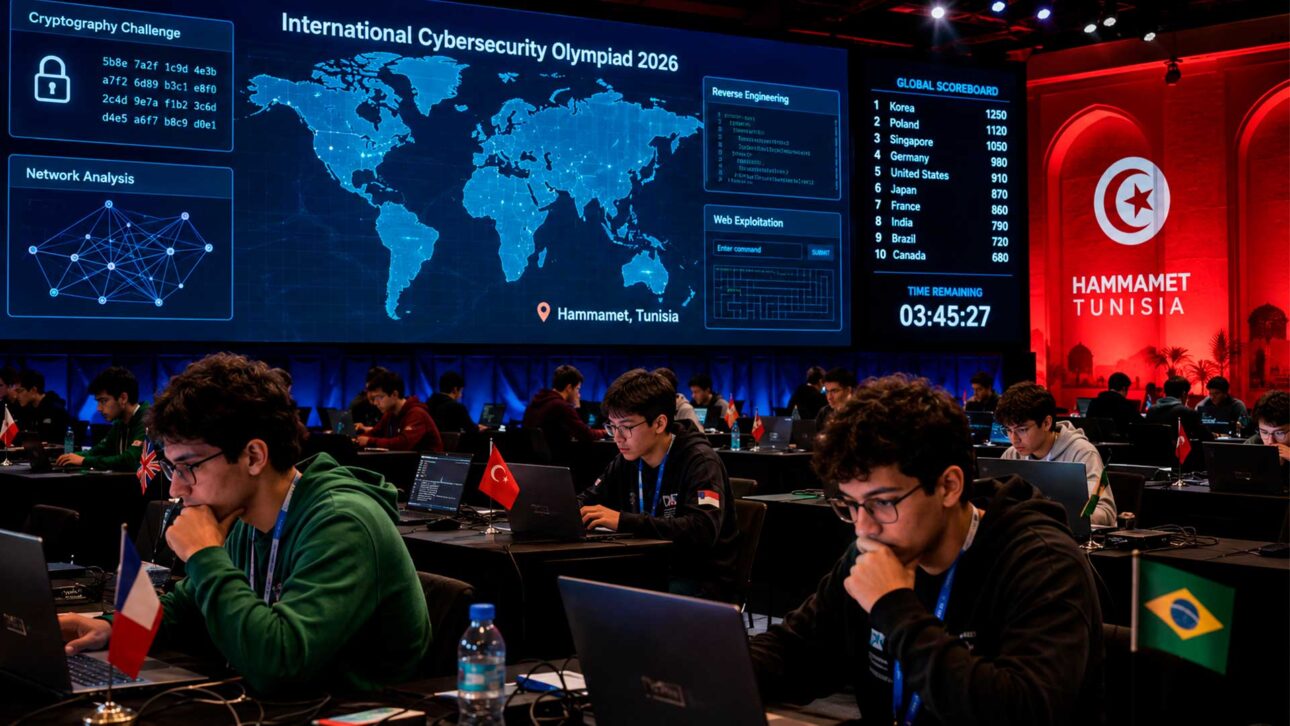
The competition follows the format of international scientific olympiads but applied to the universe of cybersecurity. Instead of traditional classroom tests, students face technical problems that require logical reasoning, careful reading, system analysis, and mastery of advanced concepts.
Topics involved include cryptography, digital forensics, reverse engineering, and vulnerability exploitation. In practice, competitors need to demonstrate the ability to investigate, interpret digital clues, and solve problems within controlled rules.
The most well-known format in this type of competition is called CTF, short for “Capture the Flag.” In this model, the student solves a challenge and finds a specific sequence that proves the solution, without involving real invasion or harm to others.
Brazil’s presence in the event reinforces the entry of young national talents into global technology competitions. Besides competing for medals, this type of olympiad serves as a showcase for academic training, a career in digital security, and connection with researchers and specialists.
Binary exploitation is one of the most difficult areas of digital security
The category in which Felipe excels, known in the technical field as Pwn or binary exploitation, is considered one of the most complex in competitive cybersecurity. It requires understanding how programs work at levels very close to the processor and computer memory.
In simple terms, the competitor needs to identify unexpected behaviors in software and understand why that happens. It’s not just about “tinkering with the computer,” but interpreting logic, internal structure of programs, and details that usually go unnoticed.
This area requires patience, mathematics, programming, and the ability to handle frustration. Often, the student spends hours analyzing a problem until finding a small flaw that changes the outcome of the challenge.
Therefore, Felipe’s spot in the Olympics has symbolic significance. At 15 years old, he enters an arena where many adults trained in technology still find difficulty, especially because binary exploration depends on a solid technical foundation and continuous study.
The case also shows that training in cybersecurity does not only come from formal courses. They are important, but the field values practice, curiosity, discipline, and participation in technical communities that teach how to solve problems legally and under supervision.
An ethical hacker is not a cybercriminal and the difference needs to be clear
The popularization of the word hacker has created a dangerous confusion. Many people use the term as a synonym for invader, scammer, or digital criminal, but this association is not correct in all contexts.
An ethical hacker studies systems to find flaws, report problems, and protect users. Meanwhile, a cybercriminal uses technical knowledge to steal data, commit fraud, extort companies, or cause damage.
This difference is fundamental in a news story about a teenager competing in cybersecurity. The Olympics do not encourage illegal invasions, but rather controlled challenges, created to measure knowledge, reasoning, and technical preparation.
At the same time, the story requires responsibility in how the topic is approached. Competition, study, and career in digital security must always be linked to rules, authorization, and ethics, because technical knowledge without legal limits can bring serious consequences.
Brazil tries to train more talents in a strategic area
According to Agência Brasil, the Hackers do Bem program opened 25,000 free spots in 2026 for training in cybersecurity and had already certified more than 36,000 students since its launch in January 2024. The initiative shows that the country is trying to expand the training of professionals in a field considered strategic.
The demand exists because companies, banks, governments, and even small shops depend on connected systems. When these systems fail or are attacked, the damage can involve money, personal data, public services, and consumer trust.
The 2025 study by ISC2, an international organization in the field, indicated that companies continue to face difficulties related to budget, skill shortages, and pressure on security teams. The report also highlighted that artificial intelligence has begun to redefine both attacks and defenses, increasing the need for prepared professionals.
In this scenario, the participation of a 15-year-old Brazilian in an international competition gains greater significance. It is not just an individual achievement, but a sign that young talents can emerge early when they find access, encouragement, and safe learning paths.
Competition in Tunisia may open doors for a new Brazilian generation
The ICO 2026 will be held at the Diar Lemdina Hotel in Hammamet, a Tunisian city known for tourism and its location in North Africa. For the competitors, however, the focus will be on technical challenges and interaction with students from other countries.
This international contact can be decisive. In scientific olympiads, participants not only compete but also exchange experiences, learn study methods, and create connections that can influence academic and professional choices.
For Felipe, the trip represents the chance to test his own knowledge in a global environment. For Brazil, it represents the opportunity to show that the country can also reveal strong names in an area increasingly linked to digital sovereignty.
The story also raises an important discussion: Is Brazil prepared to identify, support, and protect young talents in technology before they seek opportunities outside the country? The answer involves schools, families, the public sector, companies, and universities.
If cybersecurity has already become one of the most sensitive areas of the digital economy, cases like Felipe’s show that the future of this defense can start early, at home, with a curious teenager, a computer, and many hours of study.


