Portuguese
  Spanish


Learn how a home exercise of single-leg support can strengthen balance, improve functional stability, and contribute to fall prevention in people over 60, as long as it is performed safely and with proper guidance.
The home exercise for balance has been identified as an efficient strategy to strengthen functional stability in people over 60. Instead of relying solely on gym equipment, the specific training of single-leg support and weight transfer works on movements similar to those performed daily. Thus, the body tends to respond more efficiently during walking, getting up from a chair, climbing steps, and changing direction.
WHY CAN HOME EXERCISE BE MORE EFFICIENT FOR BALANCE?
While many gym machines prioritize muscle strengthening in guided movements, functional balance depends on the constant challenge to the ankle, hip, trunk, and center of mass.
Moreover, when training is done at home, in the same environment used daily, the repetition of movements favors functional adaptation. Consequently, confidence tends to increase, while stability during routine activities can be enhanced.
-
Spanish Farmers Turn Surplus Wool into Thermal Pool Umbrellas to Solve Rural Surplus Problem

-
Brazilian Ship Refuels with 30% Renewable Fuel in Rotterdam: Transpetro Tests B30 for the First Time, Aiming to Reduce Maritime Emissions and Showcase a Quiet Transition in Key Global Ports
-
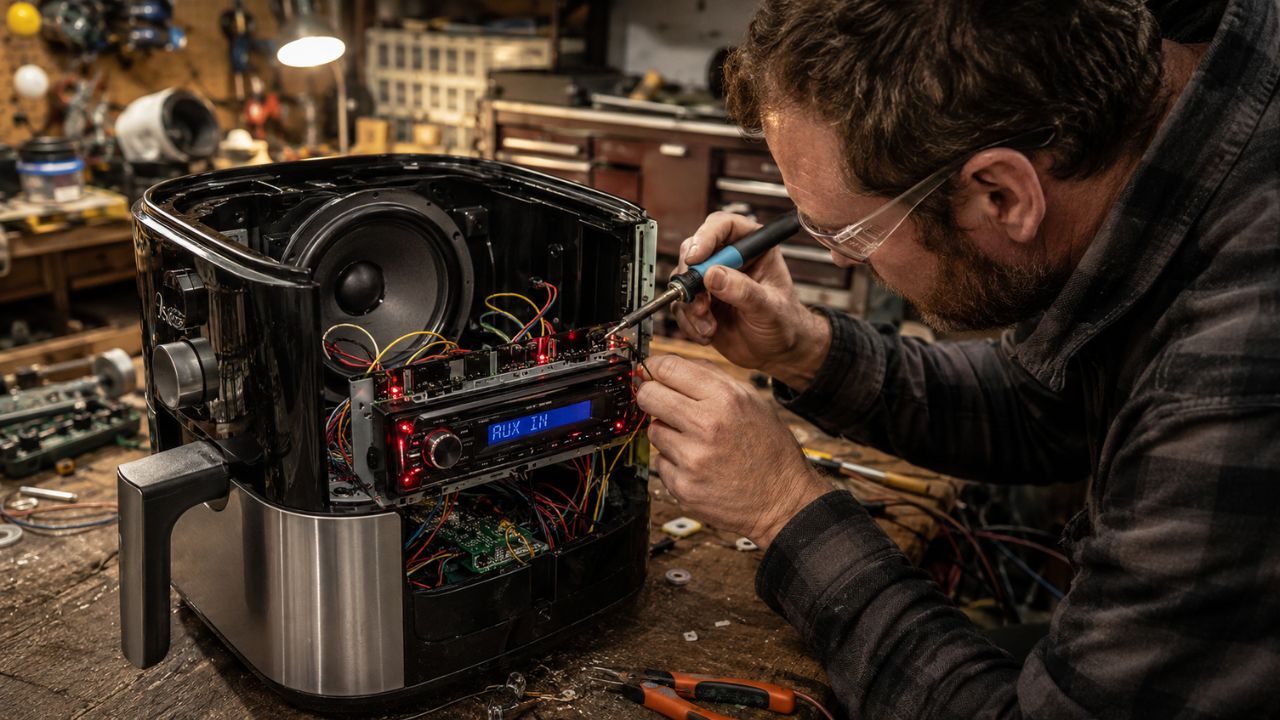
Brazilian Man Ingeniously Transforms Air Fryer into Functional Speaker with Radio and Volume Controls
-
Rows of “stone balls” emerge at low tide on California beach, with formations up to 1.5 meters aligned like a Pacific bowling alley




WHICH EXERCISE USUALLY OFFERS BETTER RESULTS?
Among the most commonly used alternatives, the support on one leg with controlled touches of the other foot on the ground stands out.
In this movement, the body weight remains on one leg. Then, the tip of the other foot touches the ground:
- In front;
- To the side;
- Behind the body.
After that, the foot returns to the center slowly. In this way, balance is challenged in different directions, stimulating the control of the hip, trunk, and ankle joint.
HOW TO SET UP A SAFE ROUTINE?
For best results, the quality of movement should be prioritized over excessive fatigue.
Therefore, it is recommended to:
- Stay next to a wall, counter, or firm chair;
- Keep the abdomen contracted and eyes fixed;
- Perform 3 to 5 repetitions in each direction with each leg;
- Execute 2 to 3 sets on alternate days;
- Gradually reduce hand support, without eliminating safety.
However, if there is dizziness, significant joint pain, or a recent history of falls, the progression should be more conservative.
Similarly, people with neuropathy, labyrinthitis, or significant muscle weakness may benefit from a prior evaluation by a physiotherapist.
WHAT DOES SCIENCE SHOW ABOUT THIS TYPE OF TRAINING?
In recent years, scientific interest in home training has grown.
In 2024, the study “Home-based interventions improve trained, but not novel, dual-task balance performance in older adults: A randomized controlled trial” remained prominent, published in the scientific journal Gait & Posture and indexed in the PubMed database.
According to the researchers, home-based interventions improved trained balance performance in the elderly, reinforcing that tasks similar to daily activities can generate more specific functional gains.
WHAT ERRORS REDUCE THE EFFICIENCY OF EXERCISE?
On the other hand, some behaviors can compromise the results.
Among them are:
- Removing hand support before the appropriate time;
- Performing movements with excessive speed;
- Tilting the torso or shifting the hip during support;
- Holding your breath;
- Using light chairs or unstable objects for support.
Additionally, exercise should be stopped if blurred vision, discomfort, or unusual instability occurs.
WHAT BENEFITS CAN BE PERCEIVED IN DAILY LIFE?
With frequent practice, an improvement in functional balance can be observed during walking, getting out of bed, getting out of the car, and turning quickly inside the house.
In addition, the fear of falling tends to decrease, while the autonomy to perform daily activities can be preserved.
Thus, when the training combines unipedal support, weight transfer, proper posture, and frequent repetition, the body develops a more useful coordination for daily demands, favoring functional stability and fall prevention in people over 60 years old.