Portuguese
  Spanish


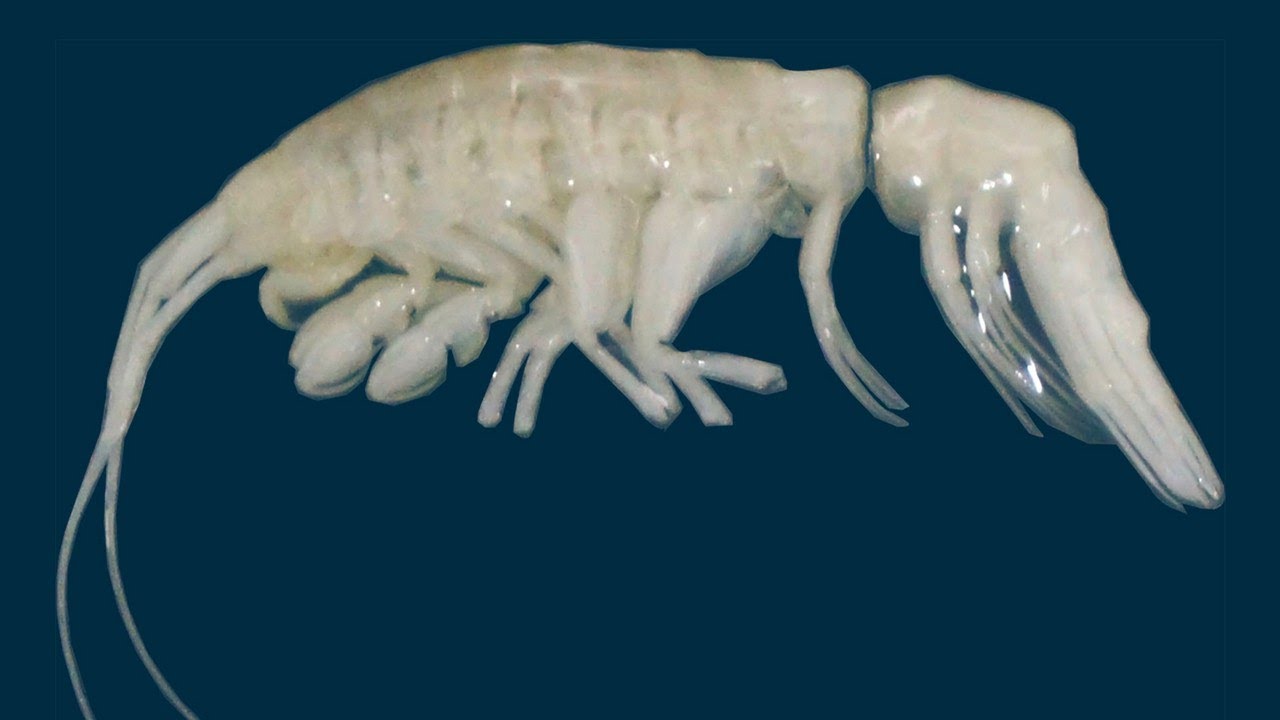


Scientists discover predator at almost 8,000 m in the Atacama Trench and reveal new limit for life in the deep ocean.
In 2024, an international team linked to the Woods Hole Oceanographic Institution (WHOI) and the Milenio Institute of Oceanography, from the University of Concepción, in Chile, identified a new species and a new genus of crustacean in the depths of the Atacama Trench, in the Pacific Ocean. The discovery, announced by WHOI on December 9, 2024 and published in the scientific journal Systematics and Biodiversity, describes the Dulcibella camanchaca, an amphipod found at 7,902 meters deep, in the hadal zone, where total darkness, extreme pressure, and scarcity of food make life a biological exception.
What made the finding especially relevant was the behavior of the animal. According to WHOI, the Dulcibella camanchaca is an active fast-swimming predator, about 4 centimeters long with specialized appendages for capturing smaller amphipods. The research highlights that predatory non-scavenging amphipods had not yet been documented in these depths of the Atacama Trench, which broadens the understanding of how food chains may function in one of the most extreme and isolated environments on the planet.
The existence of an active predator in a region marked by low food availability indicates that hadal ecosystems may be more complex, specialized, and evolutionarily distinct than previously thought. For the authors, the discovery reinforces the importance of scientific exploration of the deep ocean, especially along the Chilean coast, where the Atacama Trench already appears as a hotspot of unique species.
-
Artist’s 15-Meter Lighthouse in the Mojave Desert, 160 km from the Sea, Intrigues Visitors with 19 km Range After Years of Bureaucracy

-
Bluetti AC70 Solar-Powered Station: Powers Fridge and Wi-Fi During Blackouts, Delivers 1,000W, 3,000 Charge Cycles, Priced at $900

-
Enormous Black Hole Phoenix A* Challenges Scientific Understanding with Mass of 100 Billion Suns, Surpassing Famous TON 618 in One of the Largest Known Galaxy Clusters
-
Say Goodbye to Storing Wine in a Regular Fridge: Midea’s Climate-Controlled Cellar Holds 34 Bottles, Maintains 5-18°C, and Uses Only Half a kWh Daily


Atacama Trench is one of the most extreme environments on Earth
The Atacama Trench, also known as the Peru-Chile Trench, is one of the deepest regions on the planet, located along the western coast of South America. In some places, the depth exceeds 8,000 meters, creating extremely challenging physical and chemical conditions for life.
At this depth, the pressure can exceed 800 times the atmospheric pressure at sea level, which would be enough to crush most known organisms. Additionally, the complete absence of sunlight prevents photosynthesis, making the environment dependent on organic matter that descends from the upper layers of the ocean.


Temperatures close to 0°C and limited nutrient availability make survival in this environment a constant challenge. Despite these conditions, life not only exists but also shows surprising adaptations.
Dulcibella camanchaca represents a new type of predator in the depths
The identified organism belongs to the group of amphipods, small crustaceans that include common species in marine and freshwater environments. However, the new species presents characteristics that significantly differentiate it from its known relatives.
Measuring about 4 centimeters in length, the animal has a whitish body, adapted to the absence of light, and a physical structure that suggests the ability for active locomotion and prey capture.
Unlike many deep-sea amphipods that feed on decomposing organic matter, Dulcibella camanchaca exhibits predatory behavior. This characteristic was inferred from the animal’s morphology and the ecological context in which it was found.
Active predation suggests a more complex food chain than expected
The presence of an active predator at depths close to 8,000 meters raises important questions about the structure of food chains in these regions.
Traditionally, it is believed that hadal ecosystems are dominated by organisms that feed on organic detritus sinking from the upper layers of the ocean, a process known as “marine snow”. However, the discovery of a predator suggests the existence of more complex trophic levels.

This implies that there are prey available in sufficient quantities to sustain this type of behavior, which broadens the understanding of biodiversity in these depths.
This scenario indicates that hadal ecosystems may be more dynamic than previously thought.
Extreme adaptations allow survival under crushing pressure
To survive in an environment with extreme pressure, organisms like Dulcibella camanchaca need to exhibit specific adaptations at the cellular and structural levels.
These adaptations include changes in the composition of cell membranes, which need to remain stable under pressure, and in the structure of proteins, which must function correctly even under extreme conditions.
The absence of pigmentation in the animal’s body is also a common adaptation in lightless environments, where coloration offers no evolutionary advantage.
In addition, the metabolism of these organisms tends to be slower, which helps conserve energy in an environment with limited resources.
Discovery was possible thanks to advanced ocean exploration technology
The identification of the new species was only possible thanks to the use of modern technologies for exploring the seabed, including remotely operated vehicles (ROVs) and high-precision collection equipment.
These systems allow scientists to reach depths that were previously inaccessible, collecting samples and recording high-resolution images.
Without these technologies, much of the biodiversity of the deep ocean would remain unknown.
The evolution of this equipment has significantly expanded knowledge about the most extreme environments on Earth.
Species name references the coastal fog of Chile
The name Dulcibella camanchaca has a specific meaning. “Camanchaca” is a term used in Chile to describe a dense fog that occurs on the coast of the Atacama Desert. This reference connects the discovery to the geographical context of the region where the organism was found.
The choice of name reinforces the link between the species and one of the driest environments on Earth, contrasting with the deep marine environment where it was identified.
This practice is common in taxonomy, where scientific names often reflect characteristics or origins of organisms.
Atacama Trench remains one of the least explored regions of the planet
Despite technological advancements, much of the ocean trenches remains underexplored. The Atacama Trench is an example of a region where new species are still being regularly discovered.
The difficulty of access and high costs of expeditions limit the frequency of studies in these areas. This means that many organisms have yet to be identified, and each new mission has the potential to reveal significant discoveries.
Exploration of these regions is considered one of the frontiers of modern science. Other ocean trenches, such as the Mariana Trench and the Tonga Trench, have also revealed species adapted to extreme conditions.

However, each region presents unique characteristics, influenced by factors such as geology, ocean circulation, and nutrient availability.
The discovery of Dulcibella camanchaca reinforces the idea that each trench can harbor distinct ecosystems, with exclusive species. This diversity amplifies the challenge of understanding life in the deep ocean.
Discovery contributes to studies on the limits of life on Earth
The identification of organisms in extreme environments has implications that go beyond marine biology. These studies help define the limits of life on Earth, providing information that can be applied in fields such as astrobiology.
If organisms can survive in conditions of high pressure, low temperature, and absence of light, this expands the possibilities of life existing in other extreme environments in the universe. Thus, discoveries like this are relevant to multiple scientific areas.
Tiny predator challenges the idea that only giants dominate the imagination of the deep sea
A large part of public attention on the deep ocean is associated with giant or visually impressive creatures.
However, the discovery of Dulcibella camanchaca shows that small organisms can also play important ecological roles.
The fact that an animal just 4 centimeters long acts as a predator in an extreme environment highlights the importance of studying all scales of life. This perspective broadens the understanding of biodiversity.
Do you believe that there are still unknown predators at greater depths?
The discovery of an active predator at nearly 8,000 meters deep raises new questions about what else may exist in even deeper regions of the ocean.
With a large part of these areas still unexplored, the possibility of finding new species remains high. In light of this, a reflection arises: how many other organisms with unexpected behaviors are still hidden in the depths of the ocean, waiting to be discovered?