Portuguese
  Spanish


The Speartooth inaugurates a new stage of military submarine drones, with autonomous operation, adaptable modules, and intended use in surveillance, reconnaissance, attack, and monitoring of strategic areas on the seabed.
The Australian company C2 Robotics announced the sale of the Speartooth to Germany, through a partnership with Eurobotics GmbH, in an agreement that brings to the European market a large autonomous underwater vehicle aimed at unmanned military missions.
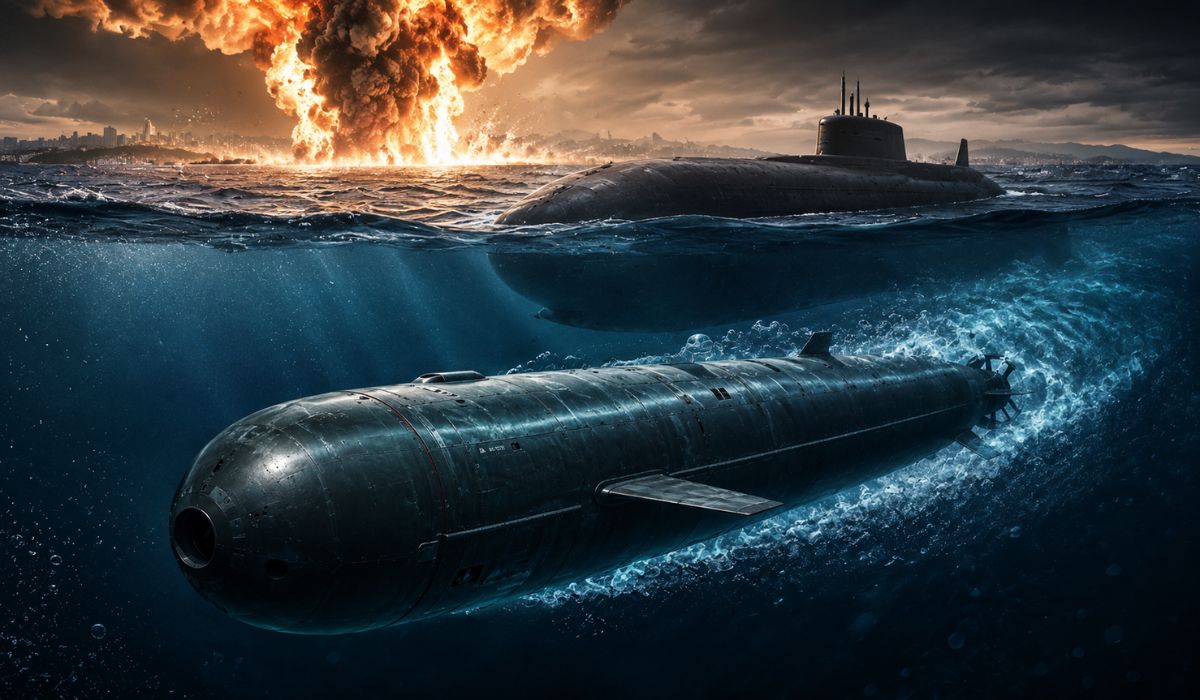
The equipment, classified as LUUV, an acronym in English for large unmanned underwater vehicle, can reach 12 meters in length, depending on the payload configuration adopted.
The announcement was made on May 20, 2026, at the C2 Robotics headquarters in Melbourne, with the presence of Pat Conroy, Australia’s Minister for Defense Industry.
-
Six Helicopters to Drop 550 Tons of Poison on Island Near Antarctica to Eradicate Mice Threatening Albatrosses and 19 Seabird Species.

-
Russia Unveils Poseidon: A 20-Meter Nuclear Torpedo-Drone with 10,000 km Range, 185 km/h Speed, and 100-Ton Capacity Threatening Coastal Cities with Radioactive Waves
-
Brazilian Innovator Converts Old Car into Electric Vehicle Using Laptop Batteries and Forklift Motor, Achieves Nearly 90 km/h in Urban Settings

-
Samsung Unveils Smart Oven with Built-In Camera, AI Food Recognition, and Real-Time Monitoring via Smartphone.


According to the company, the operation marks the European debut of the Speartooth and follows a previous delivery to the United States, cited by the company as part of the system’s international expansion.
Speartooth submarine drone operates unmanned
The Speartooth does not operate like a conventional manned submarine.
The platform was developed to perform programmed or remotely supervised missions, with sensors, navigation systems, and modular compartments capable of receiving different payloads.
C2 Robotics presents the model as a large autonomous underwater vehicle, designed for scalable maritime operations, with a modular design and the possibility of integrating equipment according to the mission.
In practice, this architecture allows adapting the same structure for tasks such as surveillance, reconnaissance, logistics, or the deployment of military payloads, without the presence of military personnel on board.
The base version reported by the company is about 8 meters in length.
According to data released about the program, the platform can be configured in larger versions, reaching approximately 12 meters, depending on the modules installed.
Specialized publications also describe the Speartooth as a system aimed at long-range missions, although part of the operational specifications remains restricted due to being military technology.
Underwater navigation requires sensors and autonomy
The operation of an underwater drone depends on different solutions than those used by aerial drones.
At great depths, radio communication and continuous use of GPS face physical limitations, which require sensors, inertial navigation, and proprietary systems to guide movement.
In the case of the Speartooth, information released by C2 Robotics indicates a platform with open architecture and integration of different payloads.
The vehicle also appears in industry publications as equipped with navigation, connectivity, and collision prevention features, necessary elements for autonomous or semi-autonomous movements in an underwater environment.
This technical set allows the equipment to execute pre-defined routes, collect information, and return data to the operator according to the chosen configuration.
Decision autonomy in this type of system does not eliminate human supervision; it reduces the need for continuous control throughout the journey, especially in long-duration missions.
Submarine cables enter the strategic debate
Submarine cables carry a large portion of digital communications between continents and are part of the global critical infrastructure.
Therefore, vehicles capable of operating near the seabed have started to be observed more closely by governments, Armed Forces, and defense companies.
C2 Robotics states that the Speartooth is aimed at missions of intelligence, surveillance, reconnaissance, attack, and logistics at sea.
In a statement about Australia’s 2026 National Defense Strategy, the company also associated the system with operations on the seabed, an area known in the military sector as “seabed warfare.”
The relationship with submarine cables should be addressed in this context.
Platforms capable of navigating at depth can be used to monitor, protect, or, in military scenarios, threaten structures installed on the seabed.
In the case of the sale to Germany, however, C2 Robotics did not publicly disclose a specific mission against cables, nor did it detail the payload that will be delivered to the buyer.
Germany enters the European market of Speartooth
The sale to Germany expands C2 Robotics’ international presence and establishes Eurobotics GmbH as the company’s partner in Europe.
According to the Australian company, the partnership provides support for European sales and to NATO countries, as well as industrial cooperation related to the Speartooth.
Troy Duggan, CEO of C2 Robotics, stated in the company’s announcement that allied countries recognize the need to protect maritime communication lines in a more uncertain strategic environment.
The statement was presented by the company in the context of the expansion of the Speartooth into the European market.
Lars Zander, Chief Operating Officer of Eurobotics, also linked the agreement to the idea of distributed autonomous platforms.
In a statement, he said that the Speartooth is built on the principle of “Small, Smart, Many,” an expression used by the company to summarize the proposal of employing smaller, intelligent, and numerous systems in underwater operations.
Underwater drones gain space in naval strategies
The interest in unmanned underwater vehicles has grown in defense programs because these systems can expand presence at sea without requiring the same structure as manned submarines.
The proposal does not replace traditional naval means by itself, but adds a layer of autonomous operation in surveillance, reconnaissance, and military cargo transport missions.
Australia’s 2026 National Defense Strategy also included the Speartooth in the future force structure of the Australian Defense Force, according to a statement from C2 Robotics.
The plan mentioned by the company envisions a fleet of large unmanned underwater vehicles for intelligence, surveillance, reconnaissance, attack, and logistics missions in the maritime environment.
Specialized reports indicate that the Speartooth had already been delivered to the United States before the announcement of the German sale.
C2 Robotics held a commissioning and christening ceremony for the vehicle intended for the Americans, at an event where a robotic arm broke a champagne bottle on the hull, with human supervision in the process.
The advancement of these systems also changes how underwater infrastructures are monitored.
Instead of relying solely on ships, conventional submarines, or fixed sensors, countries are starting to evaluate mobile, autonomous platforms capable of operating in hard-to-reach regions.
The adoption of military submarine drones still involves points not publicly clarified, such as rules of engagement, degree of autonomy in sensitive missions, and identification mechanisms in disputed areas.
For readers, researchers, and authorities, the question remains how to differentiate, at the bottom of the sea, a surveillance platform from a threat in operation.