





 Portuguese
  English
  Spanish
  3 min of reading
  0 comments


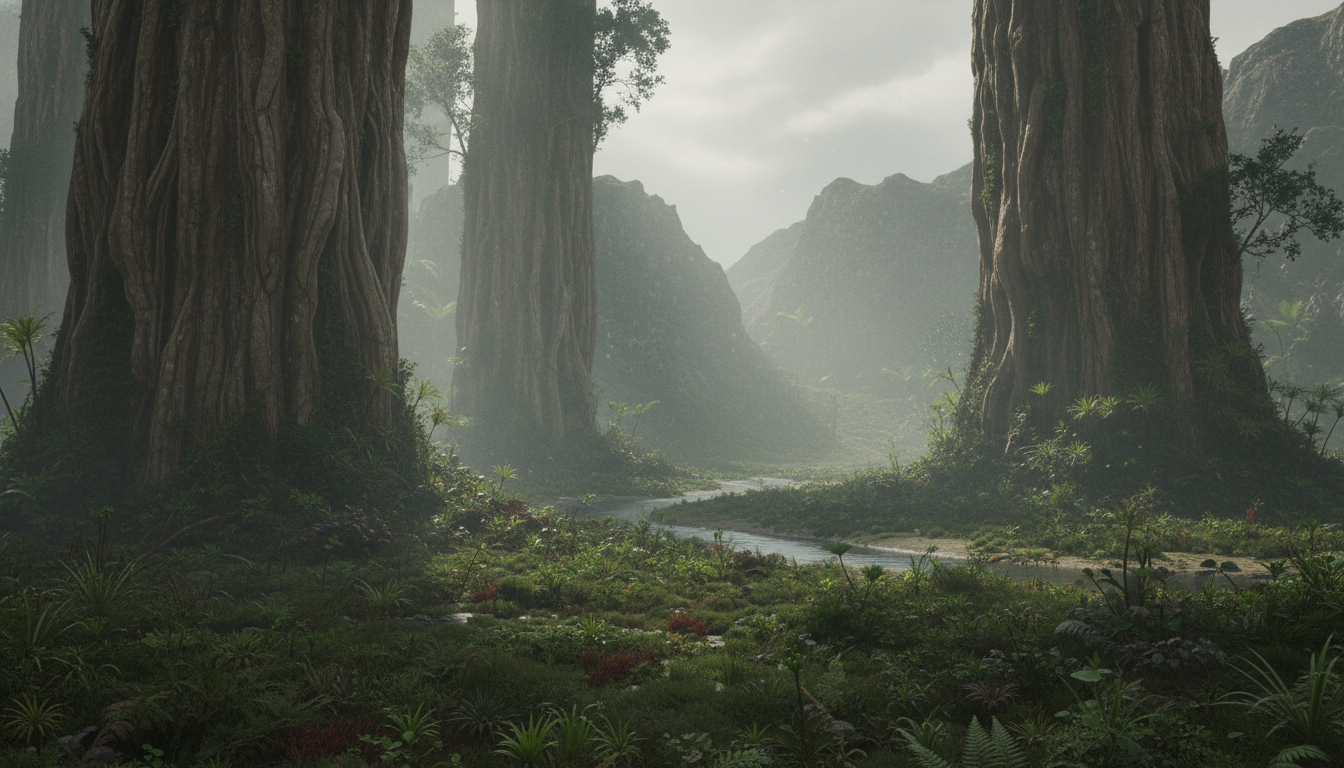
Existing between 420 and 370 million years ago, when plants were no more than 20 centimeters tall, Prototaxites reached 8 meters and were the largest terrestrial organism of the time — giant fungus, plant, or something completely different?
Imagine Earth 400 million years ago. There were no trees. There were no dinosaurs. Terrestrial plants were at most 20 centimeters tall.
And in the midst of this low and primitive landscape, structures rose up to 8 meters tall. They looked like tree trunks. But they were not trees.
They were the Prototaxites — the largest non-animal organism of that era. And to this day, more than 160 years after their discovery, no one knows for sure what they were.
-
Air bubbles from 3 million years ago extracted from Antarctic ice reveal that the current level of CO₂ has already surpassed that of the ancient, warm world, when the sea was up to 20 meters higher and there were no factories or cars burning fuel.

-
Brazil went to China to seek money and technology to reinvent TV and bring the internet to places where fiber does not reach. The mission negotiated with the BRICS Bank led by Dilma and paved the way for a Chinese rival of Starlink to connect the Amazon.
-
About 150 workers are driving, one by one, 4,585 BYD electric cars off a 220-meter ship at the Port of Itajaí. The 48-hour mega-operation is the largest shipment from the Chinese automaker in Santa Catarina this year.
-
Iceland is going to lower a drill five kilometers to reach rock at 400 degrees and try to extract clean energy on a scale that a common well cannot achieve.





The first scientific description dates back to 1859. Canadian paleobotanist John William Dawson thought they were fossilized conifers.
Since then, Prototaxites have been reclassified as algae, fungi, lichens, vascular plants, and even rolled-up microbial mats.

What was this 8-meter creature like
The fossils show vertical cylindrical structures, resembling massive trunks. The diameter could reach 1 meter.
Internally, they featured interconnected concentric tubes. The anatomy does not correspond to any currently living organism.
They existed during the Silurian and Devonian periods, between 420 and 370 million years ago. They have been found on all continents.
When they disappeared, the first true trees began to emerge. The forest replaced the mysterious giants.
To give a sense of scale: Prototaxites were 40 times taller than any surrounding plant.
The debate that has lasted over a century
- 1859: Dawson classifies as fossil conifer
- 1870s: reclassified as algae
- 2001: Francis Hueber suggests it was a giant fungus
- 2007: carbon isotopic analysis supports fungus hypothesis
- 2010: researchers propose they were rolled-up microbial mats
- Current: giant fungus is the most accepted hypothesis, but there is no consensus
In 2001, paleobotanist Francis Hueber from the Smithsonian Institution proposed that Prototaxites were giant fungi.
In 2007, analyses of carbon-13 isotopes by C. Kevin Boyce and team showed that Prototaxites had different signatures from the surrounding plants.
This suggested that they obtained nutrients differently — more compatible with fungi than with photosynthetic plants.
But in 2010, Linda Graham and collaborators proposed an alternative: mats of liverworts and rolled cyanobacteria as a giant mass.
Those interested in the mysteries of paleontology can see that even a fossil considered an octopus for 20 years was recently reclassified.

If it is a fungus, it would be the largest in the history of life on Earth
Today, the largest living fungus is Armillaria ostoyae in Oregon, USA. It spreads over 8.9 km² underground.
But in visible height, no modern fungus comes close to the 8 meters of Prototaxites.
If the fungus hypothesis is confirmed, they would be the largest visible terrestrial organism in the entire history of life on the planet.
The idea of 8-meter mushrooms dominating entire landscapes challenges our notion of what is possible in biology.
Recent discoveries, such as the 12-meter Spinosaurus in the Sahara, show that primitive Earth was very different from what we imagine.

Fascinating mystery, but far from solved
Despite over 160 years of study, there is no consensus. The fungus hypothesis is the most accepted, but it is not unanimous.
Such ancient fossils suffer from deformation and loss of details. Many internal structures have been destroyed by time.
New analysis techniques may bring answers. But they may also generate more questions about this enigmatic creature.
Information compiled from studies published in Nature and in Smithsonian Magazine. The debate over the classification of Prototaxites remains open in the scientific community.





-

-

5 people reacted to this.