






 Portuguese
  Spanish


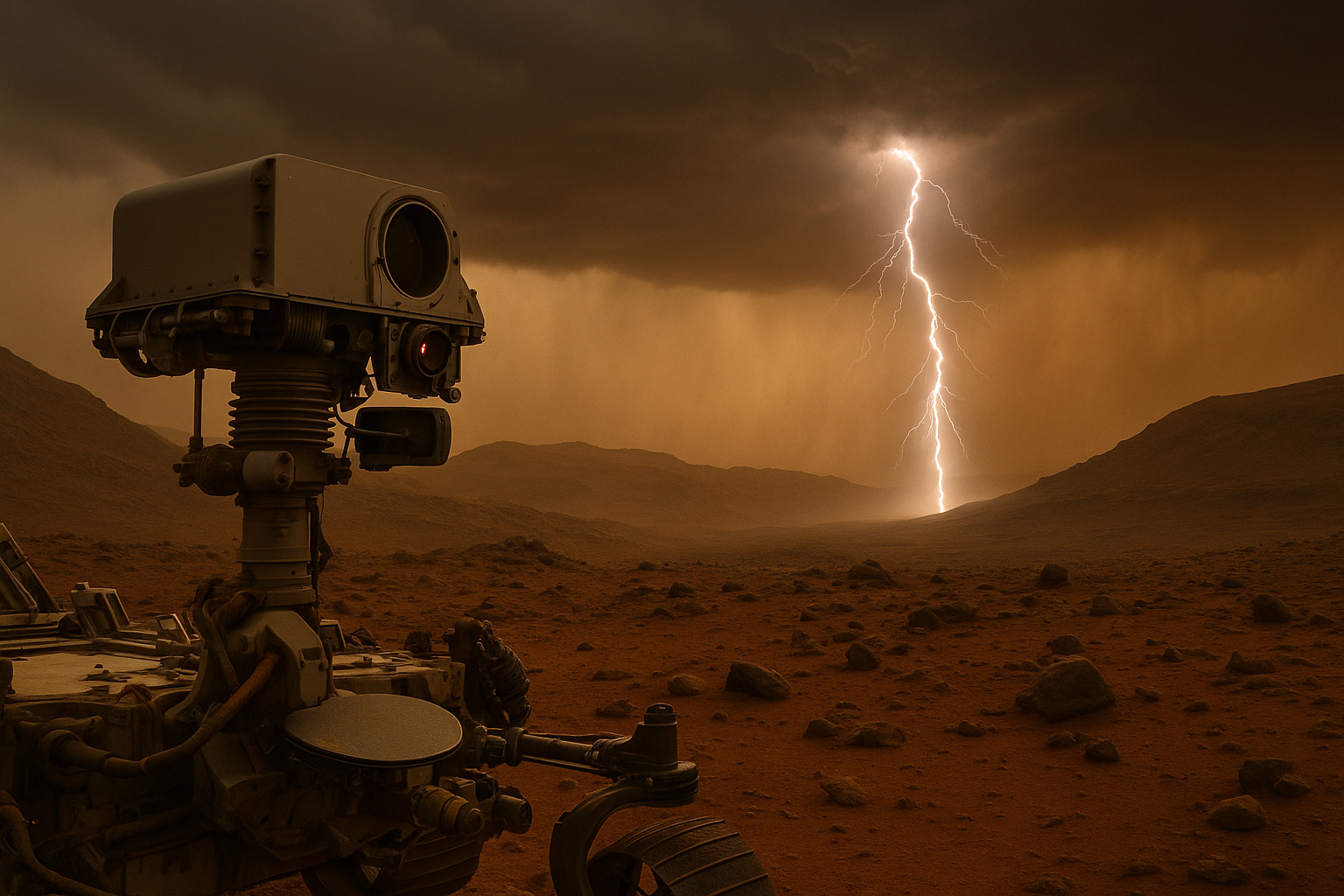


NASA’s Sound And Electromagnetic Data Show “Mini-Thunderbolts” On Mars And Reposition The Planet Among The Few With Proven Atmospheric Electricity
A major scientific discovery was recently confirmed by NASA, drawing attention from the international scientific community. For the first time, electrical activity in Mars’ atmosphere was recorded directly, ending decades of theoretical hypotheses. The data was collected by the Perseverance rover, which has been operating on the planet since February 2021, and analyzed over Martian climate cycles.
The identification of the discharges occurred through audio recordings and electromagnetic measurements conducted by the SuperCam instrument, installed on the rover. These discharges were described as “mini-thunderbolts”, a phenomenon that had never been proven outside of Earth, Jupiter, and Saturn. The discovery was published in 2025 in the scientific journal Nature, consolidating its academic relevance.
Scientific Analysis Reveals Unprecedented Atmospheric Pattern On Mars
The interpretation of the data was the responsibility of a team from The University of Toulouse in France, led by scientist Baptiste Chide. Over two Martian springs, a period equivalent to 1,374 Earth days, 55 distinct occurrences of electrical discharges were identified. This volume allowed for confirmation that the phenomenon is not isolated, but recurring.
-
China Develops Custom 140-Ton Electric Mining Truck with 770 kWh Swappable Battery, Deploys 290 Units in Xinjiang’s Largest Zinc Mine

-
Meta to Launch Arena, a New Prediction App Targeting 3.56 Billion Users, Competing with Polymarket and Kalshi

-
Scientist Challenges Famous Human Evolution Theory, Argues Homo Sapiens Evolved Gradually Over Thousands of Years
-
15-Year-Old American Builds Ocean Generator with PVC Pipe and 3D-Printed Propeller for $12, Wins National Prize, Presents at White House, and Makes Forbes 30 Under 30 List




According to Chide, the discharges occurred mainly during dust whirlwinds, known as “dust devils”, and also in fronts of Martian storms. These events are common on the planet, where extremely fine particles are continuously lifted by winds, collide with each other, and generate electricity through friction, a mechanism different from that observed on Earth.
Difference Between Mars And Earth Redefines Climate Models
On Earth, lightning is directly associated with clouds loaded with water vapor. On Mars, however, electricity arises even in a dry environment, with no significant presence of moisture. This detail broadens the understanding of Martian atmospheric chemistry, in addition to influencing studies on climate, erosion, equipment safety, and future human missions.
In a statement to the Reuters agency, Baptiste Chide emphasized that the electrical discharges have direct implications for Mars’ past habitability, as they interfere with chemical reactions in the atmosphere. Thus, the phenomenon is now considered a relevant factor in reconstructing the planet’s climatic past.
Sound Recording Confirms Phenomenon, But Images Still Do Not Exist
Despite the robustness of the data, the discharges have not yet been visualized. The available records are exclusively audio, captured by the Perseverance microphone. Particle physicist Daniel Pritchard, in a review article published in Nature, celebrated the advancement, but noted that the lack of images keeps a margin of scientific uncertainty.
According to Pritchard, visual confirmation may depend on more sensitive cameras and new atmospheric instruments, which should be integrated into future NASA missions and those of other space agencies.
Discovery Connects To Signs Of Ancient Life On Mars
This finding adds to another recent discovery announced by NASA in 2025. Researchers identified rocks with patterns known as “leopard spots” and “poppy seeds”, which contain minerals associated with chemical reactions possibly linked to ancient microorganisms. Although natural geological processes may still explain these formations, the agency states that they are the clearest signs ever found.
Currently, Mars is described as a cold and dry desert. However, accumulated evidence suggests that, billion years ago, the planet had liquid water and a denser atmosphere, conditions deemed essential for life.
In light of these successive discoveries, to what extent might atmospheric electricity have influenced the emergence or preservation of ancient life on Mars?






