Portuguese
  Spanish


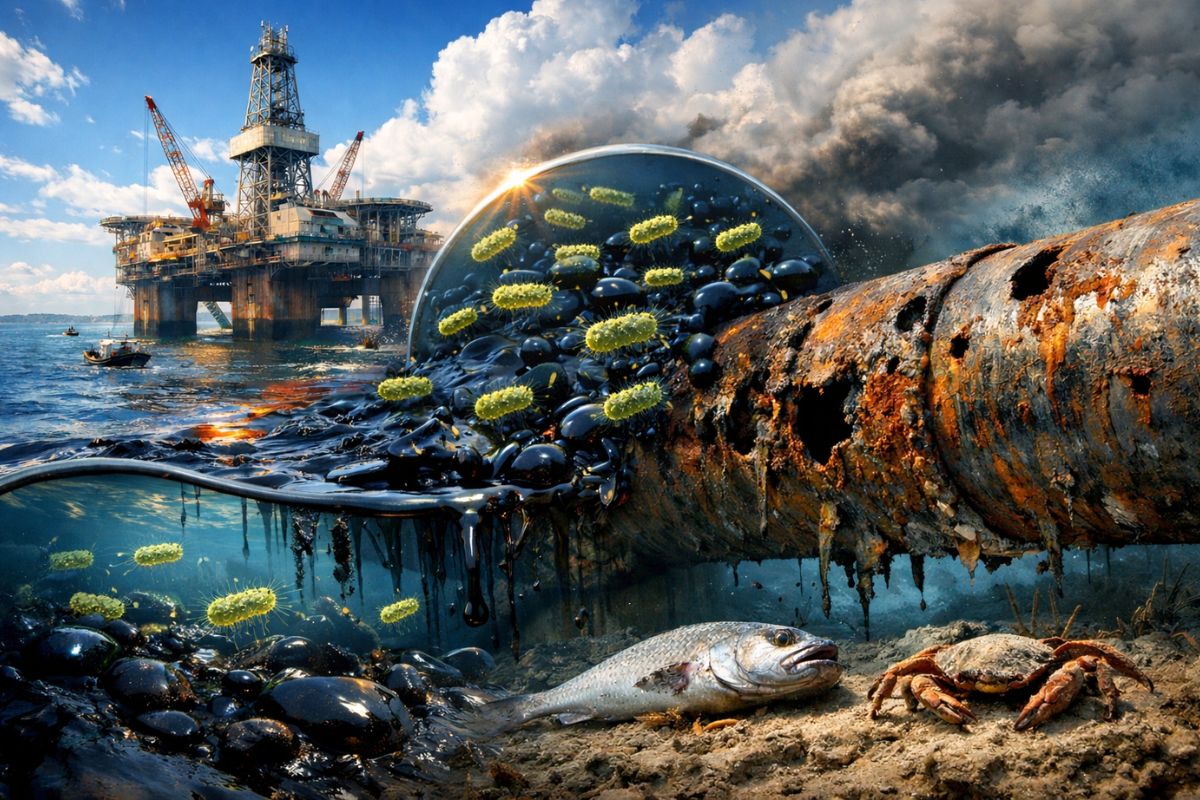


Most Of The Oil From The Deepwater Horizon Was Never Seen Again On The Surface. Scientists Discovered That Oil-Eating Bacteria Were Mainly Responsible For This Disappearance, But The Same Process That Helps Clean The Ocean Also Creates Dead Zones And Accelerates Steel Corrosion In The Gulf Of Mexico.
For 87 days, an out-of-control well spilled 779 million liters of crude oil into the Gulf of Mexico. The whole world watched the disaster in real-time, as ships, helicopters, and satellites attempted to estimate the magnitude of the catastrophe. And then, the enigma arose. Despite this enormous volume, about 75 percent of the oil disappeared from the surface and the seabed. What no one could remove with barriers, controlled burning, and chemical dispersants, oil-eating bacteria started to silently attack beneath the water.
The mystery of the disappearance was not resolved only in the Gulf. In a small research lake in Canada, scientists recreated a miniature spill and witnessed the same scene on a smaller scale. An apparently impossible-to-clean layer of oil began to disappear as oil-eating bacteria rapidly exploded in number and took control of the ecosystem. From this clue, it became clear that Earth has been training microorganisms to deal with oil for millions of years. The problem is that this invisible army does not act without cost: by devouring the oil, oil-eating bacteria can also strip the oxygen from the water, create lifeless zones, and accelerate the destruction of wrecks and pipelines in the Gulf of Mexico.
Deepwater Horizon, 779 Million Liters, and The Question Nobody Knew How To Answer

On the night of April 20, 2010, the Deepwater Horizon platform exploded in the Gulf of Mexico. The flames reached the height of a 20-story building, and two days later, the structure sank to more than 1500 meters deep.
-
Entrepreneur Turns Neighbor’s Coffee Grounds Waste into Eco-Friendly Pellets, Earning Up to $40,000 Monthly in Brazil

-
In China, Six-Armed Humanoid Robot Revolutionizes Washing Machine Factory, Boosting Efficiency by 30%

-
Engineers Uncover Rain’s Role in Airflow Mystery at Brazilian Underground Facility

-
Brazilian Engineers Lead $200 Million Project to Bring Water from São Francisco River to Transform Supply in Northeastern Cities


The safety valve failed, and the well began to gush oil like a black volcano, out of control for 87 consecutive days.
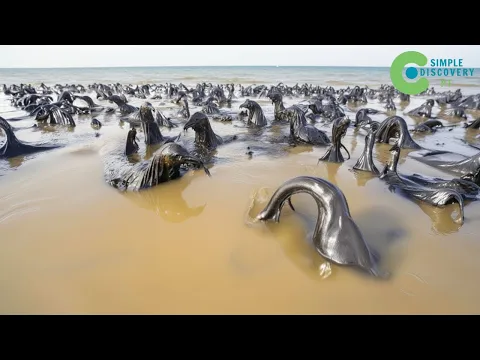
In total, 779 million liters of crude oil and hundreds of thousands of tons of natural gas were released into the water. The oil darkened waves, covered beaches in Louisiana, Mississippi, Alabama, and Florida, and turned white sand into toxic sludge.
At many points, the oil was so thick that it looked like clay being shoveled away. Fish, turtles, and dolphins emerged one last time in methane-saturated waters and sank without returning to the surface.
The United States mobilized everything they had. Suction boats, surface oil burning, floating barriers, large-scale chemical dispersants. In the end, all this effort recovered only between 15 and 25 percent of the total spilled.
The remainder, more than 75 percent of the oil, simply vanished from official accounts. It was not on the surface, did not form mats on the bottom, and did not match the computer models that predicted thick layers of oil in numerous points of the Gulf.
It was at this point that the question shifted from technical to almost philosophical: if almost nothing was recovered, and the ocean was not covered in oil, who or what ate that oil?
The Clue In A Lake In Canada: When Oil Becomes Microbial Food

To answer this question, scientists had to leave the Gulf of Mexico and look at a controlled scenario.
In a research lake in Ontario, Canada, they isolated a small area, poured crude oil, and repeated the human cleaning protocol: removal of the surface film, washing the banks, debris collection. Even so, a fraction of the oil insisted on remaining infiltrated in the water and sediment.
From there began what really mattered. For months, they collected water and sediment samples and monitored the community of microorganisms. In just a few days, the lake’s microbiota transformed.
Species of bacteria that were hardly visible before began to dominate the contaminated area. When analyzing the DNA, the team discovered the pattern: they were oil-eating bacteria, equipped with enzymes capable of breaking down hydrocarbons, the main component of crude oil.
What was most surprising was not discovering that oil-eating bacteria exist, but realizing that they did not arise because of modern industry.
Every year, over 1.3 million tons of oil leak naturally through fissures in the ocean floor. Since the time of dinosaurs, oil has been slowly leaking into the sea. In a hydrocarbon-saturated environment, evolution did what it always does: it selected specialized microorganisms.
These oil-eating bacteria have spent millions of years refining their weapons. They detect hydrocarbon molecules from a distance, swim towards the concentration gradient, and activate enzymes that break down those carbon chains into smaller pieces until they become dissolved carbon dioxide, water, and bacterial biomass. The Canadian lake merely made this process visible on a reduced scale.
How Oil-Eating Bacteria Work In The Ocean
When it comes to oil-eating bacteria, there is no single species solving everything. Oil is a complex mixture of hundreds of hydrocarbon structures, ranging from simple chains to extremely stable aromatic rings. Therefore, nature has assembled a microbial work chain.
The pioneers, like the Alcanivorax group of bacteria, arrive first. They perceive oil via chemotaxis, swim to the contaminated plume, and release enzymes that primarily attack alkanes, the simplest chains. It is as if they used an invisible plier to cut a very long chain into smaller links.
As soon as this stage ends, other groups come into play. Species like Marinobacter take over the intermediate fragments.
At the end of the line are microorganisms like Cycloclasticus, capable of attacking the more resistant aromatic rings.
The sum of all these groups forms what many researchers call an army of oil-eating bacteria, a microbial consortium that dismantles the oil step by step.
In ideal conditions, with plenty of oxygen and oil abundance, the population of these oil-eating bacteria can increase by 300 to 500 times in just a few weeks.
One researcher compared the process to a fire that receives more wind. Each additional liter of oil acts as fuel to multiply the army trying to eliminate it.
The Gulf Of Mexico As A Trained Immune System
If a small lake can quickly activate oil-eating bacteria, what happens in an entire sea that has lived with hydrocarbons for millions of years?
The Gulf of Mexico is not just any ocean. There are over a thousand natural oil leak points where oil seeps from the ground into the seawater every day. This has transformed the region into a sort of natural immune system of the Earth, where oil-eating bacteria not only survive but are constantly trained by this chronic exposure.
In addition to natural leaks, the Gulf concentrates a significant part of the oil industry. Small leaks from ships, pipelines, and platforms function as micro regular doses of oil, something akin to a microbiological vaccination over decades. From the bacteria’s point of view, it’s like living in a permanent training laboratory.
Add to this a third decisive factor. Oil-eating bacteria are more efficient in warm waters. They work best between 20 and 30 degrees.
The Gulf rarely drops below this range. The combination of warm water, constant oil, and oxygen created a biological pressure cooker.
When the Deepwater Horizon exploded, oil-eating bacteria were already ready, adapted, and in high abundance. They didn’t need time to learn to use oil as food.
The contrast with the cold of Alaska is brutal. In the Exxon Valdez disaster in 1989, oil can still be found in nearly intact blocks beneath the frozen sand.
The cold water causes the enzymes of oil-eating bacteria to practically freeze, slowing the process to the point where it seems like time has stopped.
In the Gulf of Mexico, the scenario was the opposite. The high temperature turned these bacteria into turbocharged biological machines, capable of rapidly reducing the concentration of oil in the water column.
The Invisible Cloud And The Dark Side Of Oil-Eating Bacteria

Even so, there was something strange about the numbers from Deepwater Horizon. The speed at which the oil disappeared was so high that computer models, radars, and remotely operated vehicles simply could not keep up.
When remote vehicles descended to about a thousand meters deep, they found no black carpet of oil covering the bottom, as many expected.
Instead, they saw a gigantic murky cloud of oil suspended in the water column, stretching for kilometers and hundreds of meters thick. An oil plume that neither sank nor rose completely, an invisible storm in the middle of the sea.
Samples from this cloud showed that the concentration of hydrocarbons was 100 to 500 times lower than expected, a clear sign that oil-eating bacteria were already working there on a massive scale.
However, this army comes at a cost. To grow by 300 to 500 times, oil-eating bacteria need oxygen in large quantities.
When trillions of cells begin to break down the oil simultaneously, they quickly strip the dissolved oxygen from the water. The result is dead zones, areas where fish, crustaceans, and turtles cannot survive.
Measurements in the Gulf of Mexico recorded drops of 30 to 50 percent in oxygen levels in some regions linked to the Deepwater Horizon plume, enough values to kill species accustomed to extreme environments.
One researcher coldly summarized: these bacteria eat the oil, but they can end up devouring the surrounding ecosystem as well.
The dark side doesn’t stop there. The Gulf of Mexico is home to over two thousand shipwrecks, including vessels centuries old. Steel samples taken from these wrecks began to show abnormal corrosion rates after the disaster.
The reason is that some oil-eating bacteria produce fatty acids and sulfur compounds while breaking down the oil. These chemical byproducts corrode steel 5 to 20 times faster than natural corrosion, threatening both submerged archaeology and pipelines, valves, and oil platforms.
Ships that have weathered storms for hundreds of years now face a microscopic enemy, fueled precisely by the oil seeping on the ocean floor.
Why It Is Not Enough To Speed Up Oil-Eating Bacteria

Faced with the mysterious disappearance of so much oil, many companies imagined a shortcut: if oil-eating bacteria do this work for free, why not speed up the process with human technology?
First, they tried to release cultured bacteria from the lab, strains optimized to degrade hydrocarbons. In petri dishes, these cells worked perfectly. In the real ocean, they failed.
The native microbiota, oil-eating bacteria already living in the Gulf, was so well adapted that it consumed the available nutrients before the artificial strains could establish themselves. The lab bacteria were simply outpaced and eliminated from the system.
The second idea was to fertilize the sea, adding nitrogen and phosphorus to feed the local oil-eating bacteria. In some areas, degradation did speed up, but never at the speed hoped for. In others, the excess nutrients caused symptoms of eutrophication, further reducing oxygen and complicating the situation.
In the end, scientists hit a basic limit. No matter how powerful they are, oil-eating bacteria cannot work infinitely faster without risk. If a lineage were capable of instantly breaking down crude oil, it could also attack other materials with a similar structure, like certain plastics, asphalts, and even components of coastal infrastructure. Nature itself seems to impose a safety ceiling so that this chemical power does not turn against everything else.
When Oil Feeds Entire Ecosystems
With this whole story of dead zones and corroded steel, it would be easy to imagine oil on the ocean floor as an absolute poison. But expeditions in the Gulf of Mexico have shown another side, even more unexpected.
At over three thousand meters deep, where the pressure would crush steel and darkness is permanent, there are called asphalt volcanoes.
These are points where oil leaked naturally and solidified over thousands of years, forming black and shiny rivers on the ocean floor. Instead of barren fields, submersible robots found vibrant ecosystems on top of these asphalt structures.
Mussels form dense colonies, red crabs circulate around the edges of the fissures, tube worms burrow deeply into the dark material, and even sponges and corals grow around. None of these species directly eat oil.
The secret lies in the symbiotic bacteria that live within the tissues of these animals, many related to the same oil-eating bacteria that are free in the water. Instead of turning oil into a dead zone, this arrangement converts a natural leak into an energy base for an entire community.
These asphalt volcanoes demonstrate that the relationship between oil-eating bacteria and the rest of the ocean is ambiguous. In some contexts, they mitigate the impact of a spill. In others, they create new forms of life. And in extreme situations, they can transform entire regions into oxygen deserts.
Biotechnology, Plastic, and The Future Of Ocean Cleaning
The ability of oil-eating bacteria has inspired a new generation of research. In the lab, scientists have already shown that certain fungi can degrade heavy oils, turning used lubricants into much less toxic compounds.
Another milestone was the discovery of a bacterium capable of degrading PET, the plastic used in bottles. In a controlled environment, it converts this material into sugars in about 24 hours, compared to the hundreds of years that plastic would take to decompose on its own.
From this line of reasoning, teams in Asia have developed biological products based on natural bacteria that degrade oil, in liquid form for soils, granules for sand, and filters for contaminated water.
All this points to a future where oil-eating bacteria and other microorganisms are used as planned tools for disaster response, not just as an invisible resource in the background.
At the same time, an obvious concern arises. The more efficient these tools become, the greater the risk that they escape control and start interacting with materials we do not want to degrade, from infrastructure to the ecosystems themselves.
In the end, the story of Deepwater Horizon illustrates a paradox. The same oil-eating bacteria that help clean the ocean can also corrode steel, suffocate animals, and reshape entire ecosystems.
The Gulf of Mexico is, at the same time, a disaster laboratory and a showcase of how nature tries to defend itself against the damage we cause.
And you, do you think humanity should trust oil-eating bacteria more to recover the oceans, or do you fear that this power could get out of control someday?