





 Portuguese
  English
  Spanish
 4 min of reading
  7 comments


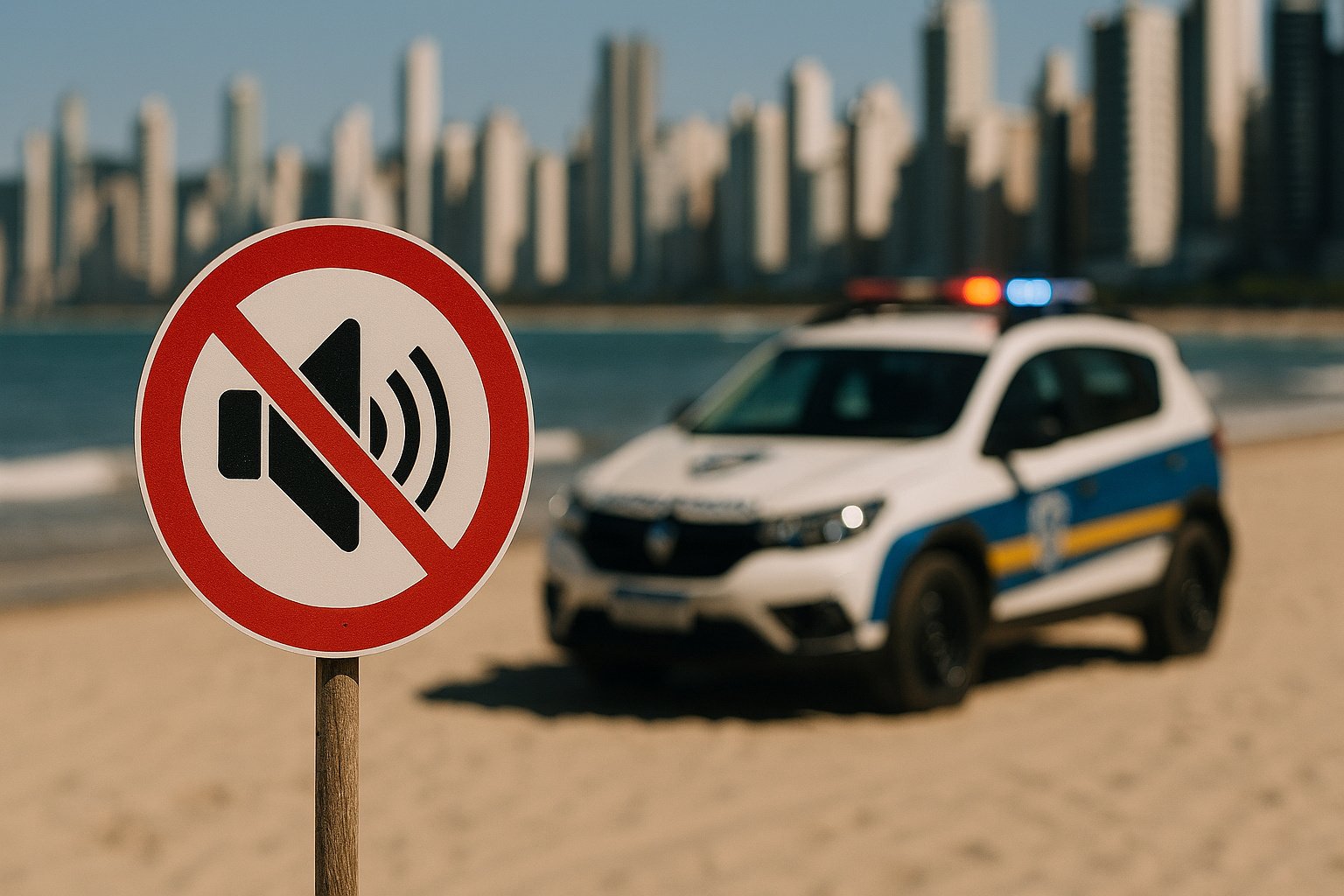


Complementary Law No. 282/2019 Toughens Rules Against Loud Sound in Balneário Camboriú, Provides Fines Above R$ 5 Thousand and Authorizes Seizure of Equipment.
Balneário Camboriú decided to put an end to a problem that had dragged on for years and intensified each tourist season: excess noise on beaches, public roads, and residential properties. Based on the Complementary Law No. 282/2019, which establishes and updates the Municipal Code of Conduct, the city hall began to enforce noise pollution control regulations more strictly, increasing fines, expanding inspections, and authorizing the immediate seizure of equipment.
The change did not create a “new” law from scratch but marked a turning point in the practical application of the already existing legislation. With the regulations and increased enforcement, the municipality made it clear that the right to leisure does not outweigh the collective right to peace and health.
What Does Complementary Law No. 282/2019 Say About Noise Pollution
Complementary Law No. 282/2019 defines noise pollution as any noise emission that exceeds the established technical limits, considering time, location, and type of activity. The regulation applies to both individuals and legal entities, with no exceptions for tourists, residents, or commercial establishments.
-
Justice confirms that old debts in tax executions that have been stalled for more than 15 years can no longer be collected through judicial or administrative means.

-
Churches may gain a new exemption in the tax reform, but the Treasury warns that Brazilians may pay more taxes to compensate for the loss of revenue.

-
Consumer was awarded R$ 10,000 after being led to believe that the apartment had a private yard, but discovered that the external area was common to the condominium.
-
Claro may face a multi-million fine after ANPD found evidence of irregular transfer of customer data to Serasa in a partnership that raised concerns about privacy, transparency, credit analysis, and the limits of the LGPD in Brazil.


The decibel limits vary according to the time of day. During the night and early morning, when rest is protected more rigorously, the tolerance is significantly lower. The law also authorizes inspections to act regardless of a formal complaint, as long as there is a technical confirmation of the violation.
Fines That Can Exceed R$ 5 Thousand and Immediate Seizure
One of the toughest points of Complementary Law No. 282/2019 lies in the penalty regime. The fines are progressive, taking into account the severity of the violation, the duration of the noise, and recidivism. In more severe situations, the amounts can exceed R$ 5 thousand.
In addition to the fine, the legislation authorizes the immediate seizure of speakers, amplifiers, instruments, and any equipment responsible for excessive noise. The goal is to cease the violation on the spot, preventing the noise from continuing even after the citation.
Beaches Are Definitively Covered by the Municipal Law
The application of Complementary Law No. 282/2019 on the beaches was one of the most notable points. Portable speakers, common in groups and gatherings, became direct targets of inspections when they exceed the permitted limits.
The law does not absolutely prohibit the use of music but makes it clear that any sound that compromises collective peace constitutes an administrative violation. The criterion is not musical taste but the impact caused on the environment and other visitors.
Apartments, Private Parties, and Seasonal Rentals
Another advancement in the application of the law occurred in apartments and properties rented seasonally, especially in areas with a high concentration of short-term rentals. Private parties with loud music began to be treated as administrative violations, even when held within residential units.
Complementary Law No. 282/2019 allows holding the occupant of the property responsible and, in certain situations, the owner. Building managers and condominium administrators began to collaborate with the public authorities, providing information when requested, which increased the effectiveness of inspections.
Technical Inspection and Integrated Action
To avoid arbitrariness, the city hall structured inspections based on technical criteria. Decibel meters are used to prove violations, and inspectors work in conjunction with environmental and urban regulation agencies. In cases of resistance, there is support from the municipal guard.
The enforcement has become more frequent during critical periods, such as weekends, holidays, and high season, when the number of occurrences historically surges.
Why Balneário Camboriú Decided to Toughen the Enforcement of the Law
The toughening of the enforcement of Complementary Law No. 282/2019 reflects the growing pressure from residents, the hotel sector, and even merchants who saw noise disorder affecting the city’s image. Constant complaints, lawsuits, and institutional wear led the municipality to adopt a firmer stance.
In addition, recent court decisions reinforced the ability of municipalities to legislate and oversee noise pollution, provided that technical criteria and the right to defense are respected.
Direct Impact on Daily Life in the City
In practice, the law changes the expected behavior of those living in or visiting Balneário Camboriú. The message is clear: leisure is permitted, excess is not. The city chose to prioritize urban coexistence, rest, and quality of life, even knowing that this requires continuous enforcement and facing resistance.
Balneário Camboriú stops treating noise as a “cultural problem” and starts addressing it as a real administrative violation with real consequences.
And you, reader: are stricter laws against loud noise the inevitable price of urban coexistence or a necessary limit to protect those who just want to rest?








A tranquilidade de todos deve ser garantida. O som em praias, assim como animais, devem ser terminantemente proibidos, pois se o direito de um termina onde começa o do outro, o som não tem fronteiras!
Precisa multar os Motoboys que passam buzinando o tempo todo no meio dos carros. Está ficando insuportável como São Paulo!
A Avenida Brasil segue com circulação de motos e carros com escapamentos adulterados ou sem abafamento para perturbação ao sossego de quem aqui reside e paga impostos