Portuguese
  Spanish


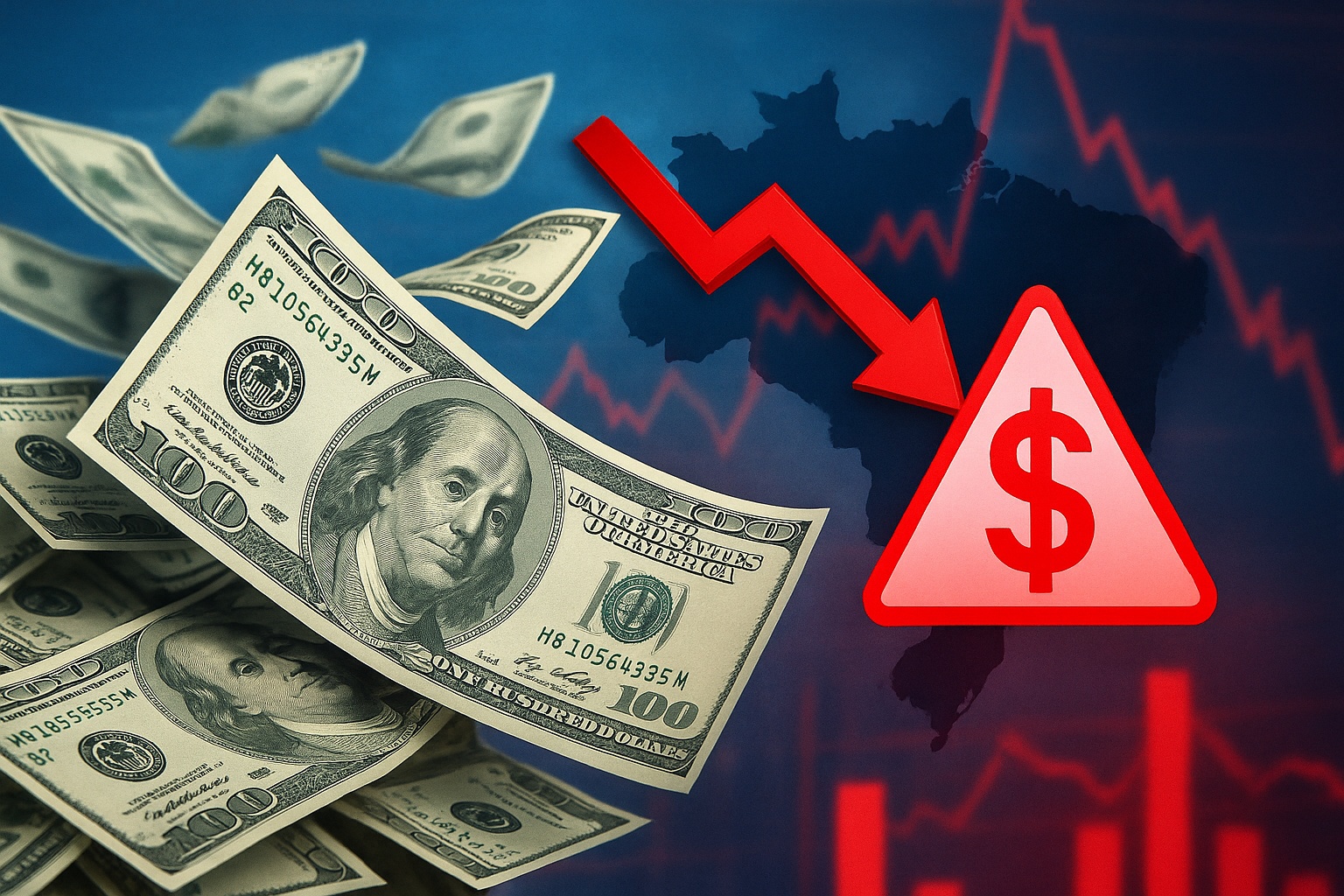

Central Bank Confirms Record Outflow of US$ 18 Billion in 2025. Largest Dollar Exit in Recent History Pressures Exchange Rate and Scares Investors.
The year 2025 has already entered the history of the Brazilian financial market as one of the most turbulent of the last decade. In a report released by the Central Bank, it was confirmed that more than US$ 18 billion left the country in just three months, configuring the largest capital flight in recent history. The figure, which far exceeds the negative flows recorded in previous crises, raised alarm bells in both Brasília and Wall Street.
The immediate consequence was pressure on the exchange rate: the dollar soared, reaching levels not seen in years, and investors began to question their confidence in Brazil as a safe destination for their resources. Analysts classified the movement as an “unprecedented financial exodus,” capable of reshaping prospects for the national economy in 2025.
The Size of the Drain – Investments That Stop Financing Companies, Infrastructure Projects, and Even Internal Consumption
To understand the gravity, one only needs to look back. In crises like those of 2015 or the pandemic of 2020, Brazil recorded significant capital outflows, but nothing comparable to what is seen now. The net withdrawal of over US$ 18 billion in 2025 represents a dangerous acceleration: it is the largest amount since the beginning of the Central Bank’s historical series.
-
Facing Labor Shortage, Japan Plans to Invest $34 Million to Attract Foreign Workers in Construction, Healthcare, Industry, and Commerce

-
Brazilian City Makes Remarkable Leap, Becomes 4th Wealthiest in the Country with GDP of R$ 134.1 Billion

-
Controversial 6-day Workweek Elimination in Brazil Faces Economic Criticism Over Productivity Claims
-
Itaú to Refund Customers After 14 Years of Unauthorized Credit Card Charges; Agreement Includes No Interest or Adjustments, Deadline by 2028, with Potential Impact of Up to $6.5 Billion





This money is not just a figure: it represents investments that stop financing companies, infrastructure projects, and even internal consumption. In practice, the outflow of dollars weakens foreign exchange reserves, pressures inflation, and increases the cost of credit for families and businesses.
Why the Dollars Are Leaving
The Central Bank and market analysts point to an explosive combination of factors to explain this movement:
- Fiscal Uncertainty: With public debt projected to reach 84% of GDP by 2028, investors fear an imbalance in accounts and loss of credibility.
- Higher International Interest Rates: The recovery of the American economy and the Federal Reserve’s policy make investments in U.S. securities more attractive, draining resources from emerging countries.
- Lack of Structural Reforms: The slow pace of approving changes like administrative and tax reforms increases the perception of risk.
- Political Volatility: Institutional crises and lack of regulatory predictability reinforce caution.
Together, these elements created a scenario in which foreign investors prefer to exit now before the turbulence increases.
The Impact on the Exchange Rate and Real Life
The capital flight is not an abstract phenomenon restricted to technical reports: its effects are already felt in daily life. The rising dollar increases the costs of imports, fuels, and agricultural inputs, raising prices for the final consumer. Companies indebted in foreign currency see their costs explode, while families suffer from rising food and airfare prices.
Experts warn that if the trend continues, Brazil could face additional inflationary pressure in 2025, even in a high-interest environment. The equation is cruel: expensive dollar, restricted credit, and weakened consumption.
Comparison with Past Crises
The magnitude of the flight in 2025 recalls dramatic moments in Brazilian economic history. In the 1980s, the country faced a foreign debt crisis; in the 1990s, the collapse of the fixed exchange rate led to massive capital flight; in 2002, electoral uncertainty caused the dollar to surge; and in 2020, the pandemic resulted in an abrupt outflow of resources.
But, even in these episodes, the numbers did not reach the current level in such a short time. This is why experts classify the US$ 12.8 billion outflow as the largest financial exodus in recent history, comparable only to global crises that shook the entire system.
The Fear of Downgrade
Another ghost that haunts the corridors of Brasília is the risk of credit rating downgrade by international agencies. With the capital flight, the perception of risk increases, and if Brazil loses more points in its rating, the spiral could intensify.
A downgrade would mean, in practice, an increase in the cost of public debt, greater difficulty in attracting investments, and the consolidation of the image of a high-risk country. This is the main concern of economic policymakers at this moment.
The Response of the Government and the Central Bank
In the face of pressure, the Central Bank reinforced its actions in the foreign exchange market, using instruments such as swaps and dollar auctions to contain the surge of the currency.
The government, for its part, seeks to accelerate the reform agenda and signal a commitment to fiscal responsibility.
However, the market still expects concrete measures, not just rhetoric. For investors, what is at stake is Brazil’s ability to provide stability in an increasingly competitive world for attracting capital.
What Lies Ahead
If the capital outflow continues at the current pace, Brazil may face months of prolonged instability in 2025. Analysts are already revising GDP growth projections downward and warning that the exchange rate may remain under pressure.
Some experts, however, see a window of opportunity: if the country manages to approve structural reforms and stabilize public accounts, it can turn the crisis into a turning point, recovering international confidence and attracting back some of the dollars that are now fleeing.
The Central Bank’s confirmation of the record flight of US$ 12.8 billion in 2025 is more than a technical data point: it is a dramatic warning about the fragility of the Brazilian economy. It is a financial exodus that is already affecting the exchange rate, inflation, and the lives of millions of Brazilians.
Brazil faces a crossroads: it either acts quickly to regain confidence and contain the drain, or risks plunging into a cycle of instability that could define this decade. The message from investors has been delivered — it remains to be seen if the government will have the energy and courage to change course before it’s too late.