Portuguese
  Spanish


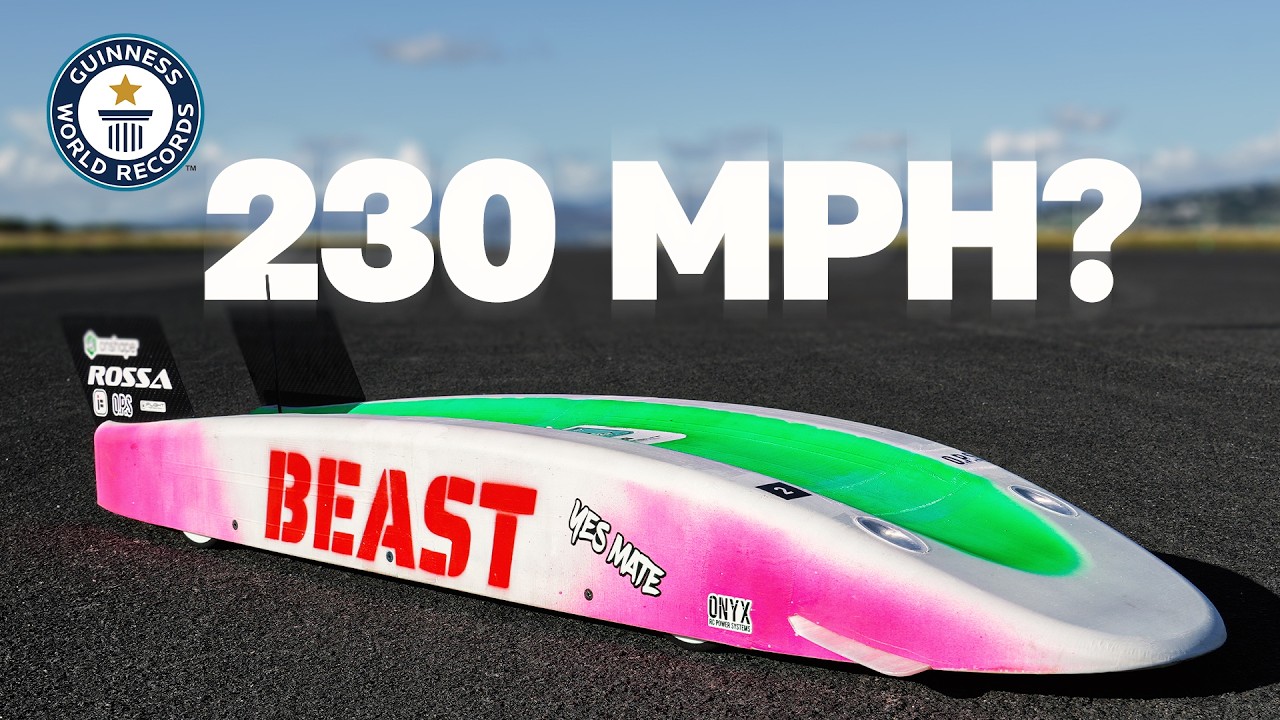

RC electric car reaches 377.73 km/h and enters the Guinness, surpassing supercar speeds in reduced scale.
On September 19, 2025, British Stephen Wallis entered the Guinness World Records by reaching 377.73 km/h with a battery-powered remote-controlled car in Llanbedr, Gwynedd, United Kingdom. The vehicle, nicknamed The Beast, surpassed the previous record by more than 25 km/h and drew attention for achieving, in reduced scale, a speed comparable to high-performance supercars.
The project is not just a simple adapted hobby. It is an extreme miniature engineering platform, built to withstand acceleration, aerodynamic drag, vibration, directional stability, and control at a speed range where any minimal variation can completely compromise the trajectory.
The result is a compact machine operating at the physical limit of remote control, where battery, motors, tires, bodywork, and electronics need to work precisely to keep the vehicle stable at over 377 km/h.
-
The Trap of Modern Technology: How Screen Overload and Digital Connections Can Impact Your Mental Health and Well-being

-
Wyoming Couple Grows Tropical Fruits Year-Round in -40°C Using Geothermal Greenhouse, Demonstrating Earth’s Heat Can Produce Oranges and Lemons in Snow Without Traditional Heating

-
Ship Returns from Brazilian Coast with Thirty Newly Discovered Life Forms
-
Nigerian Professor Invents Electricity-Free Refrigerator Using Clay Pots and Wet Sand, Extending Shelf Life of Vegetables to 27 Days; 7,000 Units Distributed in Energy-Deprived Villages



Achieved speed surpasses many high-performance cars in real scale
To contextualize the achievement, it is important to compare the recorded number with real vehicles. The speed of 377.73 km/h places the remote-controlled car on a level equivalent to high-performance hypercars, such as models from Bugatti or Koenigsegg.
This comparison highlights the level of engineering involved in the project, as the vehicle needs to deal with challenges similar to those of full-scale cars, but with additional limitations imposed by its reduced size.
At scale, aerodynamic forces and instability are even more difficult to control, making the record even more significant.
Aerodynamic challenges become more critical in small-scale vehicles
At extreme speeds, aerodynamics becomes a determining factor for vehicle stability. In the case of a remote-controlled car, this challenge is amplified.


Due to the reduced size, small irregularities on the track or variations in airflow can cause significant instabilities. Additionally, the limited weight of the vehicle reduces the grip force, increasing the risk of losing contact with the ground.
To achieve speeds close to 380 km/h, the design needs to balance downforce, air resistance, and directional stability with extreme precision.
This requires a level of refinement that goes beyond what is found in commercial models.
Electric system operates at the limit to generate sufficient power
The electric motor used in the project is one of the most critical components. To achieve such high speeds, it is necessary to generate a significant amount of power in an extremely limited space.
This involves the use of high-discharge batteries, advanced electronic control systems, and motors designed to operate at very high RPMs.
Thermal management also becomes a challenge, as the heat generated can compromise the performance and integrity of the components.
Each element of the electric system needs to be carefully sized to avoid failures during the record attempt.
Tires and traction represent one of the greatest technical challenges
One of the most critical aspects in projects of this type is the contact with the ground. At speeds close to 400 km/h, the tires are subjected to extreme forces, which can cause deformation or even rupture.
Unlike full-scale vehicles, where there is a greater margin for impact absorption, a remote-controlled car needs to deal with these forces in a much smaller contact area.
This requires the development of specific tires capable of withstanding high RPMs and maintaining traction in extreme conditions. Any failure in this component can result in an immediate loss of control.
Remote control at high speed requires absolute precision
Another critical factor is the control of the vehicle. At such high speeds, the response time between the command and the car’s reaction is extremely short.
This means that the operator needs to have exceptional precision and reflexes, in addition to relying on electronic systems that ensure stability and quick response.
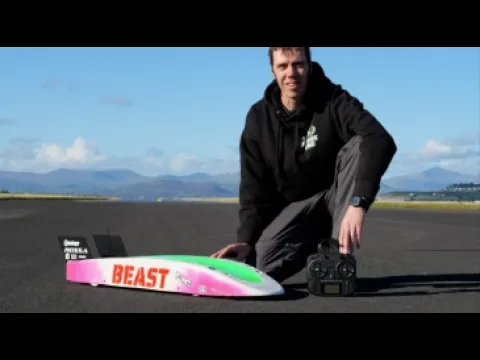
Small adjustments in steering can represent significant differences in trajectory, especially on long, straight tracks. The combination of human skill and onboard technology is essential for the success of the operation.
Record requires controlled environment and ideal track conditions
To register a speed of this magnitude, it is not enough to just have a capable vehicle. An appropriate environment is also necessary.
The track used needs to be long, flat, and free of imperfections that could compromise the car’s stability. Additionally, climatic conditions such as wind and temperature also influence performance.
The record was achieved under carefully controlled conditions, ensuring safety and accuracy in measurement. These factors are fundamental to officially validating the result with Guinness.
Precision engineering transforms hobby into high complexity project
Although remote-controlled cars are often associated with hobbies, projects like Stephen Wallis’s demonstrate that this field can reach high levels of technical complexity.
The development of a vehicle capable of reaching nearly 380 km/h involves knowledge of: aerodynamics, electronics, mechanics, materials, and control.
This brings the project closer to industrial and research applications, where each component is optimized for maximum performance. The result is a convergence between hobby and advanced engineering.
Miniaturization amplifies challenges and demands innovative solutions
Scaling down does not simplify problems, but often makes them more complex. In smaller systems, tolerances are more critical and margins of error are reduced.
This means that solutions used in larger vehicles need to be adapted or completely reinvented.
Miniaturization requires constant innovation, as physical and thermal limitations are harder to overcome. This aspect makes the record even more relevant from a technical standpoint.
Case evidences potential for innovation in compact electric systems
The performance achieved by the vehicle also highlights the potential of electric systems in high-performance applications.
Electric motors offer advantages such as immediate response and high efficiency, essential characteristics for achieving extreme speeds.
The evolution of these technologies on a reduced scale may have applications in other sectors, including robotics and electric mobility. The project demonstrates how innovation can occur at different scales.
Record reinforces extreme limits of physics applied to vehicles
Reaching speeds close to 380 km/h with a miniature vehicle implies operating near the physical limits of the materials and systems used.
Aerodynamic forces, friction, component resistance, and dynamic stability are pushed to the extreme.
Each record attempt represents a practical test of the limits of engineering and applied physics. This type of project contributes to the advancement of technical knowledge.
Do you believe that small-scale machines can continue breaking even greater records?
The record set by Stephen Wallis shows that miniature engineering still has room for evolution. With new materials, more advanced electronic systems, and aerodynamic improvements, it is possible that even higher speeds will be achieved in the future. In light of this, a reflection arises:
how far can small-scale vehicles go and what will be the next limits to be broken in this type of technology?