






 Portuguese
  Spanish


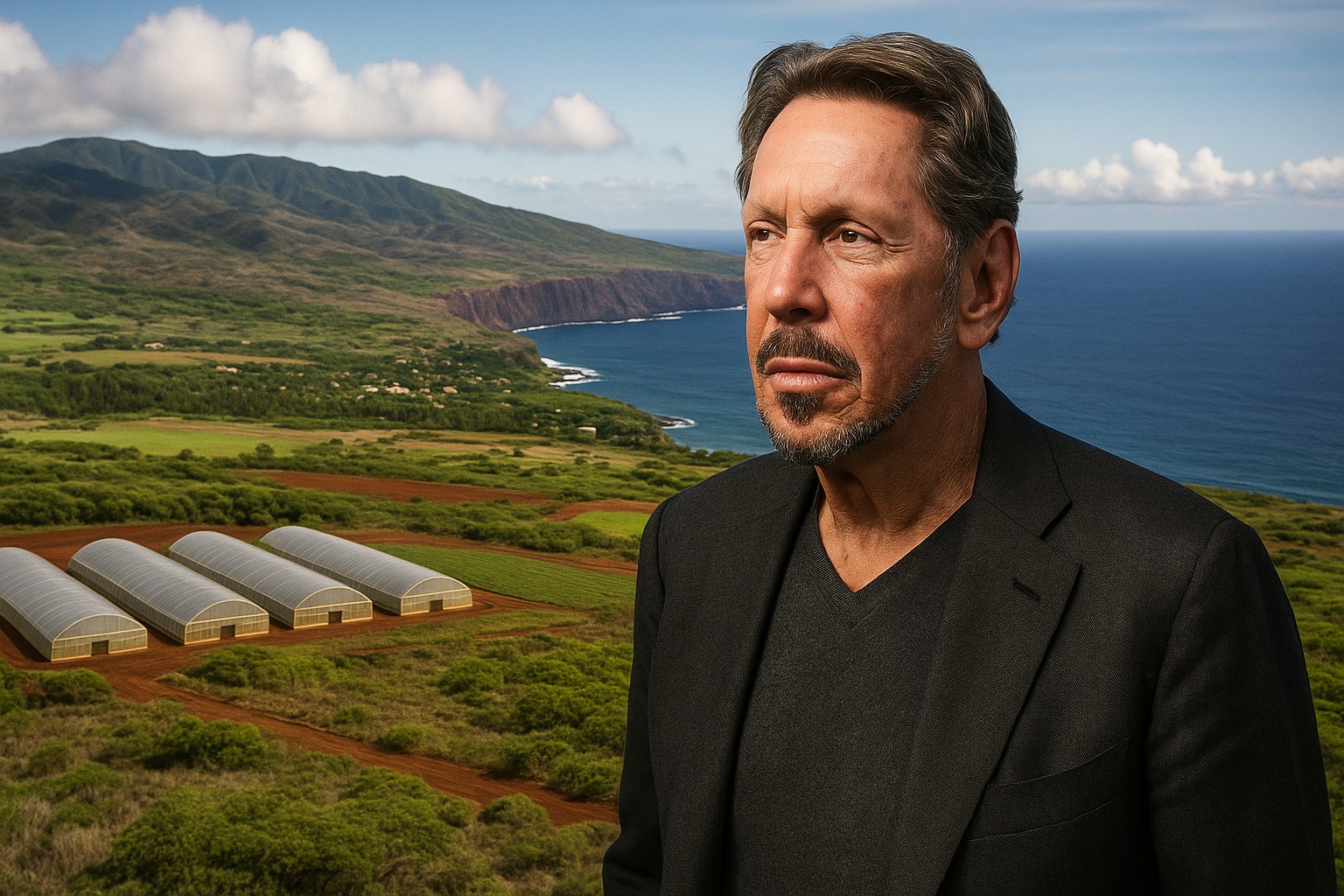


Larry Ellison’s Initiative In Lanai Promised To Revolutionize Agriculture With Advanced Greenhouses, Sensors And Clean Energy – But Natural, Technical And Management Challenges Transformed The Experiment Into An Expensive Lesson About The Limits Of Technology
Larry Ellison, co-founder of Oracle and one of the richest men on the planet, decided to transform Lanai, his private island in Hawaii, into a high-tech agricultural experimental field. The ambition arose because he believed that the location could serve as a model for sustainably producing food and, therefore, inspire practices capable of helping other regions.
The proposal seemed bold, and, moreover, extremely expensive: over half a billion dollars allocated to erect a project that was supposed to combine innovation, advanced cultivation, and global impact.

The Purchase That Launched The Experiment
When Ellison acquired 98% of Lanai for about US$ 300 million in 2012, he envisioned a purpose greater than just having an exclusive refuge.
-
Former Atacadão Employee Turns Online Cake-Baking Lessons into a Confectionery Brand with Factory, Store, Delivery, and Nearly $400,000 in Revenue

-
Brazilian Startup Sells Nearly 9 Million Surprise Bags of Near-Expiry Food, Prevents Thousands of Tons of Waste, Aiming for $42 Million Revenue by 2026
-
How to Prevent Brown Recluse Spider Bites: Common Hiding Spots and Free Tips to Reduce Risks

-
Natto: The Unusual Japanese Superfood Gaining Popularity on Social Media and Driving Record Exports




According to a report from The Wall Street Journal, the billionaire aimed to restore part of the island’s agricultural vocation, which had previously been harmed by pineapple cultivation, while also testing modern technologies to produce food.
“We have an island where we can’t grow anything, and we need food,” stated David Agus, co-founder of Sensei Ag, the company created to execute the plan.
“We are going to change agriculture.” This idea gained traction with an initial investment of US$ 500 million, a figure higher than what was spent to acquire nearly the entire island. The proposal included robotics, sensors, hydroponic methods, and artificial intelligence.
Greenhouses That Faced Reality
The theory seemed flawless; however, practice proved otherwise. The six greenhouses built in Lanai quickly became an example of how innovation and the natural environment can clash.
The Israeli engineers responsible for the project did not take into account the strong winds and high humidity.
The roofs, estimated at US$ 12 million, were blown off multiple times by gusts reaching 130 km/h. Repairs raised this cost to approximately US$ 50 million.
Another obstacle arose with the solar panels sent by Elon Musk to power the greenhouses. Dust accumulated by the wind reduced efficiency and required frequent use of diesel generators, contradicting the plan to operate sustainably.
Technology That Should Have Helped, But Hindered
Unstable Wi-Fi connections hampered essential sensors responsible for controlling temperature, light, and ventilation. Therefore, the operation of the structures was always irregular.
The technical complexity, initially seen as a differentiator, became a heavy burden that was difficult to manage. A former manager reported that the original vision gradually faded as challenges increased.
Results Far From Global Ambitions
With all the investment, Sensei Ag achieved modest performance. It became a strong producer of lettuce and cherry tomatoes to supply Hawaii itself.
Although this represents a positive outcome within the local scale, it is far from the promise of feeding the world or revolutionizing agriculture.
Ellison’s constant changes in direction also hindered greater progress. He attempted to restore the soil using mineral-rich plants, then considered growing exotic fruits, imported molds for square watermelons, and analyzed the cultivation of mangoes in the greenhouses.
All these ideas were discarded due to cost, market, or technical feasibility issues. Even wasabi made the list of possibilities but was also abandoned when local chefs recommended simpler practices. In the end, the focus returned to lettuce and tomatoes.
More Technological Than Agricultural Leadership
Sensei Ag faced difficulties because its leadership always came from the technology sector. Dave Douglas, a software engineer living in Massachusetts, took over the management of the operation even from a distance.
The director of technology, Danny Hillis, is a reference in computer networks but has no agricultural experience.
This structure hindered sound decisions about essential cultivation practices. For the inhabitants of Lanai, which number about 3,200, this generated doubts.
The island still imports between 80% and 90% of its food, which reinforced criticism about using the land as a laboratory instead of a solution for the community itself.
Course Correction
In recent years, Sensei has scaled back its ambitions. Instead of trying to produce food on a large scale, it has begun developing software and technologies for indoor agriculture. The intention now is to provide tools that other farms can license.
Test centers in California are working on robotics and systems to reduce labor costs.
Additionally, the company cut crops like peppers and cucumbers to prioritize more profitable lettuce mixes. David Agus summarized the decision: “People don’t like cucumbers very much. There was no sustainable market.”
A Mega-Project On The Island: An Experiment That Turned Into A Lesson
Ellison’s project shows how the logic of Silicon Valley does not always work in traditional sectors.
Although he invested more than half a billion dollars, the results fell short of the initial promise. An employee compared the expectation to “getting a Bugatti and ending up with a Yugo.”
Ellison continues to fund local initiatives, such as improvements to the hospital, reconstruction of a theater, and construction of housing.
However, his attempt to revolutionize agriculture remains a costly reminder that technology alone does not solve challenges related to climate, soil, and actual cultivation.
With information from Luxurylaunches.







for this kind of project experts in agriculture and natural farming ex. permaculture, regenerative farming and chicken ,goat and sheep and cows grazing on land will improve soil fertility in few months to a year you can use technology as an added advantage
Esse camarada, estava sem problemas e muinto dinheiro disponível pra gastar, aí foi procurar com onque ocupar a mente e gastar a grana,…não fique com.pena dele não, fez o que queria , não deu certo….paciência.
Tem que apresentar a Embrapa para o Elisson, para ele tomar algumas aulas sobre como desenvolver a agricultura com recursos limitadíssimos em um ambiente hostil.
Embrapa deveria mudar o nome para Embramagic.
Parabéns! Matou à ****!