






 Portuguese
  Spanish
  4 min of reading
  0 comments


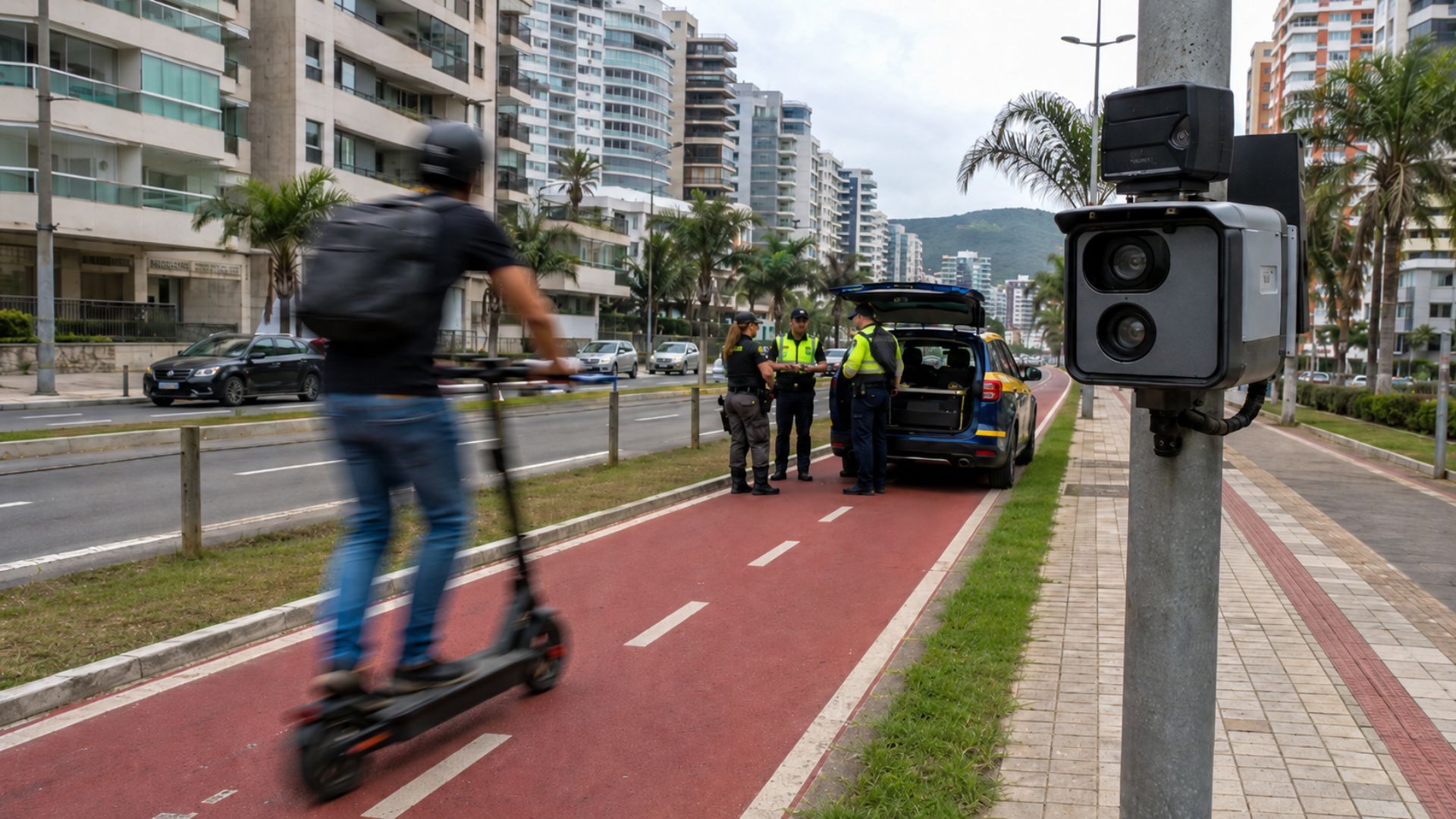
Itajaí, in the Northern Coast of Santa Catarina, began this Friday (29) the monitoring of electric scooters, electric bicycles, and scooters on bike paths and urban roads with a portable radar. According to Codetran, the scooter or any self-propelled vehicle that exceeds 32 km/h ceases to be classified as such and is reclassified as a moped, requiring registration and driver licensing. Equipment caught above the limit may be removed to the yard, and the driver may receive a fine. The radar will operate in a 30-day test period but is already valid for issuing fines.
The tolerance has ended for those who turn the electric scooter into a high-speed vehicle on the bike paths of Itajaí. The city’s Traffic Coordination, Codetran, has started using a portable radar to measure the speed of scooters, electric bicycles, and scooters that circulate on urban roads, bike paths, and cycle lanes. The limit is 32 km/h: any scooter or self-propelled vehicle that exceeds this speed ceases to be classified as active mobility equipment and is reclassified as a moped or electric cycle, a category that requires mandatory registration and driver licensing.
Leandro Ferreira, coordinator of Codetran, explained that the measure was motivated by the increase in public complaints and the rise in accidents involving this type of equipment, “especially on bike paths and cycle lanes, spaces intended for the safe circulation of cyclists and active mobility means.” The portable radar will initially operate in a 30-day test period but already integrates into enforcement actions and is valid for fining those caught with the scooter above the permitted limit.
What happens with the scooter above 32 km/h

The consequence is threefold. The scooter or self-propelled vehicle that exceeds 32 km/h may be removed to the Codetran yard, the driver may receive a traffic fine, and if they do not have a license, the infraction is aggravated. According to information released by the NDMAIS portal, the logic of the inspection is that a scooter at 40 or 50 km/h on a bike path represents a real risk for cyclists and pedestrians who share the same space expecting vehicles at speeds compatible with conventional bicycles.
-
FIRJAN’s mega plan of R$ 526.3 billion for Rio de Janeiro aims to revive Brazil’s largest industry, with two-thirds of the investments going to oil and gas.

-
China signals an increase in beef imports, Brazil has already consumed 70% of the 1.106 million ton quota and seeks to renegotiate the tariff that jumps from 12% to 55%, while demand from the US also skyrockets.
-
Food inflation rose 302% in 20 years in Brazil, but the supermarket changed: purchasing power yielded 87% more mortadella and 31% less fruit, and ultra-processed foods took over the cart.
-
Petrobras sells the first batch of 3,800 m³ of aviation fuel made with certified soy, capable of reducing emissions by up to 70%, in an unprecedented project that anticipates the aviation sector’s requirements expected for 2027.



The registration required for vehicles above 32 km/h is not just a bureaucratic formality. It links the equipment to an owner, allows identification in case of an accident, and enables the vehicle to be tracked in theft situations. For those who use the scooter only as a means of urban transport within the speed limit, nothing changes. For those who have modified the equipment to go faster, the cost now includes a license plate, a license, and the risk of losing the vehicle.
How the radar will work in Itajaí
Codetran agents will be positioned at various points in the city with the mobile radar, measuring the speed of self-propelled vehicles. The equipment will be used on urban roads, bike paths, and cycle lanes, precisely in places where high-speed scooters pose the greatest danger to other users of the shared space.
The initial 30-day period serves to calibrate the operation and identify the most critical points, but the inspection is valid from the first day. Codetran did not disclose in advance the locations where the radar will be positioned, a strategy aimed at preventing scooter drivers from simply avoiding the monitored areas. The idea is that the possibility of being caught at any point in the city discourages risky behavior.
The increase in scooter accidents on bike paths


The decision to use radar to monitor self-propelled vehicles did not come out of nowhere. The increase in incidents involving scooters and electric scooters on bike paths and cycle lanes in Itajaí pressured Codetran to act, especially after complaints from cyclists who report feeling unsafe sharing the space with equipment that travels at much higher speeds than a conventional bicycle.
The problem is national. In several Brazilian cities, the electric scooter has occupied bike lanes without clear regulation, and the speed of some modified models exceeds 60 km/h, a speed compatible with that of a car on an urban road. The difference is that the scooter does not have ABS brakes, does not have a protective structure, and circulates alongside helmetless cyclists and distracted pedestrians.
What scooter regulation in Itajaí can inspire
If the portable radar model works in Itajaí, other cities in Santa Catarina and Brazil may adopt the same strategy. The regulation creates a regulatory precedent that clearly defines the boundary between an urban mobility scooter and a motorized vehicle that requires a license plate, license, and insurance, just like a motorcycle.
For manufacturers and sellers of electric scooters, the message is direct: equipment that exceeds 32 km/h must be sold with the information that the buyer will have legal obligations identical to those of someone buying a moped. For users, the message is that the bike lane is not a racetrack, and that the radar is now watching those who thought no one was measuring.
Do you think it’s fair to use radar to monitor scooters on bike lanes? Is the 32 km/h limit adequate or should it be higher? Tell us in the comments.





Be the first to react!