






 Portuguese
  Spanish
  3 min of reading
  0 comments


Study Reveals Historic Record of Chinese Investments in Energy, Oil, and Industry Sectors in Brazil
Brazil stood out in 2024 as the top destination for Chinese investments among emerging economies. This data was presented on September 4, 2025, by the Brazil-China Business Council (CEBC), with support from Bradesco Corporate.
Historic Record of Projects in the Country
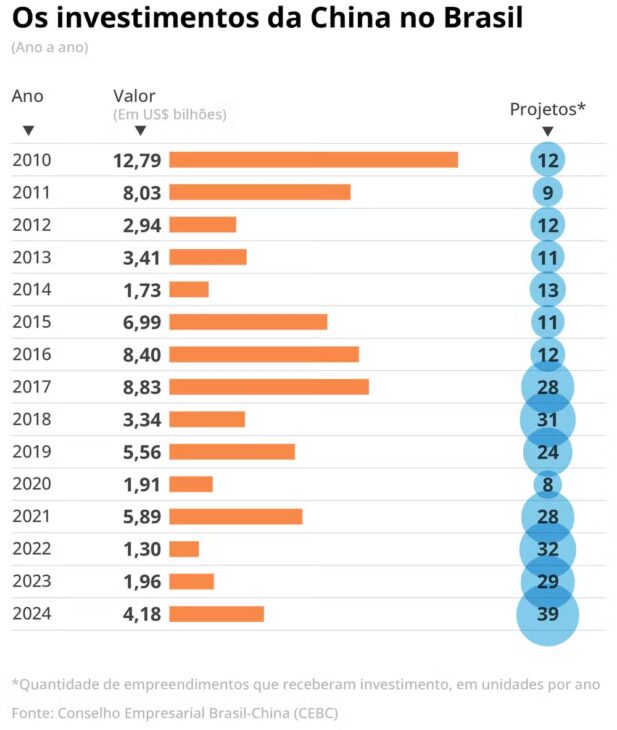
In 2024, Chinese companies registered 39 projects in Brazilian territory, the highest number since 2006. In total, the investments amounted to US$ 4.18 billion, nearly double the volume of 2023. Thus, Brazil held the position of the third-largest global recipient of Chinese capital, behind only two developed economies.
The study titled “Chinese Investments in Brazil – 2024: Reindustrialization and Energy Transition” was presented in September 2025. The presentation was live-streamed on Zoom and included industry specialists.
-
Brazilian Joins Homeownership Consortium, Faces Decade of Dual Payments Totaling $141,000, Surpassing Traditional Mortgage

-
Land Rover to Halt Production in July, Putting 371 Jobs at Risk, as Chinese Automaker Negotiates to Convert Factory to 100,000 Vehicles Annually by 2027

-
Mexican Pest Threatens U.S. Cattle Herds at Historic Lows, Potentially Boosting Brazilian Beef Exports as Burger Prices Soar

-
Brazilian Freight Bill Progresses in Congress with $5,000 Minimum Wage, 70% Advance Payment, and Fines Up to $1 Million, as Agriculture and Industry Warn of Rising Costs and Legal Uncertainty


Electricity and Oil Sectors Concentrate Resources
The electricity sector led the investments, absorbing 34% of the total, or US$ 1.43 billion. The projects included new initiatives in solar and wind energy. Right after, the oil sector received 25% of the investments, about US$ 1 billion. Thus, it became clear that while renewables are advancing, fossil fuels continue to attract strong interest from China in Brazil.
Manufacturing Industry on Continuous Growth
Since 2021, Chinese projects in the manufacturing industry have grown uninterruptedly, reaching eight ventures in 2024, a historic record. This advancement is connected to the policy of “New Industry Brazil”, launched by the federal government to stimulate reindustrialization.
The program prioritizes infrastructure, sanitation, sustainable mobility, digital transformation, energy security, and decarbonization. Therefore, the Chinese presence strengthens in strategic areas aligned with Brazilian development guidelines.
Mining and Critical Minerals Gain Space
In addition to industry and energy, mining has also come into focus. Chinese companies announced new projects in strategic minerals such as tin and copper. These inputs are considered essential for the high-tech industry.
According to the CEBC, this activity opens up opportunities for greater integration between Brazil and China in global value chains, especially those aimed at energy transition and emission reduction.
Future Projections for Brazil-China Partnership
The CEBC Research and Content Director, Tulio Cariello, stated that sectors such as energy transition, high-standard manufacturing, and critical minerals are emerging as the most promising for new investments.
According to the report, this expectation results from the Brazilian reindustrialization agenda and the joint commitment to decarbonization. Both countries plan to intensify partnerships in these areas in the coming years.
Study Launch Event
The launch event took place on September 4, 2025. The opening featured Luiz Augusto de Castro Neves, president of the CEBC and former ambassador of Brazil to China, and Fabiana D’Atri, superintendent of Economy at Bradesco Asset.
Following that, Danilo Goulart, head representative of Bradesco in Hong Kong, and João Ricardo Tiusso, head of Project Strategy at GWM Brazil, participated. Tulio Cariello presented the key results, while Cláudia Trevisan, executive director of the CEBC, moderated the session.
In summary, Brazil consolidated its position in 2024 as the largest destination for Chinese investments among emerging economies, achieving billion-dollar investments and strengthening its presence in energy, oil, industry, and mining.
What do you think should be a priority for Brazil: to expand Chinese investments in strategic sectors or to balance the partnership with greater protection for the national industry?





-

-

3 people reacted to this.