






 Portuguese
  Spanish




An Alarming Study From NASA Says Brazil May Face a Dark Future in the Coming Decades, With Some Regions Becoming Uninhabitable.
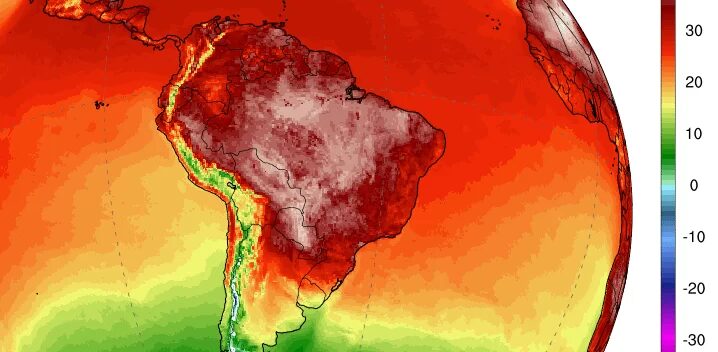
Could Brazil really cease to exist in half a century? According to Sérgio Sacani, a Geophysicist and YouTuber, explains that an alarming study from NASA presents a devastating scenario, with a map of the country completely in red, indicating a critical situation.
According to him, the forecasts are grim and concern grows each day. Is the future of Brazil at stake? Perhaps. The severity of the situation is undeniable, and we are witnessing the consequences of various combined factors.
According to experts, studies like these tend to be accurate. Proof of this is that the heavy rains in Rio Grande do Sul seen this year were predicted in a 2020 report. At the time, the text stated that Rio Grande do Sul should face a significant increase in rainfall, a prediction that was confirmed last year.
-
The Arctic is no longer just a frozen region and is becoming a new military board with the opening of maritime routes, expansion of bases, nuclear icebreakers, and competition among Russia, NATO, the United States, and China.

-
She spent 73 years breathing inside an iron lung, survived the aftereffects of polio, and became the last woman in the United States dependent on the equipment before dying at 78 years old.
-
Brazilian students created a $1 filter using pine bark, cotton, and 3D-printed parts to clean cassava wastewater, reduce the toxicity of a hazardous waste, and transform contaminated water into biofertilizer.

-
Astronaut from Artemis II steps down after mission to the Moon and decision surprises after a record of 406,771 km, a historic 10-day journey, and an unprecedented achievement for Canada.




“These forecasting models, based on temperature and humidity data, attempt to anticipate future climate changes. However, rising temperatures may render some areas uninhabitable,” he explained.
Recently, Rio de Janeiro recorded temperatures of up to 48ºC, a scenario that could become common. “If these temperatures persist for months, the situation may become unbearable. In Rio de Janeiro, the heat index reached 60ºC, a concerning increase that should be treated with caution,” he explains.
Forecasting Models and the Threat to the Future of the Planet
Climate forecasting models, developed by the IPCC with data from NASA and NOAA, make predictions based on current conditions, without considering significant future changes. According to the geophysicist, if we continue on the current path, the results may be disastrous.
According to Sergio Sacani, one potential solution to these problems is the electrification of the vehicle fleet. “China, for example, has significantly reduced pollution by electrifying part of its fleet,” he says.
Regarding the risk of this being the end of Brazil, Sergio Sacani discusses the human capacity for adaptation to reject the idea. “The capacity for adaptation in humans is remarkable,” he says.
“The history of the planet has always been marked by catastrophes and drastic changes, and the ability to adapt is one of the greatest characteristics of our species. This allows us to face adversities and seek solutions to the problems that arise,” he concludes.






