






 Portuguese
  Spanish
  5 min of reading
  0 comments


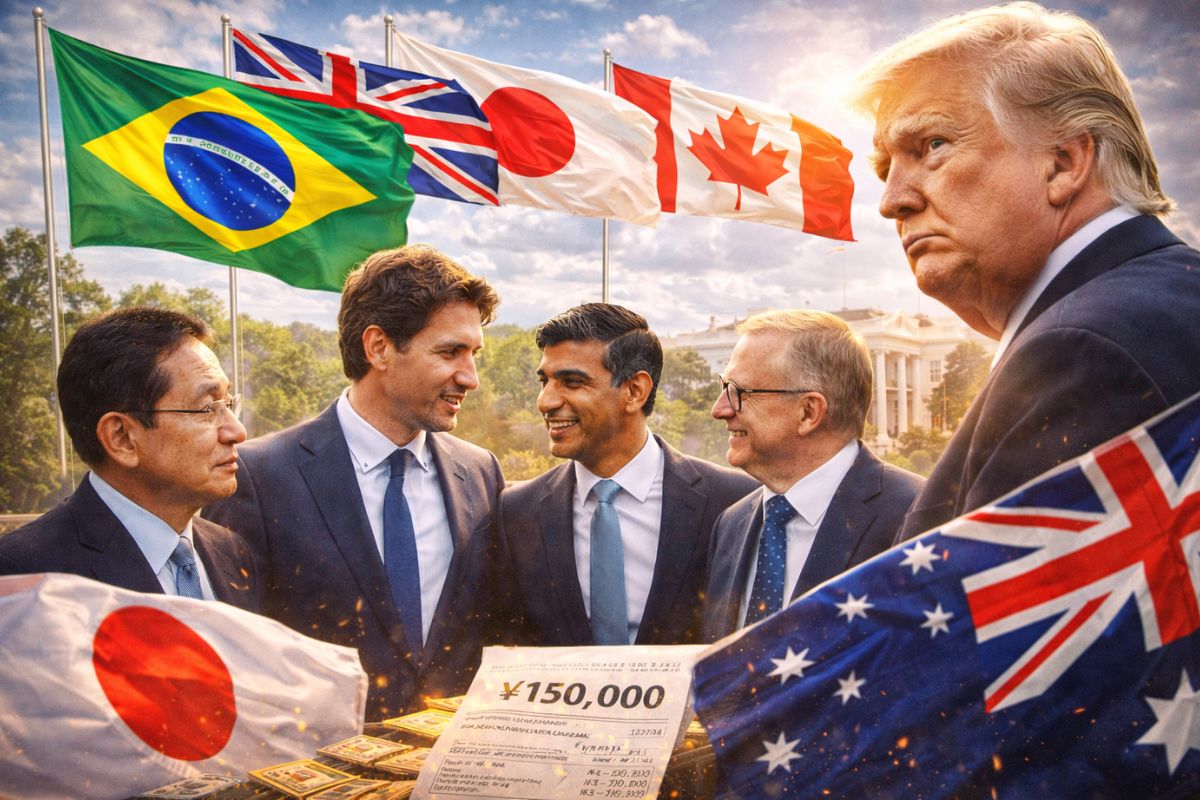
In The 36th World Report, Human Rights Watch Advocates For A New Global Alliance With Brazil, Canada, Japan, Australia, The United Kingdom, And Europeans, Conditioning Trade And Security Agreements On Human Rights, While Criticizing Donald Trump And Warning That The Rules-Based Order And Democracy Are Now At Risk.
The debate about a new global alliance re-emerges in Brazil on February 4, 2026, after Human Rights Watch publishes the 36th World Report and states that the country may be among the coordination centers for an international response to backsliding in democracy and human rights.
According to Human Rights Watch, the trigger is twofold: on one hand, the wear of the international order led by the United States; on the other, the pressure from authoritarian regimes, already associated in the report with the actions of powers like China and Russia, combined with direct criticism of Donald Trump’s government and its internal actions.
The framework suggested by the organization aims to turn this diagnosis into international public policy: a coalition that does not rely on statements, but on criteria, by conditioning trade and security agreements to minimum standards of human rights and democracy.
-
The neighboring country of Brazil that reduced the working hours and increased the minimum wage by 23.7% had to hire 787,000 extra workers to cover the reduced hours, and even so, it records unemployment at a historic low.

-
A resident of Guangzhou infiltrated the village where the 500 factories that make Shein’s clothes are located, disguised, and filmed everything: shifts from 8 am to 10 pm, factories operating at night, and owners who accept any conditions to avoid losing the contract.
-
Traffic jammed between BH and Nova Lima may get significant relief with the Viaduto Ferradura, a R$ 48 million project that promises to connect MG-30 and MGC-356 without passing through the Belvedere junction.

-
After Russia turned off the tap, Europe looks to Africa as a new energy salvation: two giant pipelines of up to 7,000 km may cross the Sahara and the Atlantic, costing $25 billion and transforming Nigerian gas into a geopolitical weapon.




What Human Rights Watch Says And Why The Issue Has Resurfaced Now
Human Rights Watch describes a scenario where democracy ceases to be merely rhetoric and begins to depend on concrete incentives, with a new global alliance designed to condition trade and security agreements on the compliance with human rights.
The organization claims that Donald Trump’s return to the White House has intensified a global process of democratic backsliding. The thesis of the document is simple and harsh: when rules become optional, democracy pays the price.
In this context, the organization maintains that the normalization of violations of human rights, when tolerated by powers, reduces the international cost for governments that attack democracy.
In the report, the central concern is institutional: the “rules-based order” appears as an invisible infrastructure that underpins decisions in security, trade, and diplomacy.
When this infrastructure wears down, incentives shift, and the defense of human rights tends to be treated as an obstacle, not as a parameter.
Who Would Join The New Global Alliance And How Would It Work
Human Rights Watch cites Brazil, Canada, Japan, Australia, the United Kingdom, and European Union countries as central pieces for a new global alliance.
The suggested framework is not limited to statements and points to mechanisms of pressure in trade and security cooperation.
In practice, this means tying benefits and partnerships to verifiable standards of human rights.
The proposal aims to transform values into operational criteria, so that democracy and human rights cease to be a footnote when commercial interests come into play.
The very formulation from Human Rights Watch suggests a “test” of credibility: if the coalition exists, it will need to be consistent in the application of incentives and conditions, even when there are economic costs and diplomatic frictions.
It is in that consistency that a new global alliance would cease to be a concept and become policy.
Where The Report Targets The United States And Why It Matters
The 36th World Report dedicates a particularly critical chapter to the United States, something described as unlikely in previous editions.
Human Rights Watch states that Donald Trump shows “blatant disregard for human rights” and lists actions treated as examples of an authoritarian turn.
Among the cited cases are operations considered abusive by ICE, the use of security forces in internal actions seen as politically motivated, persecution of opponents, and attempts to weaken institutional checks and balances.
The central point is political and operational: what a government does at home changes the maneuvering space of the international system.
The effect, described indirectly in the document, is one of signaling. If the main post-war power relativizes human rights standards, the argument of “exceptionalism” spreads, and democracy loses its ability to impose costs on violations, especially in multilateral environments.
Numbers, Narratives, And The Cost Of Treating Democracy As A Detail
In the report, Human Rights Watch argues that the response should also involve coordinated action at the UN to preserve international accountability mechanisms and thwart abuses committed by states and political leaders.
The argument is that democracy depends on institutions that function in networks, and not just within national borders.
The organization also reiterated the accusation of enforced disappearances, a crime under international law, by citing the deportation of 252 Venezuelan migrants to a maximum-security prison in El Salvador.
Subsequent reports mentioned allegations of torture, physical assaults, and sexual violence, without detailing events. When numbers enter the debate, the risk is losing sight of the people who became statistics.
Here, the “how much” has a dual function: quantifying a state decision and simultaneously defining the size of the problem that can be absorbed by public debate without generating a proportional reaction.
For Human Rights Watch, placing this discussion within the UN is a way to prevent human rights from being reduced to mere domestic rhetorical disputes.
What Brazil Gains And What It Risks By Leading The New Global Alliance
By pointing to Brazil as a central country, Human Rights Watch suggests that the new global alliance can be built from actors that have diplomatic weight and the capacity to influence trade and security, reducing dependence on a single pole.
This movement, if it advances, tends to expose internal and external tensions. Internally, the narrative of democracy and human rights becomes more rigorously demanded.
Externally, coordination would require consistency in dealing with partners, even when the pressure for immediate economic results is high. It is in this friction that “leadership” ceases to be a slogan and becomes cost, choice, and priority.
There is also a timing dimension: Human Rights Watch describes the scenario as accelerated by Donald Trump and authoritarian pressures.
In a strictly institutional reading, this pushes countries like Brazil to decide whether the defense of democracy and human rights will be a guiding axis of foreign policy with material consequences or a discourse that does not alter trade and security.
The Human Rights Watch report positions the new global alliance as a reaction to an environment where democracy is treated as a geopolitical variable and human rights become a bargaining clause, not just rhetoric. Philippe Bolopion summarizes the warning in one sentence: “The global human rights system is in danger.”
At the same time, the proposal lays bare the dilemma facing countries labeled as leaders, such as Brazil: defending democracy and human rights with trade and security instruments requires decisions that rarely please everyone, especially when the domestic politics of major powers, including Donald Trump, come into play.
Ultimately, the discussion is about credibility and consequence. If the new global alliance exists, it will need to survive the test that the report itself suggests: turning principles into practice, without selectivity.
In your view, what condition should be non-negotiable for this new global alliance: human rights clauses in trade, security requirements, or another rule you consider essential to defend democracy?





-

1 person reacted to this.