






 Portuguese
  Spanish
  6 min of reading
  0 comments


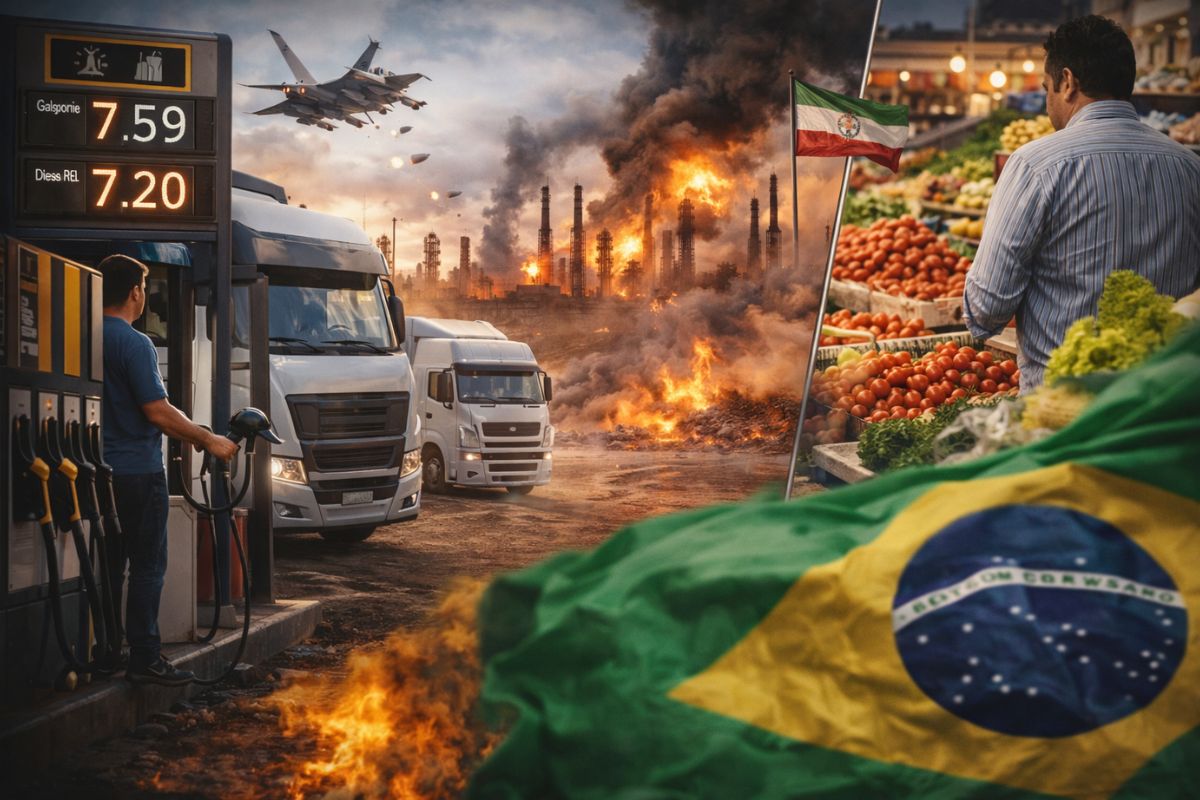
Even Without Gunfire on Brazilian Territory, a US Attack on Iran Could Trigger a Cascade Effect on the National Economy Through Oil, the Strait of Hormuz, Fertilizers, Exchange, and Freight, Impacting Fuels, Industry, and Food Across the Country, with Reflections on Families’ Budgets.
The cascade effect mentioned in the theme does not depend on a long war to start appearing. If there is a direct attack by the United States on Iran, the first impact tends to arise in the international energy market, with immediate pressure on oil prices and an increase in the so-called geopolitical risk premium, something that then spreads to transportation, production, and retail prices.
In Brazil, this movement reaches from large urban centers to small towns in the countryside. Geographical distance does not protect the consumer when the shock begins with fuel, freight, and agricultural inputs, because the Brazilian economy operates connected to maritime routes, global quotations, and supply chains that react quickly to crises in the Middle East.
The External Trigger That Could Start the Cascade Effect in Brazil
The base presented describes a deterioration in relations between the United States and Iran, with stalled negotiations, increased military movements, and assessments that a confrontation has become more plausible than a diplomatic solution. The hypothesis of a prolonged operation lasting weeks is also present, which increases the risk of miscalculation and regional escalation.
-
The next few hours will be marked by increasing tension regarding the stance to be adopted by the Central Bank’s Monetary Policy Committee (Copom/BC) concerning the benchmark interest rate (Selic) at the end of this Wednesday’s (17th) meeting. Although the market is ‘divided’ on the committee’s decision, the stronger trend in recent weeks is that the rate will remain unchanged at the current level of 14.50% per year. Meanwhile, a minority faction still ‘bets’ on a 0.25 percentage point (p.p) decrease.

-
Casa CazéTV transforms internet chat into a live event during the World Cup, targeting over 100,000 fans in São Paulo and Rio, and boosts a Brazilian experience company that expects to grow up to 60% with shows, big screens, activations, and Brazil’s games.

-
Guarulhos becomes the “Faria Lima of warehouses” with logistics square meter at R$ 37.11, more expensive than the São Paulo capital, while Shopee, Mercado Livre, Amazon, and billion-dollar funds compete for space near the largest airport in South America.
-
Amazon plans to invest more than R$ 1 billion to transform the Brazilian airport into a major cargo hub; the agreement with the city hall is expected to be signed by 2026 and could generate around 5,000 jobs.




In this scenario, the most sensitive point is the Strait of Hormuz. About one-fifth of the oil consumed globally transits through it, and any significant interruption in the route, even if temporary, exerts pressure on prices and expectations. When such a strategic area enters the war radar, the market reacts before any military outcome, because traders, insurers, and logistics operators start pricing risk immediately.
The base also mentions the Iranian announcement of temporary closures of sections of the route during live ammunition exercises and the bolstering of the US naval presence in the region. This helps explain why the debate has transitioned from being merely diplomatic to affecting economic calculations on a global scale.
The central point is that even an operation described as surgical can expand. Iran maintains retaliation capability and a network of allies on different fronts, transforming a bilateral conflict into a regional crisis with the potential to impact energy infrastructure, navigation routes, and market confidence.
How the Cascade Effect Reaches Diesel, Gasoline, and Freight in Brazil
Brazil is an oil producer, but this does not eliminate the transmission of external shocks to the domestic market. The base itself notes that pricing policies and reliance on imported derivatives mean that international price increases almost immediately make diesel and gasoline more expensive in the country.
This is where the cascade effect takes a concrete form for those who do not follow geopolitics. More expensive fuel increases the cost of road transportation, and road transport has a direct weight on the distribution of food, medicines, industrial goods, and daily-use merchandise throughout the national territory.
When diesel prices rise, freight costs rise, and this additional cost is passed along the chain. It first affects transport companies and logistics operators, then distributors, supermarkets, wholesalers, and small businesses. Finally, it reaches the end consumer, often without them associating the price increase locally with a crisis that started thousands of kilometers away.
This chain reaction also puts pressure on the industry. Higher energy and transportation costs increase production expenses and reduce margins, especially in sectors already dealing with long logistics. The cascade effect, therefore, is not a vague metaphor, but a relatively predictable economic sequence when there is a shock in oil and strategic routes.
Food, Fertilizers, and the Double Risk for Brazilian Agriculture
In agriculture, the impact can be double, as the base highlights. The first channel is that of fertilizers and inputs. Iran is mentioned as a relevant exporter of urea and other nitrogen-based fertilizers, and a blockade in the Strait of Hormuz or severe sanctions could hinder the flow of these products to international buyers, including Brazil.
If the arrival of these inputs is delayed, reduced, or made more expensive, the production cost of grains like soy and corn tends to rise. This point is crucial because it impacts the origin of the food supply chain, not just the transportation of the final product. The pressure begins in the fields and then spreads to feed, animal protein, processing, and food prices.
The second channel is commercial. The base indicates that Iran was the second main destination for Brazilian agribusiness in terms of volume in 2025, with US$ 2.9 billion in imports of products like corn, soy, and sugar. A war or economic collapse of the partner would affect revenues, sales planning, and profitability of exporting sectors.
This means that the cascade effect does not only operate through the side of internal inflation. It can also affect export flows, the trade balance, and the cash flow of production chains that depend on this market. In other words, the crisis can tighten costs on one side and reduce revenue on the other, amplifying stress on producers and trading companies.
Exchange, Global Fear, and Extra Pressure on Emerging Economies
In addition to oil and fertilizers, the base points out an important financial component. In large-scale geopolitical crises, the search for safer assets rises, such as gold and the dollar, a movement that tends to put pressure on currencies of emerging economies and increase exchange rate volatility.
For Brazil, this exacerbates the cascade effect because it makes imports more expensive and can increase costs in sectors that depend on foreign inputs priced in dollars. Even companies with no direct relationship to the Middle East feel the exchange rate pressure, especially when they are already facing higher freight costs and elevated interest rates.
The base also mentions supply chains still recovering from previous crises. This detail matters because successive crises reduce the ability to absorb shocks. A new rupture in energy and logistics does not hit a fully stabilized system, and this accelerates the transfer of costs and contractual insecurity.
In practical terms, those who pay first are usually those who have the least margin to wait. Low-income families feel the impact on fuel, gas, transportation, and food; small businesses feel it in stock replenishment and logistical costs; producers feel it in inputs and commercial uncertainty. The cascade effect spreads unevenly, but widely.
Where the Impact Appears First and Why the Reaction Needs to Be Quick

The first signs usually appear in commodity and currency markets, but the social reflection quickly shows up at gas stations and in distribution logistics. In a country of continental dimensions, with a strong reliance on road transportation, the pass-through of diesel to freight has a great capacity to contaminate prices in almost all regions.
That is why the interior of Brazil, mentioned in the theme, is not outside the reach of the crisis. Small towns depend on goods that travel long distances and arrive through chains sensitive to fuel costs. When the transportation base becomes more expensive, the local impact may be even more visible than in capitals with greater competition and supply.
The base also mentions emergency measures such as maintaining diplomatic channels and diversifying fertilizer suppliers. These responses do not eliminate the shock, but they can reduce vulnerabilities in times of international stress, especially when the risk is concentrated in a key maritime route like Hormuz.
The most important point is timing. If the market prices in risk before the military outcome, companies and producers also react early, revising purchases, schedules, and exchange exposure. The cascade effect starts with expectations and solidifies in pricing, which explains why an external crisis can impact daily life in Brazil even without a confirmed prolonged war.
A potential attack by the United States on Iran would not just be a distant international news item for Brazil. Due to the weight of oil, the Strait of Hormuz, fertilizers, exchange rates, and logistics, the country could face a cascade effect that presses diesel, gasoline, freight, and food in chain, with a direct impact on family budgets and production costs.
In your routine, what would be the first sign of this cascade effect that you would notice? Fuel, freight, market price, or work costs? And if you depend on transportation or rural production, which point today seems most vulnerable if the crisis in the Middle East escalates for real?







-

1 person reacted to this.