






 Portuguese
  Spanish
  5 min of reading
  4 comments


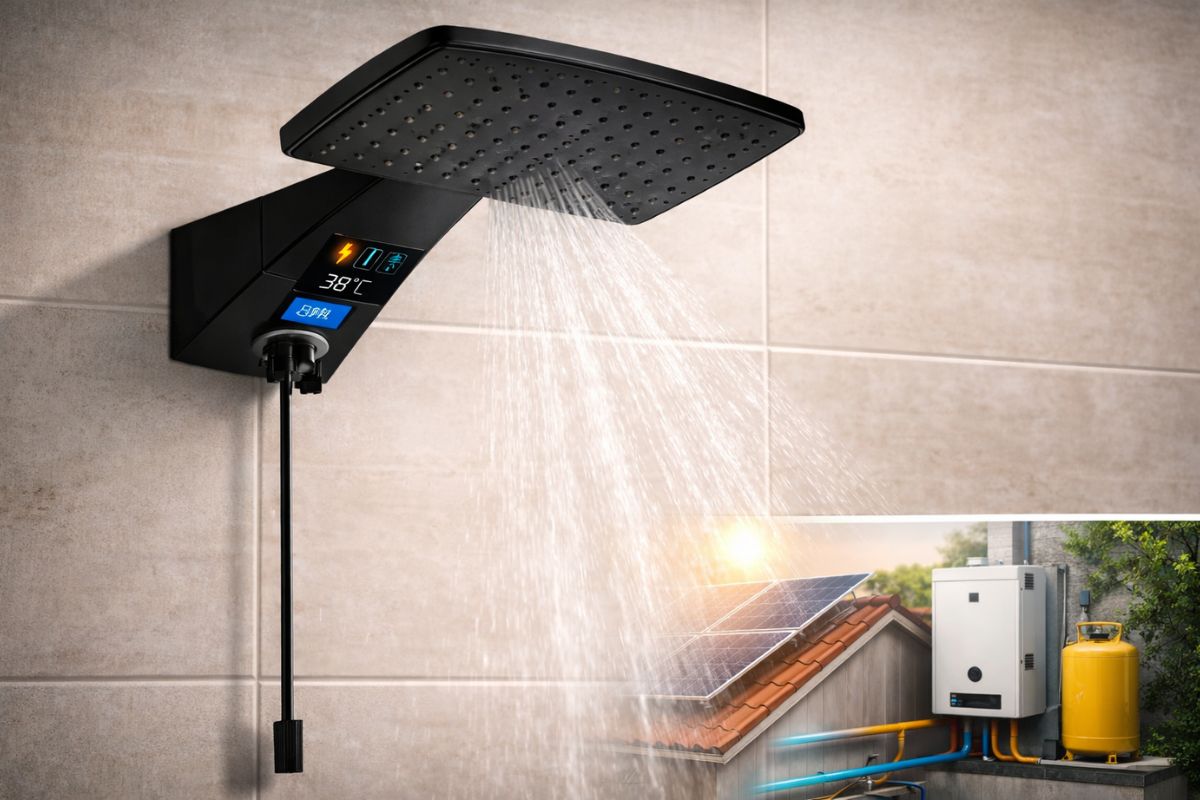


From Houses In Popular Neighborhoods To Apartments With Limited Heating, Brazilians Test Hybrid Showers To Relieve Their Energy Bills, Using Electricity On Start-up, Shifting To Gas And Activating Solar Energy When There Is Sun, With Automatic And Discreet Switching That Seeks A Constant Temperature And Less Waste Throughout The Shower.
The energy bill often weighs more than it seems because showering combines two expensive factors at the same time: high power and daily repetition. This is where the hybrid shower comes in as a promise of savings without “shortcuts,” automatically switching the heat source to maintain comfort with lower consumption.
Interest has grown because the hybrid shower doesn’t just sell a striking number. It sells predictability: water at steady temperature, less variation in the middle of a shower, and an attempt to reduce the dependence on electricity when other sources, such as gas and solar energy, can take over part of the heating.
When The Shower Becomes A System And Is No Longer Just A Resistance

In the regular electric shower, almost everything depends on a resistance heating water instantly.
-
Central Bank changes rule that lasted decades and allows dollar and euro accounts in Brazil for exporters and companies with foreign capital, eliminating the need for currency exchange in some transfers starting in October 2026.

-
The Central Bank ends the R$ 500 limit on Pix by approximation, and account holders will be able to use the general Pix limit to pay any amount by tapping their phone on the terminal starting in October 2026.
-
A collective political will that allows for the creation of a cross-party and state agenda, focusing on concrete actions such as reducing the Custo Brasil; commitment to fiscal balance; feasible goals that enhance professional qualification and the adoption of a myriad of incentives aimed at innovation.

-
PIX from BRICS becomes reality: BRICS Pay advances to enable international payments without the dollar; system inspired by Pix and based on blockchain could move up to 20% of global trade by 2030, while bloc countries already account for 40% of the world economy.




This is simple, but it can be aggressive on the energy bill, especially when the house concentrates showers at similar times and electricity becomes the only way to heat up quickly.
In the hybrid shower, the logic changes: the device starts to function like a small energy system, combining electricity, gas, and solar energy.
Instead of “forcing” just one path, it tries to choose what makes the most sense at each moment, with the goal of keeping the water steady and reducing the expenses that appear at the end of the month.
The Automatic Switching Between Electricity, Gas, And Solar Energy
The operation described for the hybrid shower usually starts with electricity, because the resistance heats up quickly and ensures immediate start-up.
The difference comes later: when the desired temperature is reached, the system switches to auxiliary sources, aiming to sustain the heat with lower electrical consumption.
This is where gas and solar energy come in. The switching can be automatic and almost imperceptible, especially when there is solar energy available.
The idea is simple in theory: use electricity to start, use gas to maintain, and take advantage of solar energy when the sun helps, reducing the load on the resistance and, consequently, the pressure on the energy bill.
The Promise Of Up To 74% And What Can Vary In Real Life
The reports circulating about the hybrid shower speak of reductions of up to 74% in the energy bill, and there are also references to savings of up to 70%.
It’s a range that catches attention, but it comes with a detail that determines the experience: savings depend on the usage profile and how regularly the household can activate gas and solar energy.
Based on available data, there are mentions of studies from the International Reference Center for Water Reuse (CIRRA), in partnership with the University of São Paulo (USP), indicating similar savings.
This helps to substantiate the efficiency talk, but it doesn’t turn the promise into a guaranteed value for every home: the savings that appear on the energy bill tend to be sensitive to habits, shower duration, and installation conditions.
The Initial Investment That Scares And The Return That Tries To Convince
The hybrid shower is described as more expensive than the traditional electric shower, mainly because it requires more complex technology and, in some cases, auxiliary systems.
This is where many people get stuck: the energy bill may drop, but the wallet feels it first, and not everyone can or wants to pay this initial “toll.”
The favorable argument is that the return comes in the medium term: with constant savings on the energy bill and a durability claimed to be superior, the equipment pays for itself over time.
In practice, what convinces is not the talk, but the monthly repetition of the smaller number, especially for families who shower every day and want to reduce spending without compromising comfort.
Constant Temperature, Less Waste, And The Environmental Aspect
The focus of the hybrid shower is not only on the energy bill. By maintaining a more stable temperature, it can reduce those continuous adjustments that make showers longer and waste water.
Less correction on the faucet, less time “to get it right,” more efficiency in daily use.
There is also an environmental component mentioned: by harnessing solar energy and reducing the weight of electricity in heating, the hybrid shower tends to decrease carbon emissions associated with energy consumption.
It’s a double savings, in the pocket and in impact, as long as gas and solar energy are actually available and well integrated into the real use of the home.
Without Breaking The Law, But With Installation And Routine Demands
A strong point that emerges is the idea of saving without cheating or breaking the law.
The hybrid shower, as described, doesn’t rely on improvised solutions to “trick” the energy bill; it tries to consume less electricity by using gas and solar energy as support, keeping the shower functional.
However, there is a practical limit: for the switching to work effectively, the installation needs to be suitable for the auxiliary systems and the home environment.
This is not a product that can be solved just by “swapping the shower”, because the promise depends on the integration between electricity, gas, and solar energy, as well as habits that keep the temperature stable without exceeding consumption.
What Changes In The Day-To-Day Of Those Who Adopt The Hybrid Shower
For those who adopt the hybrid shower, the central change is often the perception of stability: less variation in the middle of the shower and less feeling of a “spike” in spending.
When the system can alternate well, the shower becomes more predictable, and the energy bill tends to reflect this constancy throughout the month.
But the experience is not the same for everyone. Houses with good sun incidence, for example, have a better chance of frequently utilizing solar energy; on the other hand, residences without this condition may rely more on electricity and gas, which alters how much the energy bill actually drops.
The promise is great, but the result lies in the details of the house and the routine.
The hybrid shower has become a topic of discussion because it touches on a sensitive point: the energy bill.
It promises high savings by combining electricity, gas, and solar energy, maintaining stable water and reducing electrical consumption, but it requires an initial investment and an installation that needs to meet the proposal.
If you had to choose coldly, what would weigh more in your decision about the energy bill: investing in a hybrid shower now or continuing with the regular electric shower and accepting the monthly cost? In your home, is there enough gas or solar energy for this switching to truly make a difference in your shower?




Baratear e diminuir a conta de energia e so RETIRAR O MONTE DE IMPOSTOS COBRADOS E SO VERIFICAR NA NOTA , A METADE DA CONTA E IMPOSTO, PARA BANCAR A GASTANCA DESSES NOSSOS MARAVILHOSOS GOVERNANTES, A METADE, NAO E NARRATIVA E SO VERIFICAR.
Desligar a energia do chuveiro é simples e barato. Comutar a origem da água do chuveiro não é! Por mais que a canalização alternativa tenha isolamento térmico, a água parada no cano esfriará, não estará na mesma temperatura da água aquecida eletricamente. O desperdício de água será igual ao uso de simples aquecedores a gás ou solares acoplados em um chuveiro elétrico comum porém desligado. Não se justifica um gasto extra com um aparelho cuja única utilidade é desligar o chuveiro elétrico quando possível. Tomar banhos frescos no calor também economiza energia e tem custo zero de instalação.
Excelente ideia 💡.