Portuguese
  Spanish


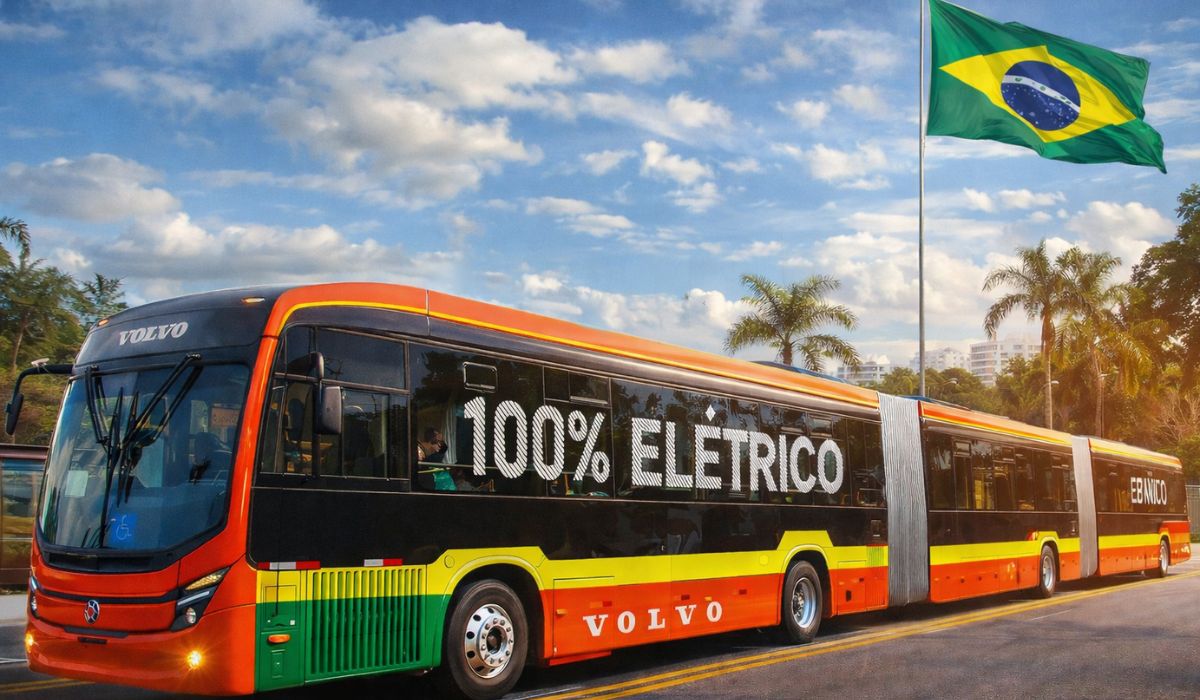

Urban mobility project places large vehicles at the center of a technological change that blends electrification, engineering, and daily operation in a high-demand corridor, with direct impact on how cities view public transport.
Goiânia has begun operating articulated and bi-articulated electric buses on the East-West BRT corridor, in a project that has placed the capital of Goiás among Brazilian cities adopting high-capacity vehicles with zero local emissions of pollutants.
The operation includes 21 units of the Volvo BZRT model, consisting of 16 articulated and 5 bi-articulated buses.
Large electric buses in Goiânia
The vehicles draw attention for their size and the role they play in the system.
-
The large jar blender has a rival: Oster Ultra Power bets on 1,000 W, six stainless steel blades, and two portable cups with leak-proof lids.

-
Tesla injected an additional $250 million into the German factory, doubled the battery cell target, and opened its own production line for startups.

-
No more TV stuck on the wall: Samsung The Freestyle+, the new projector with over 400 lumens projects on walls, floors, and ceilings, bringing cinema to any corner of the house.
-
A Japanese governor single-handedly stalled the construction of the world’s fastest train for nine years, and only now has he agreed to allow a tunnel excavated at a depth of 1,400 meters.



The bi-articulated buses are 28 meters long and can carry up to 250 passengers.
The articulated buses reach 21 meters and can transport up to 180 people.
In structured corridors, this type of bus is used to serve lines with high demand and reduce the need for fleet expansion to offer the same number of seats.
The main feature of the project is the combination of electrification and operation in large vehicles.
Electric buses are already in operation in different cities, but the regular use of bi-articulated models is still less common.
For this reason, Volvo presented Goiânia as the first city to regularly put a fleet of electric bi-articulated buses from the brand into public transport service.
In practice, the bi-articulated bus occupies a specific space within the logic of urban transport.
It is designed to carry a large volume of passengers in exclusive or segregated corridors, operating similarly to medium-capacity systems.
This format is already known in Latin American cities and, in the case of Goiânia, has become associated with electric propulsion.
The buses used in the operation are equipped with two electric motors of 200 kW each, totaling 400 kW of power, equivalent to 540 hp.
In the bi-articulated buses, the system can operate with up to eight batteries, with a total capacity of 720 kWh.
The motor was installed in the central part, below the floor, while the batteries are also located in the lower part of the vehicle.
According to the manufacturer, this configuration aims to better distribute the weight and preserve the internal space allocated for passengers.
“`html
How vehicles in circulation work
In buses of this size, the onboard systems play a central role in the operation.
The models delivered for Goiânia include cameras to expand the driver’s field of vision, front and side sensors to monitor blind spots, and traffic sign recognition features.
Additionally, the vehicles are equipped with the Volvo Dynamic Steering system, aimed at assisting maneuvers and enhancing stability.
There is also preparation for activating a feature called “Safety Zones,” which uses GPS to automatically reduce speed in areas considered more sensitive, such as regions near terminals, schools, and hospitals.
The buses were also equipped with doors on both sides and air conditioning.
These features meet the operational standards of BRT corridors, which require boarding compatible with platforms and integration with stations along the route.
Another relevant point is the operational silence.
Since there is no combustion engine, circulation tends to generate less noise, especially during starts and stops.
This effect is often cited in urban transport electrification projects, alongside the elimination of local emissions from exhaust.
BRT East-West and the operation in Greater Goiânia
The adoption of the new vehicles occurred in an already structured system.
The BRT of the metropolitan region of Goiânia is pointed out by Volvo as one of the most traditional in the country, originating in the 1970s.
In recent years, the East-West corridor has undergone revitalization works and gradual fleet renewal.
In August 2025, the government of Goiás announced the entry into circulation of new buses in the East-West BRT and confirmed the incorporation of the electric bi-articulated buses manufactured by Volvo.
At that time, the project was presented as part of a broader modernization process of the network, with plans for the use of electric vehicles, biomethane, and Euro VI standards.
Later, in February 2026, Volvo announced the start of regular operation of the electric fleet and the inauguration of the Eletroposto Oeste, a charging structure installed at the Metrobus garage.
According to the manufacturer, the location has 23 chargers of 240 kW, with the capacity to serve up to 46 buses simultaneously.
“`This data helps to size the infrastructure needed for the electrification of lines with high demand.
The change involves not only the arrival of the vehicles.
It also depends on garage adaptation, installation of charging points, operational planning, and adjustment of the system to the routine of electric refueling.
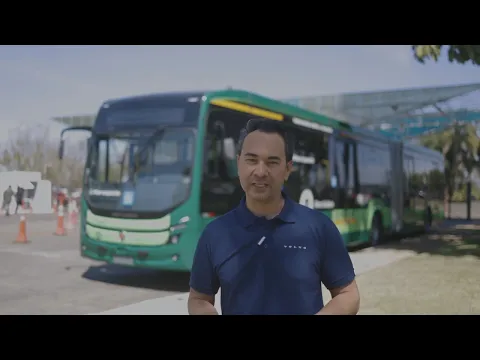

Public transport, electrification, and infrastructure
The operation in Goiânia is part of a broader agenda for energy transition in public transport.
In corridors with high passenger flow, larger vehicles can increase service capacity without altering the basic logic of the system.
When this operation is carried out with electric buses, the replacement of the propulsion system also becomes part of the mobility policy.
In the case of Goiânia, the project was structured in partnership with GreenMob Capital, a company linked to the HP Group.
The sale was closed by Sweden Vehicles, a Volvo dealership in part of the Midwest and Southeast, with support from Volvo Financial Services for the credit to acquire the chassis.
When announcing the deal, the president of Volvo Buses in Latin America, André Marques, stated that the adoption of the vehicles represented an important step towards the decarbonization of public transport in Goiânia.
In the same vein, Paulo Arabian, responsible for sales at the manufacturer in Brazil, said that the city would be the first in the world to regularly operate Volvo electric bi-articulated buses and highlighted that the vehicles would be among the largest electric buses in daily operation.
The entry of the fleet into circulation placed Goiânia in a technological showcase within the sector.
The project includes 28-meter vehicles, active safety systems, dedicated charging infrastructure, and operation in an exclusive corridor.

These elements have come to be seen as part of a concrete experience of electrification in a high-capacity system.
At the same time, the case shows that the electrification of buses is not limited to smaller vehicles or experimental operations.
In Goiânia, the proposal was applied in a well-established public transport axis, with daily use and integration into a metropolitan network.
This increases interest in the adopted model and the possibility of replication in other urban systems.
Although each city has its own conditions of infrastructure, financing, and demand, the use of articulated and bi-articulated electric buses in Goiânia has become a reference for operational practices in Brazilian public transport.
The project combines industrial, logistical, and urban dimensions in a single operation, without relying on a change in the basic logic of BRT.
In this context, the Goiânia case also draws attention for bridging vehicle engineering and urban routine.
The buses do not function merely as a technological novelty.
They are part of a daily operation aimed at transporting thousands of passengers in a mass transport corridor.
From this regular use, the fleet’s performance tends to be observed as a concrete indicator of the viability of similar projects in other cities.