






 Portuguese
  Spanish
  5 min of reading
  0 comments


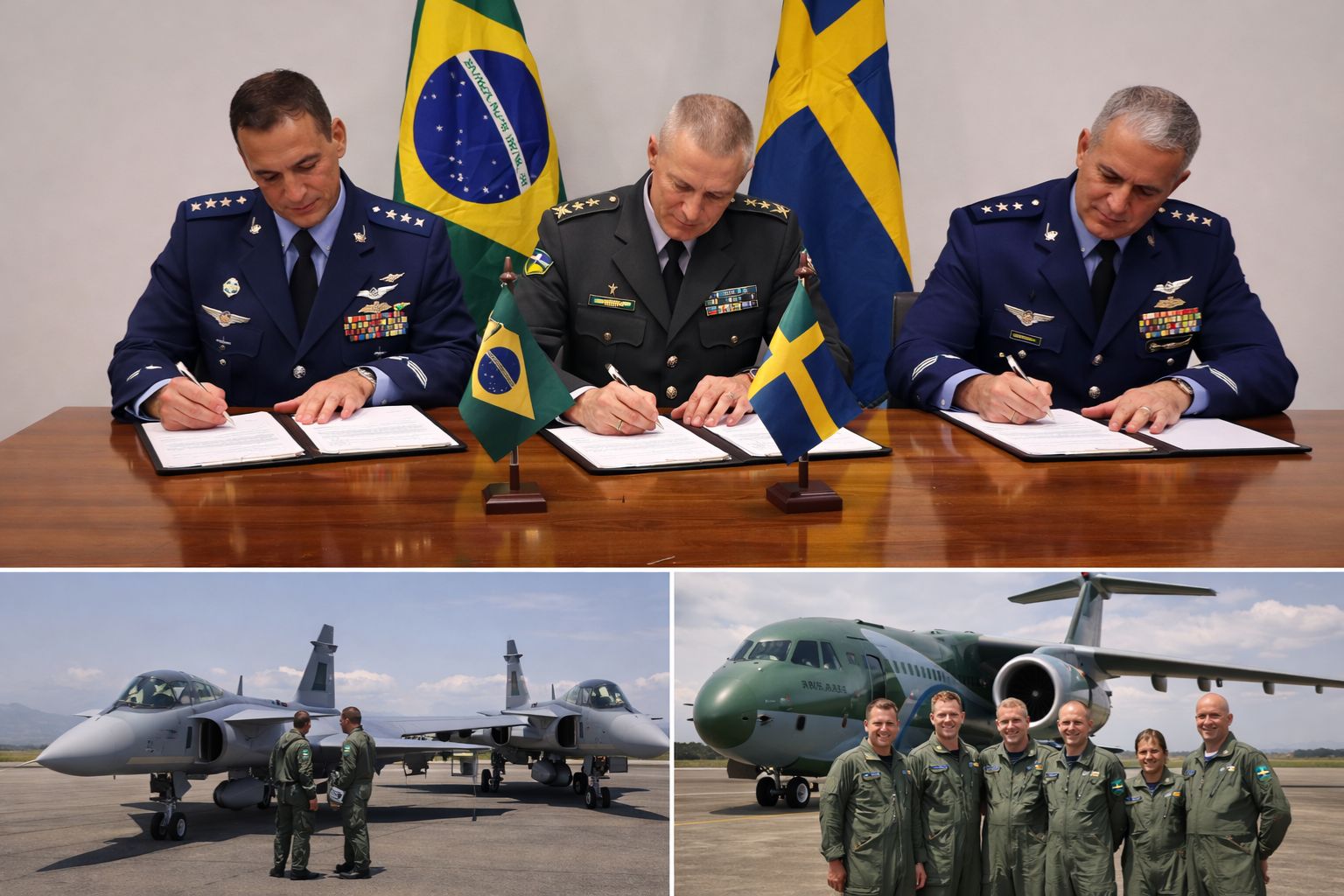
The Brazilian Air Force and the Swedish Air Force signed a military cooperation agreement during the III Staff Talks in Brasília. The meeting defined actions for the next two years, including joint pilot training, knowledge exchange on Gripen fighter logistics, and training of Swedish crews of the KC-390 at Brazilian bases.
Brazil and Sweden have just consolidated a military agreement that brings together two air forces that share the same aircraft but operate in radically different contexts. The Brazilian Air Force (FAB) and the Swedish Air Force (SwAF) met on April 9 in Brasília for the III Staff Talks, a meeting organized by the Aeronautics Command (EMAER) that defined military cooperation actions for the next two years. The agreement includes pilot training, knowledge exchange on the logistics of the F-39 Gripen fighter, training of Swedish crews of the KC-390 on Brazilian soil, and participation in joint exercises, leveraging the capabilities and particularities of each air force.
What makes this military agreement particularly relevant is what each country brings to the table. Sweden has operated the Gripen for decades in a European theater marked by tensions with Russia and the recent NATO accession, giving it operational experience in real conflict scenarios that Brazil does not possess. On the other hand, the FAB has accumulated experience in the successful deployment of both the Gripen and the KC-390, a military cargo aircraft manufactured by Embraer that Sweden recently acquired. The military agreement recognizes that each air force has something to teach and something to learn.
What the military agreement between Brazil and Sweden provides in practice

The actions defined during the III Staff Talks cover four fronts of military cooperation. The first is pilot training, which will allow Brazilian and Swedish aviators to fly together and share combat techniques, navigation, and tactical employment of the Gripen in conditions that each country faces in its own airspace. For Brazilian pilots, the opportunity to absorb experiences from an air force operating in the vicinity of active conflicts is a gain that no simulator can replicate.
-
Survivor of 1966 SS Daniel J. Morrell Shipwreck in Lake Huron Recounts 38-Hour Ordeal in Extreme Cold

-
The Greatest Hoax in World Cup History? The Film That Denied Brazil’s 1958 Victory and Exposed How Fake Evidence Can Seem Convincing on TV
-
Fake South Korean Online Stores Offer Shopping Thrill Without Spending Money or Receiving Products
-
The War of Jenkins’ Ear: How a Severed Ear Sparked One of the 18th Century’s Most Unusual Conflicts


The second front is the exchange of knowledge about the logistics of the F-39 Gripen, including maintenance, supply chain, and parts management. The third action outlined in the military agreement is the training of Swedish crews on the KC-390 at Brazilian bases, where the FAB has been operating the cargo aircraft for years and has accumulated experience that Sweden is just beginning to build. The fourth front is participation in joint exercises, which allow testing interoperability between the two forces in simulated combined operation scenarios.
Why Sweden wants to train in Brazil according to the military agreement
Colonel Mats Antonson, Chief of Staff of the Swedish Air Force, was straightforward about what motivates his country’s interest. “This is an opportunity to learn, mainly from the competence in operating the KC-390, which has been a goal to be achieved by the Swedish Air Force”, he stated during the meeting in Brasília. Sweden recently acquired the KC-390 and is still in the process of integrating the aircraft into its operations, while the FAB already has years of operational experience with the military cargo aircraft.
The Swedish interest in the military agreement goes beyond the KC-390. The FAB carried out a deployment of the Gripen that Brigadier Eduardo de Carvalho Guimarães described as “successful”, and the Brazilian experience in adapting the aircraft to operate in a continental territory, with diverse weather conditions and varied airport infrastructure, offers lessons that Sweden can apply in its own processes. Each air force has operated the same aircraft in different contexts, and the military agreement creates a formal channel for these experiences to be shared.
What Brazil gains from this military agreement with Sweden
Brigadier Eduardo de Carvalho Guimarães highlighted that Sweden is “an important operator of the Gripen aircraft, with great logistical and operational experiences,” and that this approach “brings mutual benefits between the Forces.” For Brazil, the main gain from the military agreement is access to operational experiences of the Gripen in a context that the FAB does not experience: the European theater, where Sweden operates in proximity to Russia and participates in NATO exercises with air forces from dozens of countries.
The Brigadier specifically mentioned the Mission Support Elements (MSE), mission planning support technicians who concentrate skills acquired in the current European scenario. “This can provide a very beneficial exchange for Brazilian pilots”, he stated, acknowledging that certain military competencies are only fully developed when tested in real tension environments. The military agreement allows the FAB to absorb these capabilities without needing to send troops to conflict zones, a significant strategic gain for an air force that predominantly operates in patrol and territorial defense missions.
The role of the Gripen and the KC-390 in the military approach between the two countries
The aircraft are the link that connects Brazil and Sweden in this military agreement. The F-39 Gripen, manufactured by the Swedish Saab, is the multifunctional fighter that both air forces operate, and the exchange of experiences regarding maintenance, tactical employment, and logistics benefits both sides by expanding the knowledge base available to each operator. The more countries operate the same aircraft and share data, the better each can employ it.
The KC-390, manufactured by the Brazilian Embraer, reverses the equation. In this case, it is Brazil that holds the expertise as a pioneering operator, and Sweden that seeks to learn. The military agreement provides for Swedish crews to train at Brazilian bases, where the FAB can demonstrate operational procedures, loading techniques, in-flight refueling, and operations on unpaved runways—capabilities that the KC-390 was designed to offer and that the FAB has already extensively tested in national territory and in international missions.
What the military agreement represents for the future of relations between Brazil and Sweden
The III Staff Talks is the third edition of the meeting, indicating that military cooperation between Brazil and Sweden is not a one-time event, but a process under construction. The meeting consolidates the rapprochement between the Air Forces and opens perspectives for bilateral cooperation that go beyond the immediately agreed biennium, including possible joint participation in peace operations, multilateral exercises, and joint development of doctrine for shared aircraft.
For Brazil, which seeks to modernize its Armed Forces and expand strategic partnerships outside the traditional axis with the United States, the military agreement with Sweden reinforces a relationship that has already yielded concrete results in the acquisition of the Gripen and the export of the KC-390. For Sweden, newly integrated into NATO and seeking to diversify its partnerships beyond Europe, Brazil offers a partner with operational experience in a different hemisphere and with defense needs that test the aircraft in unique conditions.
Brazil and Sweden have signed a military agreement to train pilots and share experiences with the Gripen and KC-390. Do you think partnerships like this strengthen Brazilian defense? Leave your opinion in the comments.





Be the first to react!