Portuguese
  Spanish


Air-to-air missile of up to 1,850 km is studied by the US Air Force in a modular program aimed at distant targets in the Indo-Pacific.
The United States Air Force has initiated a project aimed at creating an air-to-air missile with an estimated range of up to 1,850 kilometers, a level not yet seen in such armaments. Named the Air Force Long Range Weapon (AFLRW), the program’s initial focus is on targeting aircraft operating far from the direct combat zone, with special attention to the strategic scenario of the Indo-Pacific.
According to a report by the site Poder Aéreo on July 2, the Air Force Life Cycle Management Center, through its Armament Directorate, announced a restricted meeting for defense industry representatives. The meeting is scheduled for August 25 and 26 and will take place at the Guided Weapons Evaluation Facility, located at Eglin Air Force Base in Florida.
Due to the confidential nature of the discussions, the event will be conducted under Secret classification, making it mandatory for all participants to present compatible security credentials.
-
Australia to Deploy Up to 8 Nuclear-Powered Submarines in Indo-Pacific, Establishes Billion-Dollar Naval Chain Through AUKUS, Joining Elite Group Capable of Extended Underwater Missions

-
Indonesia Begins Construction of 2,000-Ton Scorpène Stealth Submarines with Advanced Weaponry and French Steel

-
Brazil’s Largest Navy Ship, NAM Atlântico, Transforms into Field Hospital During National Crises

-
Brazilian Navy Demonstrates Strength in Naval Exercise with Over 20 Nations, Deploys Frigate Independência in Anti-Submarine and Air Defense Scenarios, and Joins Historic Formation with 26 Ships from 14 Allied Navies off the U.S. Coast



The armament is still under development. To operate at the proposed distance, it will depend not only on the missile’s performance but also on a network formed by sensors, satellites, command and control systems, and data links capable of locating and tracking the target.
Air-to-air missile will have modular and open architecture
The AFLRW is expected to be built from an open architecture, allowing the integration of different components and subsystems.
The proposal is to develop a modular platform, where parts of the armament can be incorporated or altered without necessarily requiring the creation of a completely new system.
This structure may involve propulsion, guidance, communication, sensors, and flight control elements gathered in a single missile.
The program includes two main applications:
- air-to-air version, aimed at combat against aircraft;
- air-to-surface version, intended for targets located at sea or on land.
The initial priority is on the air-to-air missile, which should be developed before the other planned configurations.
Range of 1,850 km depends on external sensors
The predicted distance exceeds the normal capacity of a launching aircraft to locate and track a target on its own.
For this reason, the kinematic range of the weapon will need to be supported by an external detection and communication infrastructure.
In practice, the aircraft firing the missile will not necessarily need to maintain direct contact with the target throughout the journey. Data sent by other platforms can update the trajectory and guide the system during the flight.
Structure planned to support the weaponry
- satellites;
- sensors installed on different platforms;
- command and control systems;
- data links;
- long-range surveillance means;
- platforms capable of tracking the target after launch.
Without this network, an air-to-air missile with a range of 1,850 kilometers could travel a distance beyond the detection capability of the aircraft that fired it.
Air-to-air missile targets support aircraft far from the front line
The strategic purpose of the project is linked to the possibility of attacking aircraft that perform essential functions without operating directly in the combat zone.
Possible targets include early warning aircraft, tanker aircraft, bombers, and command and control platforms.
These means usually remain away from the most advanced defenses and adversary fighters, but they perform important functions for the sustainment of air operations.
Early warning aircraft enhance surveillance capability, while tanker aircraft allow fighters and bombers to remain on mission longer.
Command and control platforms, in turn, help coordinate different forces and distribute information during an operation.
By reaching these targets at great distances, the United States would seek to reduce the need to bring its own aircraft closer to Chinese anti-aircraft defenses.
Program integrates long-range attack chain
The concept associated with the AFLRW is called the long-range kill chain, an expression used to describe an attack chain over great distances.
This model does not rely on a single piece of equipment. It brings together systems capable of detecting, identifying, tracking, and hitting a target located far from the launch platform.
The process may involve:
- initial location of the aircraft;
- confirmation and identification of the target;
- transmission of the coordinates;
- launching of the weaponry;
- data update during the flight;
- approach and attack on the target.
The air-to-air missile would be just a part of this structure. Its use would depend on continuous communication between different sensors and platforms.
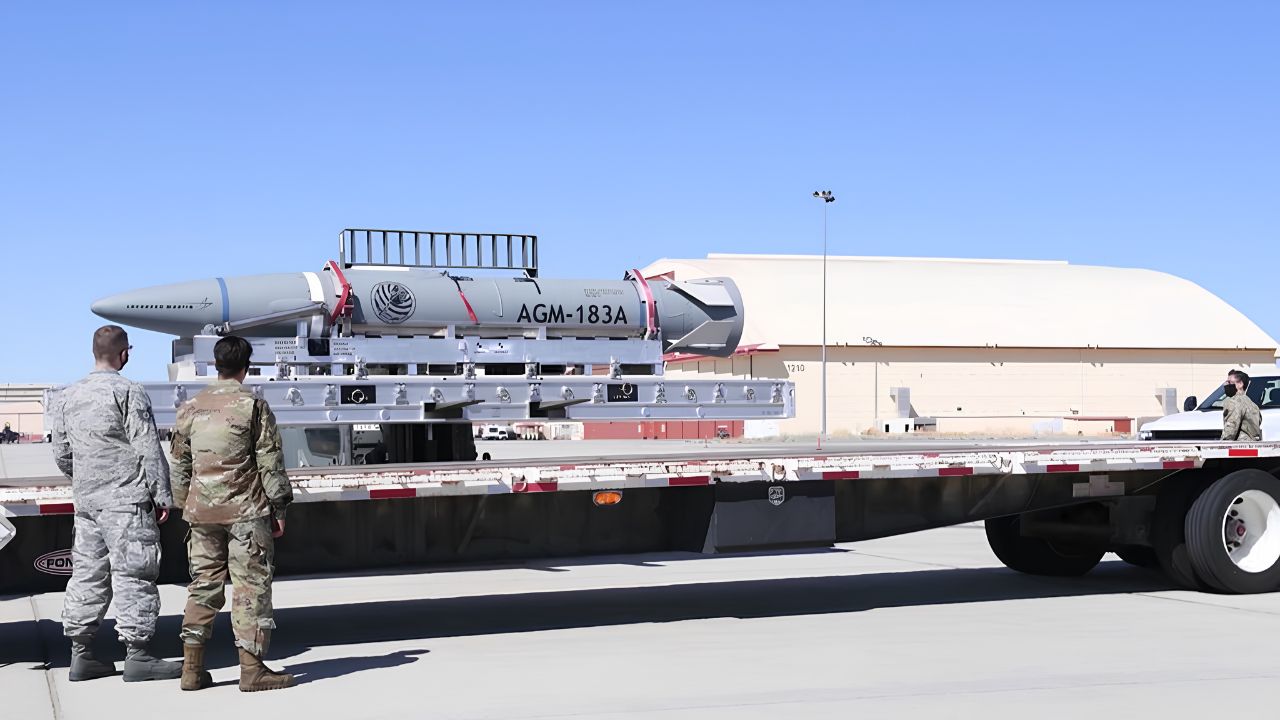
B-21 Raider can act as the weapon carrier
The stealth bomber B-21 Raider appears as one of the platforms considered suitable for carrying this type of missile.
In this scenario, the aircraft could function as a “missile truck,” carrying several long-range weapons on missions conducted over great distances.
The role would be different from that normally associated with an air superiority fighter. Instead of approaching to locate and directly engage the adversary, the bomber could launch the missiles based on data provided by the external network.
The stealth capability of the B-21 would also allow the platform to operate with less exposure, although the concept presented prioritizes precisely the attack from areas distant from adversary defenses.
Air-to-air missile would expand the range dispute
The United States and China already have weapons developed to hit aircraft at distances greater than conventional missiles.
The United States Navy operates the AIM-174B, derived from the SM-6 system, with a reported range of approximately 400 kilometers.
China has the PL-15, whose estimated distance exceeds 250 kilometers.
The expected range for the AFLRW would be considerably greater than that attributed to the two systems.
Comparison of the presented ranges
- AFLRW: up to 1,850 km, in development;
- AIM-174B: about 400 km;
- PL-15: more than 250 km, according to estimates.
The numbers do not indicate that the systems have the same dimensions, launch platforms, or operational conditions. The comparison only shows the difference between the mentioned ranges for each weapon.
Project may push away adversary support aircraft
The existence of a weapon with a range superior to current systems could change the position of aircraft operating in the rear.
Tanker aircraft, early warning platforms, and airborne command centers might need to remain even further away to reduce their exposure.
This retreat would have effects on the rest of the operation. Fighters that rely on aerial refueling, for example, could face limitations if tankers were forced to operate further away.
The same could happen with aircraft receiving information from surveillance and command platforms.
The air-to-air missile proposal is, therefore, related not only to the destruction of a specific target but also to the possibility of affecting the network that supports adversary air operations.
Air-to-surface version is also planned
Although the program initially prioritizes aerial targets, the AFLRW is expected to originate a variant for attacks against surface-located objectives.
This configuration could expand the system’s use for missions against land or naval targets.
The modular architecture planned for the project may facilitate the integration of different components according to the mission.
The presented information, however, does not detail the range, payload, or specific schedule of the air-to-surface variant.
The initial development remains focused on the air-to-air version and its integration with the long-range attack chain.
Capability still depends on program development
The range of up to 1,850 kilometers represents a project goal and not an operational capability already incorporated into the U.S. Air Force.
For the system to achieve the expected performance, it will be necessary to develop and integrate different technologies.
Besides propulsion capable of sustaining flight, the weapon will need to receive updated information about a target that may change position during the course.
It will also be necessary to ensure communication between the missile, external sensors, and the centers responsible for monitoring the mission.
The program conducted by the USAF seeks to bring together these capabilities in a modular air-to-air missile, initially aimed at the Western Pacific scenario and the attack of support aircraft kept away from the front line.
Source: CanalTech