






 Portuguese
  Spanish
  6 min of reading
  0 comments


In 2003, Hélio da Silva planted 200 seedlings in a degraded floodplain in the East Zone of São Paulo, and they destroyed everything. He persisted, planted more, and didn’t stop. Twenty-one years later, there are more than 40,000 trees and an urban Atlantic Forest in the Tiquatira Linear Park.
In the middle of Brazil’s largest concrete jungle, a man decided to create a forest with his own hands. Hélio da Silva started in 2003, planting 200 seedlings in an abandoned floodplain on the banks of the Tiquatira River, in the East Zone of São Paulo. The first trees were destroyed within days, but he didn’t put down the shovel. The result of this persistence, according to the Jornal O São Paulo, is today an urban forest that no one imagined possible there.
The turnaround is in the plot. Each time they uprooted what he had planted, Hélio da Silva returned and planted more. It took two decades of persistence against vandalism, neglect, and concrete, until the area became the Tiquatira Linear Park, a living piece of Atlantic Forest embedded in the city. The story proves that planting trees, done with obsession, can change the landscape of an entire neighborhood.
Planted 200 seedlings, they destroyed everything, and he planted more
Hélio da Silva bought 200 trees, spending about R$ 800 of his own money, and saw everything destroyed in just 15 days, according to Jornal O São Paulo. For many, it would be the end. For him, it was just the first round.
-
11-Year-Old Brazilian Prodigy Develops New Math Formula, Seeks Publication in Leading Scientific Journal

-
They promised wealth with Sigma Lithium’s lithium mining, but the Jequitinhonha Valley got cracked houses, skyrocketing rent, and R$ 0 in royalties in 2025.
-
Brazilian creates ingenious hack with bus air conditioner water and transforms invisible dripping into savings of millions of liters; Capixaba system reuses condensation on the windshield, supplies the toilet on long trips, and has become a practice in Águia Branca’s fleet.
-
An 11-year-old boy left home with two cousins to sell popcorn for R$ 5, became an entrepreneur at 15, sells 100 buckets a day, and uses the profit to pay the entire family working in the business.



Then came another 400 seedlings, also vandalized after a month. It was then that Hélio da Silva made the decision that would change the East Zone: instead of giving up, he decided to plant trees on a scale that no one could ignore, aiming for 5,000 seedlings. It took about five years to get there, and in 2008 the site was officially recognized by the São Paulo City Hall.
This initial phase is the heart of the story because it shows that the urban forest was not born from a billion-dollar project or a large company. It was born from the persistence of a man who refused to accept the “no” of vandalism. Each new batch of seedlings was a concrete response to those who had uprooted the previous ones, and that’s how the Tiquatira Linear Park began to take shape.
40,316 trees and an urban forest of Atlantic Forest
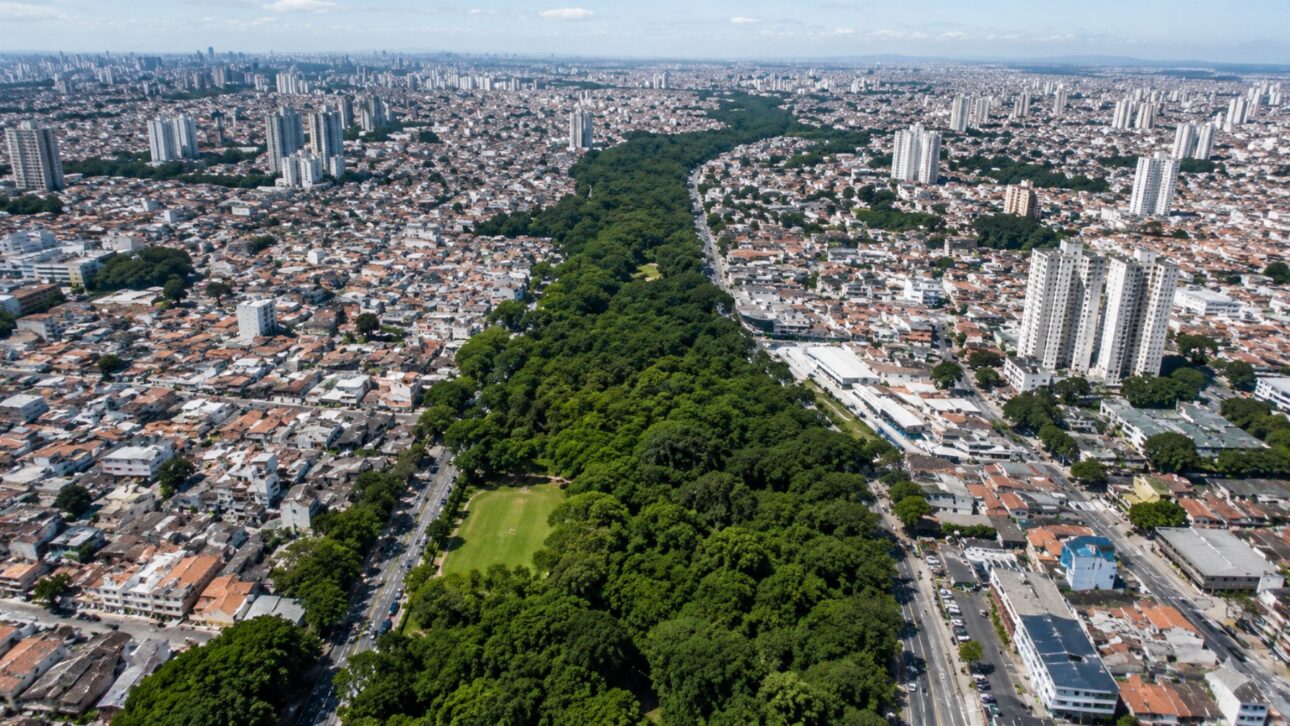
Today’s numbers are impressive precisely because they stemmed from an individual effort. Over 21 years, Hélio da Silva has planted 40,316 trees, according to Jornal O São Paulo, transforming the rubble into a true urban forest. It’s not a decorative garden; it’s a real forest, with canopy, shade, and wildlife.
The biodiversity tells the size of the achievement. The Tiquatira Linear Park gathers more than 160 species of trees, most of them typical of the Atlantic Forest, including over 100 brazilwood trees, more than 2,500 trumpet trees, and over a thousand araucarias and jequitibas, according to Jornal O São Paulo. Where there was once trash, there is now a living catalog of the country’s most threatened biome.
The fauna responded to the invitation. There are already 45 species of birds cataloged in the park, proof that the urban forest has become a functional ecosystem, not just a cluster of trees. And the pace hasn’t stopped: Hélio da Silva continues planting about 180 seedlings per month, keeping alive the routine of planting trees that started long ago.
From abandoned stream to São Paulo’s first linear park
The starting scenario was the opposite of a park. The area was located on the banks of the Tiquatira River, in Penha, filled with rubble and neglect, the portrait of degradation that spreads across urban floodplains. It was on this unlikely ground that the Atlantic Forest began to sprout again, seedling by seedling.
Over time, the work gained official recognition. The Tiquatira Linear Park is considered the first linear park in the city of São Paulo, according to the report by Metrópoles, with about 3 kilometers in length and 192 thousand square meters. A green corridor that today serves as leisure, shade, and refuge for those living in the most populous region of the capital.
The transformation is radical when you think about the contrast. On one side, the urban forest that Hélio da Silva built; on the other, the endless gray of the metropolis. The Tiquatira Linear Park shows, in practice, that it is possible to return pieces of the Atlantic Forest to the city, as long as someone is willing to plant trees every day, without waiting for permission.
“I’m not an executive, I became a tree planter”


Behind the 40,000 trees lies a life choice. Hélio da Silva left the corporate world to dedicate himself to the park, and he makes a point of marking this turning point. “I’m not an executive, there I was,” he told Metrópoles, making it clear that his identity is now different, that of someone who cares for the land.
His relationship with the park borders on family affection. “It’s about caring for nature and these dear ones, which ease the heat, control the climate, provide shade,” said Hélio da Silva to Metrópoles, speaking of the trees as if he were talking about daughters. It’s not abstract environmental discourse, it’s the attachment of someone who saw each sapling grow and still pays out of his own pocket the cost of planting trees, which ranges from R$ 4 to R$ 8 per unit.
And the commitment is until the end. “Until my last breath, I will be here,” he assured Metrópoles, before summarizing the legacy in a phrase that became a trademark: “I will never die, I will become a tree.” The declared goal is to reach 50,000 trees planted, further expanding the urban forest of Parque Linear Tiquatira.
Why an urban forest changes the life of São Paulo
Hélio da Silva’s achievement goes far beyond the beautiful. In a city that suffers from heat islands, floods, and heavy air, an urban forest acts as a natural air conditioner, a sponge for rain, and a filter for pollution. Each tree planted in the East Zone is a concrete relief for those living nearby.
There is also the ecological value of bringing back the Atlantic Forest, the biome that once covered much of the Brazilian coast and now remains in fragments. By gathering more than 160 native species in one place, the Parque Linear Tiquatira becomes a living genetic bank and a corridor for fauna, the kind of function usually expected of a reserve, not a neighborhood park.
And perhaps the most powerful effect is the example. The story of a man who decided to plant trees alone, and continued even when his work was destroyed, shows that environmental recovery does not depend solely on the government or large companies. The urban forest of Tiquatira is proof that a stubborn person, with a shovel, a sapling, and a purpose, can also change the climate of their own backyard.
Hélio da Silva took a wasteland of trash and returned to the city an urban forest of more than 40,000 trees, in a gesture that lasted more than two decades and resisted every attempt at destruction. The Parque Linear Tiquatira is today the living proof that planting trees, with stubbornness and love, transforms the concrete jungle into Atlantic Forest, and a common man into a legend of the East Zone of São Paulo.
And you, do you know any little corner of your city that could become an urban forest if someone started planting trees today? Share in the comments if Hélio’s story made you want to plant the first seedling.


Be the first to react!