






 Portuguese
  Spanish
  6 min of reading
  0 comments


Lithium mining was sold as the El Dorado that would lift the Jequitinhonha Valley out of poverty. But in Araçuaí and Itinga, in Minas Gerais, residents live with houses cracked by Sigma Lithium’s detonations, with the cost of living soaring and the promised wealth that simply doesn’t arrive.
Lithium was sold as the salvation of Brazil’s poorest region, but what many families in the Jequitinhonha Valley received were cracked walls and fear of the ceiling collapsing. In December 2025, a report by Agência Pública showed that lithium mining in the municipalities of Araçuaí and Itinga, in Minas Gerais, left a trail of cracked houses, dust, and unfulfilled promises.
The turnaround is cruel. The ore that supplies batteries worldwide, a symbol of clean energy transition, has become synonymous with loss for those living next to the mine. While Sigma Lithium, the largest lithium producer in the country, exports the metal, the mine’s neighbors report cracks, illnesses, and a cost of living that drives the poorest from their own land.
Cracked houses and the fear of the ceiling collapsing
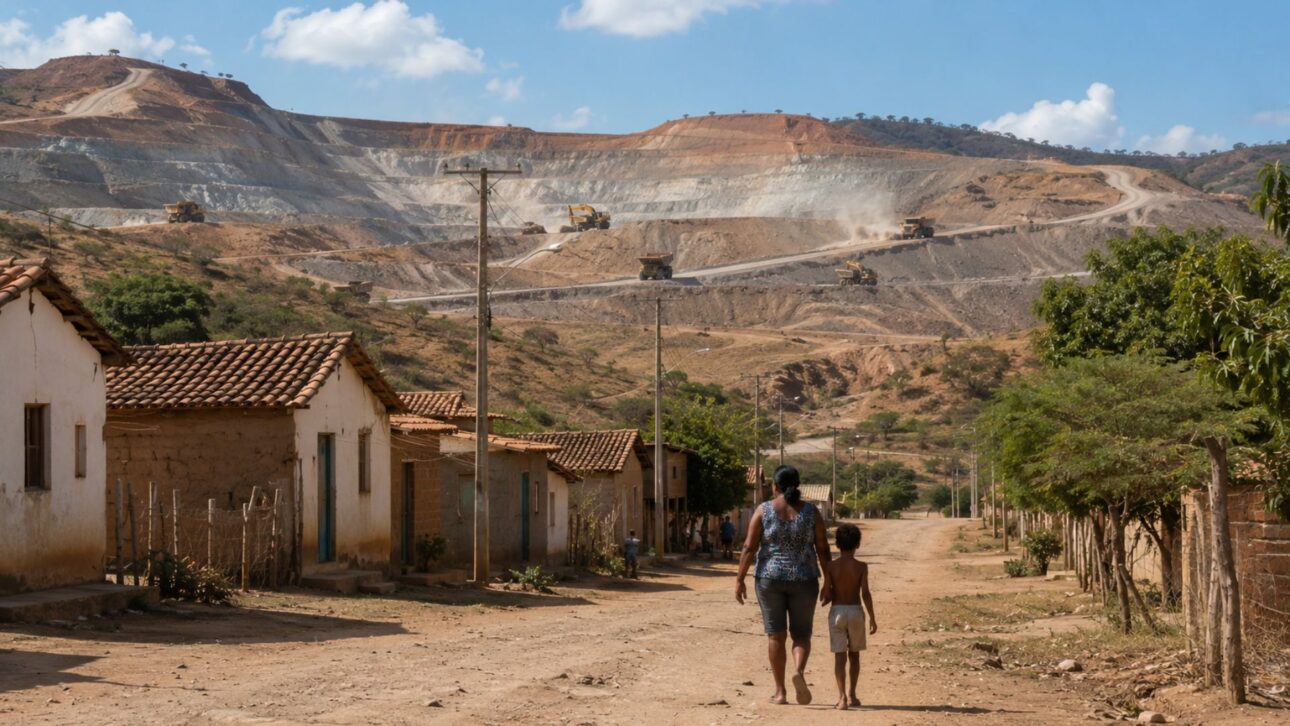
According to Agência Pública, half of the residents interviewed in the Piauí Poço Dantas region, between Araçuaí and Itinga, report cracked houses from years of mining detonations, and 89% say they feel the tremor of the explosions. It is not an exaggeration of those who complain for the sake of complaining; it is the daily life of those who sleep not knowing if the wall will hold.
-
Brazilian creates ingenious hack with bus air conditioner water and transforms invisible dripping into savings of millions of liters; Capixaba system reuses condensation on the windshield, supplies the toilet on long trips, and has become a practice in Águia Branca’s fleet.

-
An 11-year-old boy left home with two cousins to sell popcorn for R$ 5, became an entrepreneur at 15, sells 100 buckets a day, and uses the profit to pay the entire family working in the business.
-
To escape traditional rent, a couple bought a 21 m² floating house without seeing it, renovated everything in 3 months, and started living isolated on a lake in the USA, without electricity, without cell phone signal, and accessible only by boat.

-
Tired of expensive housing, couple buys a boat for US$ 1, refurbishes the sailboat at low cost, and sails over 1,600 kilometers to the Florida Keys.


Fear has a name and a voice. “I’m afraid it will fall on us at night,” said Dona Fatinha, retired, to Agência Pública, speaking about her own house. Neighbor Amilcar Viana, also retired and a resident for decades, summed up the feeling of those who saw peace end: “These people came here, we were fine. They could have left us alone.”
Faced with the cracked houses, the courts became the only path. Agência Pública identified at least 12 lawsuits filed by residents of Piauí Poço Dantas against Sigma Lithium in the state courts of Minas, in addition to a federal lawsuit by Pankararu and Pataxó indigenous people. The affected are seeking compensation and, in many cases, for the company to buy the damaged properties, as living there has become a risk.
Rent soared and the cost of living exploded
Those who don’t live near the mine feel the pinch in their wallets. The arrival of lithium mining in the Jequitinhonha Valley attracted a crowd from outside, and the cost of living soared. The Observatório da Mineração recorded that both property rents and prices in commerce rose significantly with the metal boom.
The most perverse effect hits those with less. Rural students, who need to rent a room in the city to study, are being pushed out by the high rent. “Rural area students sometimes have to pay rent to study, and many can’t,” reported Cleonice Pankararu, leader of the Aldeia Cinta Vermelha-Jundiba indigenous land, to the Observatório da Mineração. The cost of living has risen, but the income of the majority has not.
And the cost of living doesn’t stop at rent. With the population swell, access to healthcare worsened. According to the same survey, hospitals became overcrowded, and those in need of a medical specialty have to travel to Belo Horizonte or Diamantina. The promise of progress, in practice, left the local public service worse than it was before lithium mining.
The water that is lacking for the people and abundant for the mining company
Perhaps no number better summarizes the inequality than that of water. In the Jequitinhonha Valley, plagued by drought, a family can live with a 16,000-liter tank for eight months of drought, equivalent to about 2,000 liters per month, according to the Observatório da Mineração. Meanwhile, the concession granted to Sigma Lithium in the Itinga region is 3.8 million liters per day.
The numbers don’t add up for those living there. On one side, the sertanejo rationing every drop; on the other, lithium mining with permission to capture a volume of water that the local population can’t even dream of having. It is the exact translation of who wins and who loses with the so-called Lithium Valley.
The dust completes the picture. According to the report by Agência Pública, 76% of residents complain about the dust raised by mining and 55% point to health impacts because of it. José Nelson, an agent of Cáritas in Araçuaí, and Rodrigo Pires Vieira, coordinator of Cáritas in Minas Gerais, are among the voices closely monitoring the socio-environmental damages of lithium mining in the communities.
The promise of R$ 1 billion that turned into R$ 0 in royalties
The contrast between rhetoric and reality is stark when it comes to public money. Lithium mining was sold with the promise of around R$ 1 billion in royalties over 20 years, an average of R$ 50 million per year for a region that has always been poor. This was the promised El Dorado for the Jequitinhonha Valley.
The reality was different. According to Agência Pública, the CFEM collection, the compensation paid for mineral exploitation, was R$ 9.5 million in 2023 and R$ 12.5 million in 2024, but plummeted to zero in 2025, with the company not passing on a cent that year. For small municipalities, this gap is huge. “These resources have been missed,” acknowledged João Bosco Cordeiro, known as Bosquinho, mayor of Itinga, to Agência Pública.
And the jobs, the biggest selling point of lithium mining? They also dwindled. The report notes the dismissal of 500 employees by Fagundes Construction and halted operations during the period. Even the bishop of Araçuaí, Dom Geraldo Maia, contested the company’s claims, stating that the touted delivery of four schools “did not happen.” The promised wealth did not materialize in the treasury, in employment, or in schools.
Why the Lithium Valley promised so much and delivered so little
The case of the Jequitinhonha Valley is a portrait of a model that repeats itself in Brazil. It is promised that the arrival of a large mining company will transform the poor region into a hub of prosperity, and the community accepts the inconvenience in the hope of progress. However, when the bill arrives, the profit travels elsewhere, and the liabilities remain with those who never left.
Sigma Lithium operates in one of the most deprived territories in the country, in an activity that moves billions in the global market. Even so, it is the cracked houses, the high cost of living, the disputed water, and the dust that define the daily life of Araçuaí and Itinga. The green promise of lithium, inside the houses, has the color of loss.
None of this means that the region is against generating income. The frustration is with the way it is done. “I am not against mining, I am against the way the mining companies operate,” said resident Márcio to Agência Pública. It is a message that applies to the entire lithium rush: without sharing the gain and without repairing the damage, the promised development becomes just another broken promise in the Jequitinhonha Valley.
The history of lithium in the Jequitinhonha Valley shows the other side of the energy transition that no one puts in the brochure. While the world celebrates clean batteries, the families of Araçuaí and Itinga are left with cracked houses, unaffordable cost of living, disputed water, and R$ 0 in royalties by 2025, in an eldorado that promised everything and delivered the bill. The lithium mining by Sigma Lithium has become the portrait of progress that runs over those it should help.
And you, do you think it’s possible to mine lithium without destroying the lives of those who live around, or is the price for the communities always too high? Share your opinion in the comments.





Be the first to react!