






 Portuguese
  Spanish


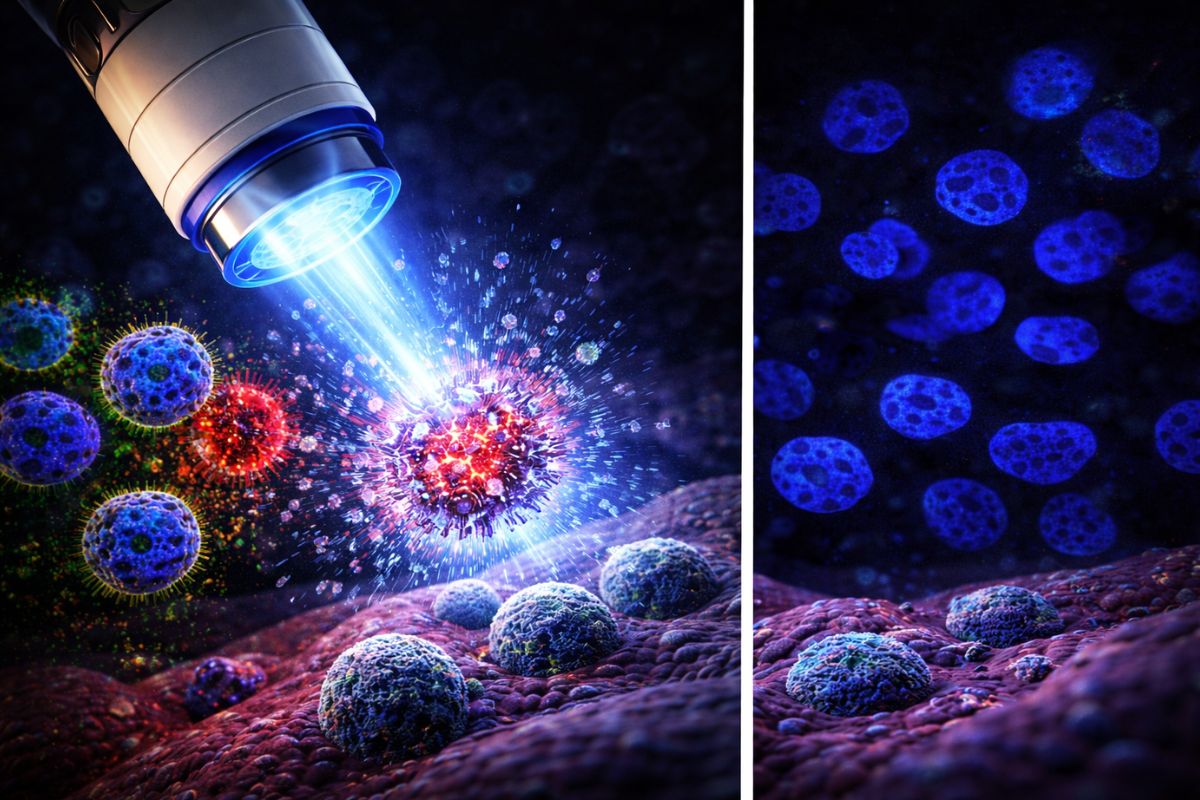


USP study published on April 17, 2026, describes how ultrasound waves break the virus envelope by acoustic resonance and open the way for tests against dengue and zika
On April 17, 2026, Brazilian researchers from the University of São Paulo published a study showing that high-frequency ultrasound waves can inactivate viruses such as SARS-CoV-2 and H1N1 without causing damage to human cells, by inducing structural changes in viral particles until their rupture.
The team describes the mechanism as acoustic resonance and claims that the method could open a new treatment possibility for enveloped viruses, with ongoing in vitro tests against other viral infections, such as dengue, zika, and chikungunya.
How ultrasound “breaks” the virus without harming human cells
The observed effect occurs when the energy of the sound waves couples with the virus structure and forces changes in its shape until the envelope ruptures.
-
China Develops Custom 140-Ton Electric Mining Truck with 770 kWh Swappable Battery, Deploys 290 Units in Xinjiang’s Largest Zinc Mine

-
Meta to Launch Arena, a New Prediction App Targeting 3.56 Billion Users, Competing with Polymarket and Kalshi

-
Scientist Challenges Famous Human Evolution Theory, Argues Homo Sapiens Evolved Gradually Over Thousands of Years
-
15-Year-Old American Builds Ocean Generator with PVC Pipe and 3D-Printed Propeller for $12, Wins National Prize, Presents at White House, and Makes Forbes 30 Under 30 List




Odemir Martinez Bruno, from the Institute of Physics of São Carlos at USP, explains that the phenomenon can be understood as a “popcorn effect,” where the protective membrane of the virus bursts and deforms, preventing the invasion of human cells.
The study points out that this inactivation by ultrasound especially applies to enveloped viruses, which rely on this membrane to maintain their integrity and infectivity.
Why the geometry of the virus becomes the central piece of the technique

Image: FAPESP Agency
The discovery drew attention for contradicting classical theories, as the wavelength of ultrasound is much larger than the size of a virus, which in theory would reduce the chance of direct interaction. The proposed explanation is geometric: spherical particles, like many enveloped viruses, absorb ultrasound energy better.
This accumulation of energy within the viral particle is what accelerates the degradation of the virus envelope, leading to mechanical rupture without requiring changes in temperature or pH of the medium.
Why virus variants would not change the outcome
A highlighted point in the study is that the process depends on the shape of the viral particle and not on genetic mutations.
In the authors’ reading, this means that variants of the virus observed during the pandemic, such as omicron and delta, should not affect the effectiveness of the mechanism because acoustic resonance targets the physical structure of the envelope.
Acoustic resonance is not cavitation and that changes everything
The described technique does not aim for general decontamination, but rather a selective effect on the virus. Ultrasound is already used for prophylaxis of dental and surgical equipment, but there the main phenomenon is cavitation, which occurs at low frequencies and destroys any biological material.
In the case of acoustic resonance, the study describes operation at high frequencies, in the range of 3 to 20 MHz, where sound energy excites internal vibrations that lead to the rupture of the virus envelope, without posing a risk to human cells.
What the study says about upcoming uses against other viruses
The authors state that ultrasound inactivation of enveloped viruses opens a possibility for treatment of viral diseases in general, especially since chemical antivirals tend to be difficult to develop. The team is already conducting in vitro tests against dengue, chikungunya, and zika, aiming to expand the method’s reach.
The text also mentions a practical advantage: since the strategy does not depend on attacking mutations of the virus, it tends to be seen as promising against different enveloped infections, in addition to being described as a “green” solution, with no waste generation and no promotion of viral resistance.
Who participated and why the research required various areas
The investigation brought together theoretical and acoustic physicists from IFSC USP and specialists from the Virology Research Center and the Research Center for Inflammatory Diseases linked to the Faculty of Medicine of Ribeirão Preto, as well as teams from the Faculty of Pharmaceutical Sciences and researchers from Unesp, with structural and toxicological analyses using microscopy and light scattering.
There was also collaboration from Charles Rice, a professor at Rockefeller University and Nobel Prize in Medicine 2020, who provided fluorescent viruses for real-time visualization.
Do you think that a physical technique to burst viruses with ultrasound has a better chance of becoming a treatment in the future than traditional antivirals?





