






 Portuguese
  Spanish
  4 min of reading
  0 comments


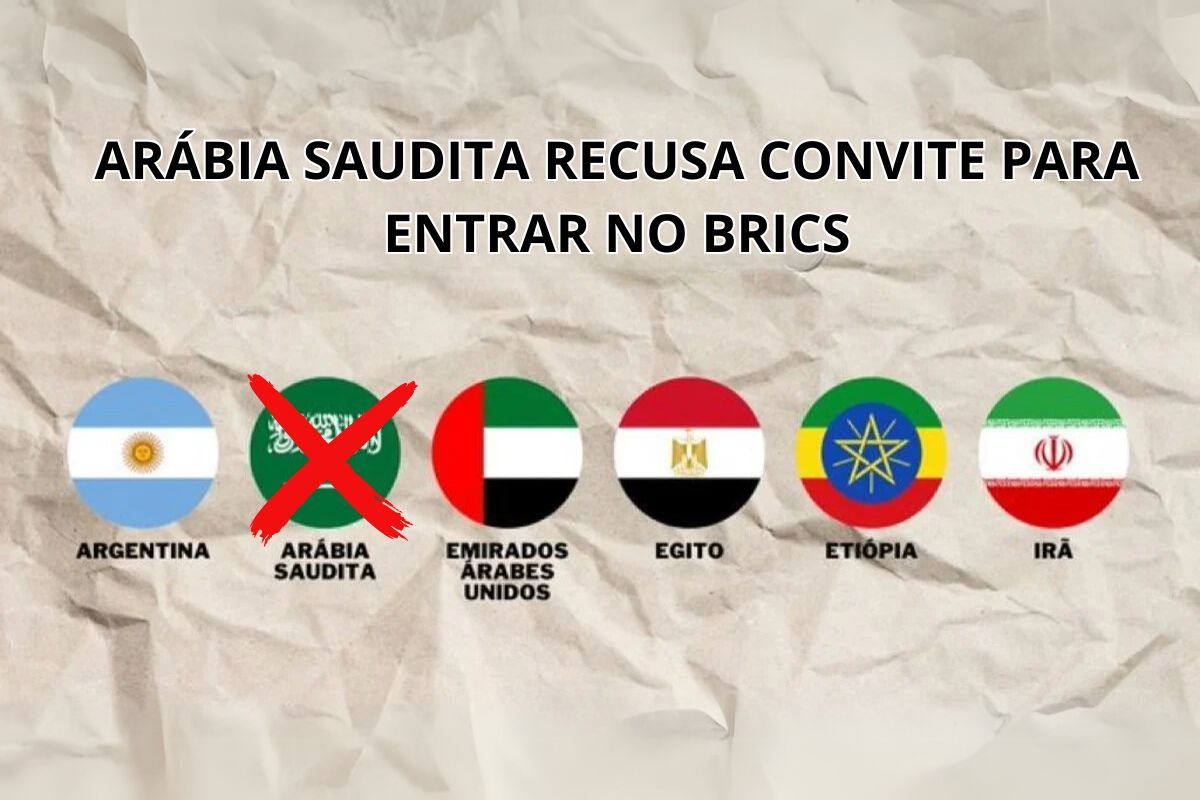
Saudi Arabia Says No to BRICS: Rivalry with Iran and Ties with the US Weighed on the Decision. Learn More About the Tensions and Global Implications!
The decision of Saudi Arabia not to join BRICS, a group made up of Brazil, Russia, India, China, and South Africa, surprised the global geopolitical scene. Despite initial interest, Riyadh opted to maintain distance from the bloc, raising doubts about the internal cohesion and the future direction of the group. Understand the main reasons behind this refusal and its possible implications.
What Is BRICS and What Is Its Purpose?
BRICS emerged as a concept in 2001, coined by economist Jim O’Neill, to describe emerging economies with high growth potential: Brazil, Russia, India, and China. In 2009, the group was formalized with the aim of promoting a multipolar global order, strengthening the influence of emerging powers, and reducing dependence on Western institutions like the G7.
Since then, BRICS has worked to increase economic cooperation, highlighted by the establishment of the New Development Bank (NDB) in 2015, aimed at financing projects in developing countries. More recently, the BRICS+ strategy began to include new invited countries such as Argentina, Iran, Egypt, Ethiopia, United Arab Emirates, and Saudi Arabia itself.
-
Israel finds Hezbollah militarized tunnel over 200 meters long under village, with 4 missile launch shafts, 12 chambers, anti-tank missiles, drones, and weapons depots at a depth of 25 meters.

-
Ukraine launches largest drone attack on Moscow since 2022, Russia claims to have intercepted nearly 200 aircraft near the capital, Kapotnya refinery targeted again, and offensive reignites alert about war reaching the Russian energy heart just a few kilometers from the Kremlin.

-
Truck drivers, freight, and fines from 2022 take center stage in politics: Chamber approves MP with amnesty, mandatory tracking by CIOT, million-dollar penalties, and new minimum wage for those who spend more than 24 hours on the road.

-
China off the radar: US plans mega $30 million weapons depot in Australia, out of reach of most Chinese missiles, with full capacity expected by 2028




Why Did Saudi Arabia Refuse to Join BRICS?
The decision of Riyadh was based on economic, political, and strategic factors. Below, we explore the main reasons:
1. Rivalry with Iran
One of the central factors is the historical tension between Saudi Arabia and Iran, two regional rivals competing for influence in the Middle East. Iran’s recent entry into BRICS heightened Saudi concerns as sharing the same political space with Tehran could undermine Riyadh’s strategic interests.
The conflict between the two countries, reflected in proxy wars such as the conflict in Yemen, has made coexistence in the bloc impractical. The participation of both in BRICS could deepen the internal divisions of the group.
2. Lack of Institutional Structure in BRICS
Another critical point for Saudi Arabia is the absence of a robust institutional structure in BRICS. Unlike blocs such as the European Union, BRICS lacks a permanent secretariat, a parliament, or clear decision-making mechanisms. This lack of organization limits the group’s ability to implement a common agenda efficiently.
The Russian president himself, Vladimir Putin, has already acknowledged the need to improve BRICS’ structure to make it more effective in its actions.
3. Strategic Relations with the United States
Saudi Arabia maintains a historical and strategic alliance with the United States, especially in areas such as defense and economic cooperation. Although Riyadh has sought to diversify its partnerships with China and Russia, joining BRICS could be interpreted as an anti-American alignment, something that would be counterproductive to its national interests.
Since the Russian invasion of Ukraine, BRICS has increasingly been viewed as a platform of confrontation with the US, especially under the influence of Moscow and Beijing. For the Saudis, this alignment could jeopardize their strategic and economic agreements with Washington.
4. The Pragmatism of Saudi Foreign Policy
Under the leadership of Crown Prince Mohammed bin Salman, Saudi Arabia has adopted a pragmatic and balanced foreign policy. The country seeks to strengthen its relations with various global powers without compromising its autonomy. This stance reflects Riyadh’s desire to maintain a strategic balance in a multipolar international scenario.
For the Saudis, joining BRICS could limit their ability to position themselves as an independent actor, especially in a bloc where Russia and China hold significant influence.
Is BRICS Becoming Anti-Western?
The perception that BRICS is transforming into a geopolitical tool for Russia and China to challenge Western interests raises concerns both for countries outside and for the members of the group themselves. Initiatives like the use of local currencies and the creation of alternative payment systems aim to reduce dependence on the dollar but also reflect the confrontational agenda of Moscow and Beijing.
This stance may generate internal resistance, especially in countries like Brazil, which maintain pragmatic relations with the United States and seek to avoid excessively polarized alignments.


Saudi Pragmatism Prevails
Saudi Arabia’s refusal to join BRICS reflects the geopolitical complexities of a multipolar world. Although the group has the potential to reshape global order, its internal divisions, lack of institutionalization, and confrontational agenda with the West hinder its consolidation.
For Riyadh, maintaining a balanced position between major powers is more advantageous than compromising its strategic alliances with the United States. The Saudi decision also exposes BRICS’ challenges in building a unified agenda that meets the interests of its members without deepening regional or ideological tensions.









-

-

3 people reacted to this.