






 Portuguese
  Spanish
  5 min of reading
  0 comments


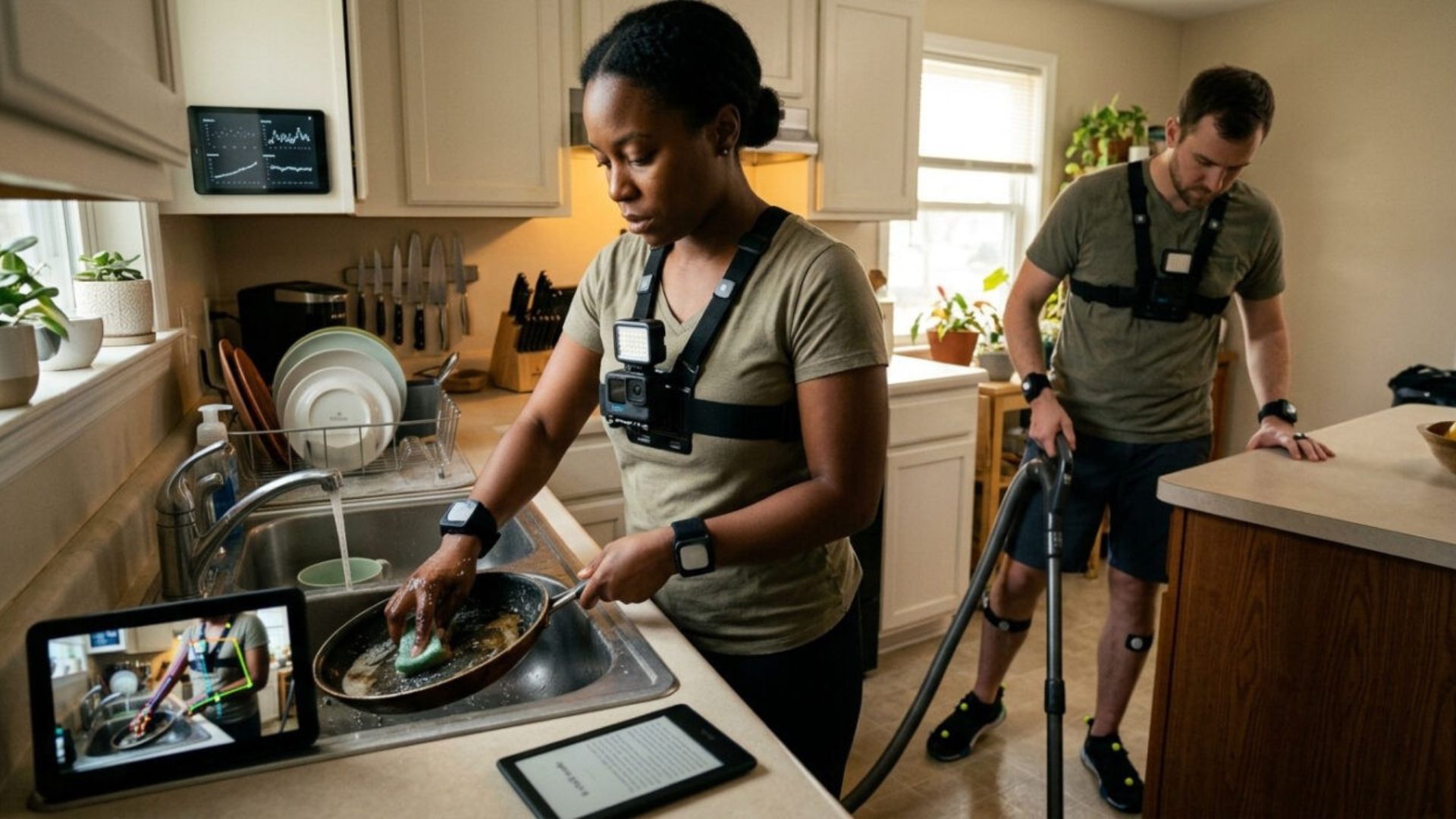
In the US, people are paid to do household tasks with cameras on their bodies, generating data that train robots and create a new type of work in the AI era.
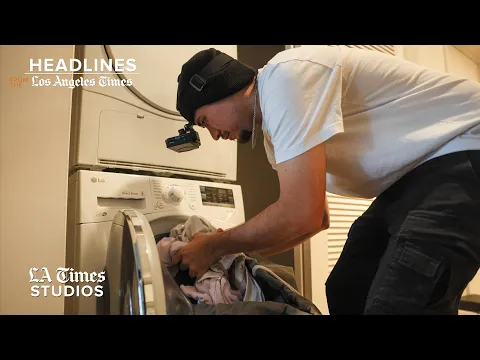
In Los Angeles, an apparently mundane scene — someone washing dishes or cleaning the kitchen — is being transformed into something much bigger: a database to train robots. Hundreds of people are being hired to perform household tasks while wearing cameras attached to their bodies, recording every movement in the first person, according to a report by the Los Angeles Times. What seems like a common job has become part of a new emerging economy, where everyday activities are converted into valuable information for the development of physical artificial intelligence. This phenomenon marks an important transition: from AI that understands text and images to AI that learns to act in the real world.
A new type of work: the “digital gig” of robotics
The model follows the logic of the so-called gig economy, but with a crucial difference. Instead of driving or delivering food, these workers perform household tasks while generating data.
Technology companies pay amounts that can reach about $80 for a few hours of recording. In return, they receive something extremely valuable: detailed records of how humans interact with objects, make decisions, and perform everyday tasks.
-
At 22 years old, a young person from Recife creates an artificial intelligence startup with a team barely over 25, serves giants like Bayer and Ipiranga, earns millions without taking a cent from investors, and transforms a young company into a national AI phenomenon.

-
The invisible danger inside the house: plugging too many devices into the same outlet and spreading extensions throughout the rooms can overload the electrical network, silently heat wires, and turn a common habit into one of the leading causes of house fires.

-
Goodbye traditional laundry: Roborock launches washer and dryer with super hydrolysis, microbubbles, 99.99% sterilization, low-temperature drying, automatic detergent, app control, and cycles to remove stains, odors, mites, and bacteria from clothes.

-
It is now possible to generate energy without batteries: new flexible material transforms body heat into electricity and paves the way for more efficient, autonomous, and comfortable wearable devices, with the potential to revolutionize personal electronics in the coming years.



This type of activity is being described as a new type of occupation — a mix of manual work with data production — that can grow rapidly as robotics advances.
Why robots need to observe humans to learn
Unlike language models, which can be trained with texts available on the internet, robots face a different challenge: understanding the physical world.
For a robot, simple tasks like washing a dish involve multiple variables:
- how to hold the object
- how much force to apply
- how to react to wet surfaces
- how to adjust movements in real-time

These nuances are difficult to program manually. Therefore, companies are adopting learning by demonstration, where machines learn by observing humans.
Body cameras: how data is captured
Workers use devices that capture action from a human perspective. This includes cameras mounted on the head, chest, or even hands.
The goal is to record not just what is being done, but how it is being done. The first-person perspective allows algorithms to analyze:
- movement trajectories
- hand coordination
- interaction with objects
- execution time
This type of data is essential for training robotic systems that need to operate in real and unpredictable environments.
From the kitchen to the laboratory: the path of data
After recording, the data is processed by artificial intelligence systems that identify behavior patterns. These patterns are then used to train robots or simulations.
The process involves:
- movement extraction
- action modeling
- reproduction in a virtual environment
- transfer to physical robots
This cycle allows machines to learn complex tasks without the need for detailed programming for each situation.
The global race for humanoid robots
The growth of this type of work is directly linked to the global race to develop robots capable of operating in human environments.

Companies like Tesla, Google, and various startups are investing billions to create robots that can perform domestic, industrial, and assistance tasks.
The ultimate goal is to develop machines that can operate in homes, hospitals, and factories with autonomy and safety. In this context, data generated by humans becomes a strategic resource.
Homes become artificial intelligence laboratories
One of the most striking aspects of this trend is the transformation of domestic environments into data collection spaces.
Kitchens, living rooms, and service areas start to function as real scenarios where AI learns. Unlike controlled laboratory environments, these spaces offer variability and unpredictability — essential factors for the robust training of robots. This enhances the quality of the data and brings learning closer to real usage conditions.
The economic impact: physical data as a new commodity
Data collection has always been one of the pillars of artificial intelligence. However, until recently, most of this data was digital. Now, a new category emerges: physical data. Movements, interactions, and human behaviors start to have direct economic value.
This phenomenon can create a new market, where people are compensated not only for the work itself but for the informational value of their actions. In the long run, the development of robots capable of performing household tasks can profoundly alter the dynamics of work.
If machines can accurately learn how humans perform these activities, repetitive functions can be automated. At the same time, new types of work may emerge, such as operators, trainers, and supervisors of robotic systems. This movement does not necessarily eliminate human work, but transforms it.
Between opportunity and questioning
Although the model represents a new source of income, it also raises important questions. The use of cameras in the domestic environment involves concerns about privacy, data security, and ethical boundaries.
Moreover, the value paid for the work is still relatively low compared to the economic potential of the systems being trained. These points should gain relevance as the practice expands.
What is happening in Los Angeles may seem like an isolated experiment, but it represents something bigger. It is a change in how artificial intelligence learns and evolves. By transforming simple tasks into structured data, technology brings machines closer to the human ability to interact with the physical world.
The beginning of a new phase of artificial intelligence
The evolution of AI has always depended on data. Now, with the expansion into the physical world, this dependency intensifies.
The work of ordinary people, performing everyday tasks, is helping to build the next generation of robots. And this could redefine not only technology but also the very concept of work. What today is a “gig” may become, in the future, a central piece of a new economy based on interaction between humans and machines.






Be the first to react!