






 Portuguese
  Spanish


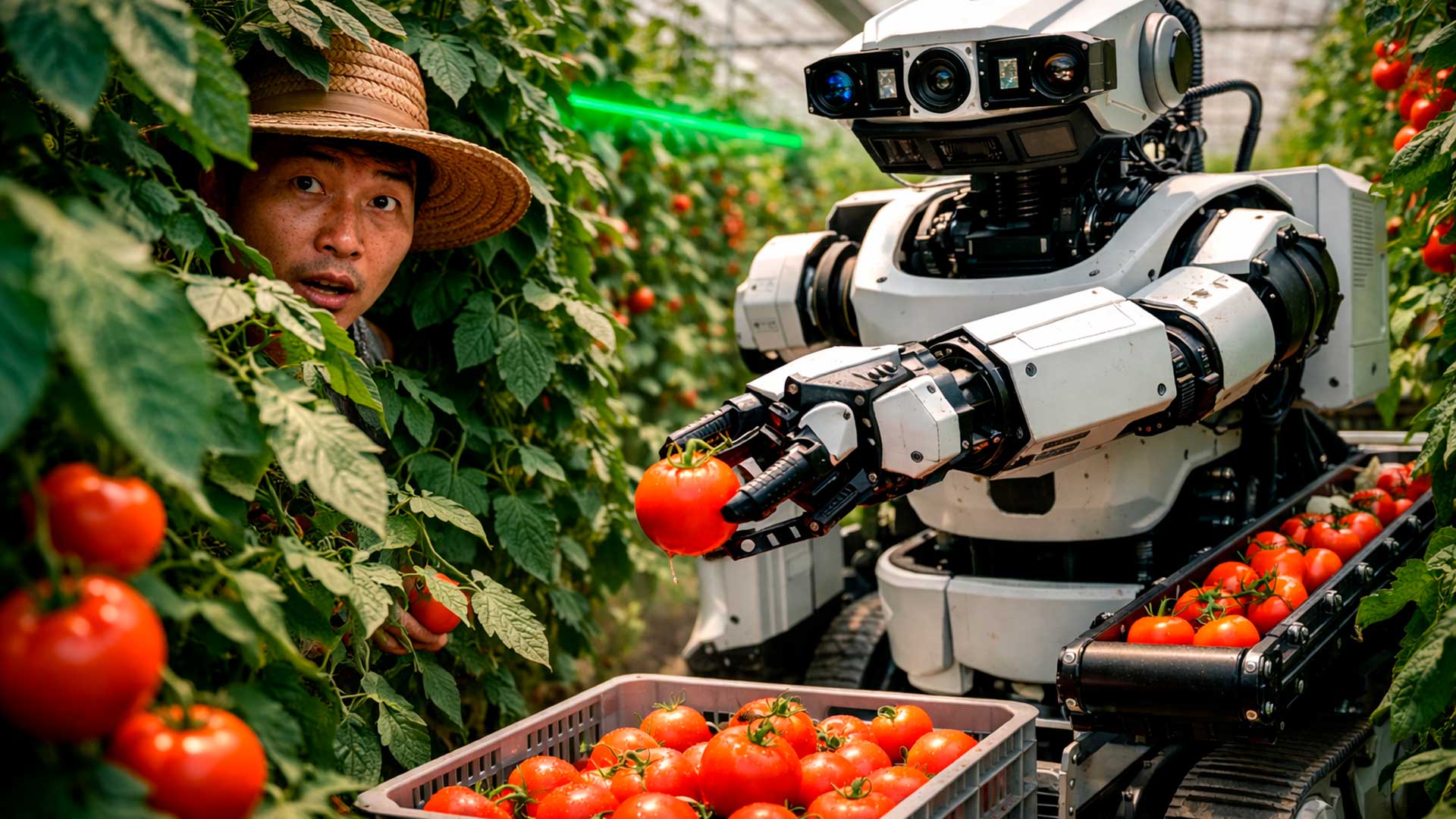


Researchers from Fudan University in China developed an agricultural robot capable of performing various stages of tomato cultivation with artificial intelligence and autonomy. Tests and data released indicate that one unit can replace up to six workers and cost a fraction of foreign solutions.
Field automation typically advances in isolated tasks, but a Chinese project has been attracting attention for promising a complete package of operations in a tomato field. According to a report published by Poder360 on January 19, 2026, the equipment was created by a team from the robotics lab at Fudan University.
The bet is that a single robot can handle work equivalent to up to six people, which could change the productivity calculations in greenhouses and labor-intensive crops. According to the state news agency Xinhua, the efficiency observed in field tests and the level of automation were points that aroused interest from the sector.
The cost also took center stage in the debate. Published information indicates that the robot could cost around 10% to 20% of the price of foreign alternatives, depending on the configuration and comparison used.
-
NASA’s Plan to Dump ISS Debris in Ocean Sparks Environmental Concerns Among Scientists

-
14-Year-Old Invents Eco-Friendly Water Pump Using Recycled Materials to Aid Communities Without Water Access
-
Pigeons Trained to Detect Cancerous Changes in Medical Images Astonish Scientific Community

-
Plastic Waste from Beaches and Poor Communities in Kenya Transformed into School Desks, Replacing Wood in Classrooms and Turning Marine Litter into Durable Study Tables


The news comes in a context where producers face pressure to reduce costs and maintain harvest consistency, while governments and companies accelerate projects in smart agriculture and agricultural robotics. China, in particular, has associated these efforts with the use of data and AI systems at scale.
How The Agricultural Robot Works In The Tomato Field From Beginning To End

The difference of the prototype described in the reports is its ability to cover multiple stages of cultivation, instead of being a single-function machine. According to Xinhua, it can perform pollination, leaf pruning, fruit thinning, and harvesting, which typically require trained teams throughout the tomato cycle.
In practice, this means the robot can switch between delicate and heavier tasks without relying on constant equipment changes. Poder360 describes the system as multifunctional and geared towards complete operations in tomato crops, with AI integration to perceive and act in the environment.
This type of combination is particularly interesting for cultivation environments with high routine repetition, such as greenhouses. The logic is to reduce labor bottlenecks at critical moments, such as during pollination and peak harvest times.
3D Vision, Autonomous Navigation, And AI In Agriculture How The Machine Sees And Decides
The technical description released by Xinhua shows a set of technologies working together. The robot uses 3D vision perception, autonomous navigation, decision-making supported by cloud computing, and deep learning, a combination that attempts to mimic the way humans assess the environment.
One example cited in the report is the bionic arm moving among tomato plants while the 3D vision system scans the scene. The article describes sensors evaluating conditions on the flower and algorithms processing data quickly to achieve precise pollination.
The main challenge is dealing with what seems simple for humans but confuses machines, like fruits hidden by leaves, nearby branches, and narrow passages in dense rows. The team reports needing to work on solutions for detecting occlusion cases and safely moving the robotic arm among the foliage.
According to Xinhua, the project advanced over four years and went through four generations of prototypes, evolving from industrial arms to autonomous robots. The leadership of the team is attributed to Shang Huiliang, an associate professor at the university, with participation from researchers in fields such as mechanics, electronics, control, software, and AI.
A symbolic point is the success rate in pollination mentioned in the report, above 90% even in more challenging natural conditions. This data is used as an argument that automation is no longer limited to fully controlled environments.
Field Tests And Promise Of Low Cost That Can Accelerate Automation In Agriculture
The reports indicate that the robot has not been confined to the laboratory. Xinhua states that the model was in field tests on a farm belonging to Bright Food Group in the Chongming region, reinforcing the attempt to validate performance in a real scenario.
Poder360 links the project’s start to 2021 and mentions that a research demonstration related to the group directed the researchers’ attention to agricultural robotics, further reinforcing the thesis that there were urgent automation gaps in agricultural environments.
If the lower cost is confirmed at scale, technology could spread more quickly, even in operations that currently cannot afford imported robots. At the same time, the cheaper the hardware, the greater the competition likely to be for data, maintenance, and software that ensure autonomy and safety.
Sinong And The Leap Of The Open Source Agricultural Language Model In China
The same wave of AI in agriculture appears in another recent announcement. According to Xinhua, Nanjing Agricultural University presented on January 13, 2026 the Sinong, described as the country’s first vertical large language model of open source for the agricultural sector.
According to the report, the model was trained with a broad and structured data set, including nearly 9,000 books, more than 240,000 academic articles, and about 20,000 policy and standard documents, as well as content based on the web. The goal is to cover topics such as horticulture, environmental resources, agricultural economics, plant protection, and crop improvement.
Another relevant detail is the distribution format. Xinhua reports that Sinong has been made available as open source on platforms such as ModelScope and GitHub, with the justification of reducing barriers to adoption and allowing development by companies and institutions.
In practice, the combination of agricultural robotics and language models suggests a path where machines gain not only “arms” but also systems to guide decisions and standardize technical recommendations. The competition becomes who delivers productivity without increasing technological dependence and without leaving small producers behind.
In your view, is this robot and agricultural AI an inevitable solution for the field or a risk of job displacement that could spiral out of control if costs drop quickly? Leave a comment saying which side you stand on and what should become a rule to protect both workers and producers at the same time.





Esse é um caminho sem volta, não se consegue mais mão de obra para o trabalho no campo.