Portuguese
  Spanish


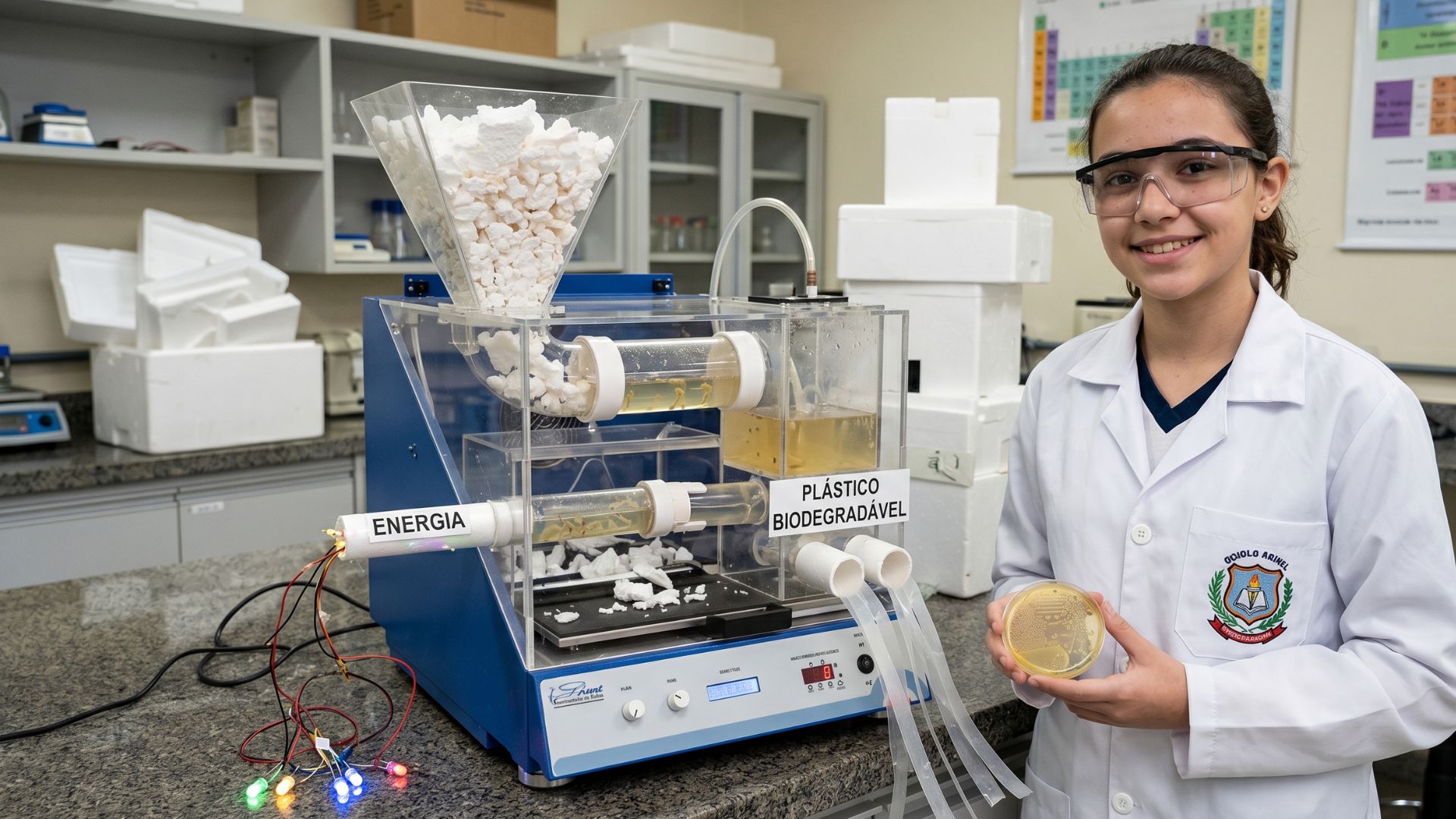


13-year-old student helped create a system with bacteria capable of degrading Styrofoam and transforming polystyrene into bioplastic, attracting international attention.
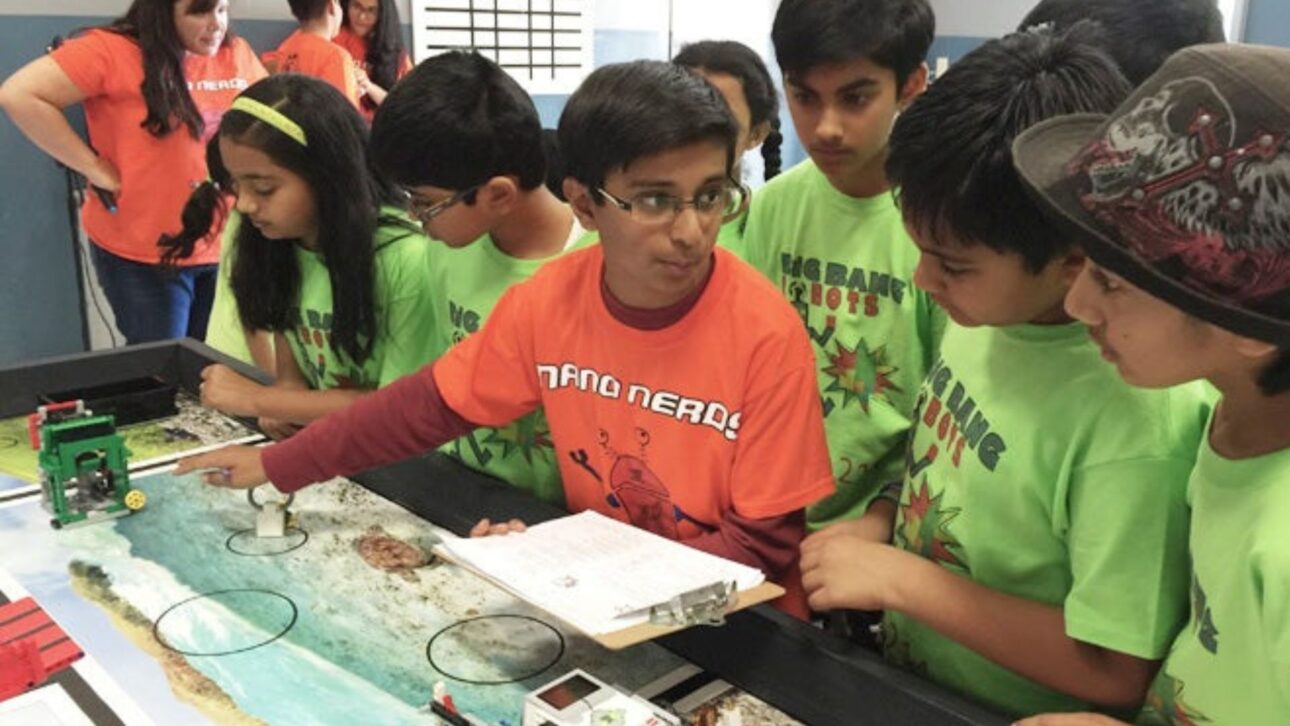
According to Fast Company, Emily Miner was 13 years old when she and other colleagues from the Nano Nerds team, from the city of Folsom, California, decided to tackle a problem that conventional recycling has not yet efficiently solved: Styrofoam. The material, technically called expanded polystyrene, is widely used in packaging, disposable cups, and appliance protection, but almost always ends up in landfills, rivers, and oceans.
The team searched the scientific literature for organisms capable of degrading the material and found the bacterium Pseudomonas putida, known for metabolizing styrene, the chemical compound that forms the basis of polystyrene. From this, the students developed the Polystyrenator, a digester that uses bacteria to consume Styrofoam and generate heat and PHA, a biodegradable bioplastic. The project reached the semifinals of the Global Innovation Award from the First Lego League, competing for a prize of US$ 20,000.
Styrofoam has become one of the most difficult wastes to recycle in the world
Styrofoam is composed of about 95% air and 5% plastic, which explains its lightness and efficiency as a thermal insulator and impact protection material. This is precisely why it appears in so many everyday products, from refrigerator packaging to disposable cups and supermarket trays.
-
California Startup Develops Giant “Space Sling” to Launch Vehicles at Mach 6, Reducing Fuel Use and Enabling Thousands of Satellite Deployments

-
ChatGPT Alerts FBI to Prevent Planned Murder of 8-Year-Old in Brazil’s Espírito Santo
-
Scientists Discover 125-Million-Year-Old “Pregnant Fossil” with Preserved Embryos and Microscopic Larvae Inside Mollusk in England

-
17-Year-Old Justin Bernstein Develops Bacteria to Produce Glass on Arctic Ice to Reflect Sunlight, Wins $50,000 U.S. Scholarship



The problem begins when this material ends its usage cycle. Unlike plastics with a more established recycling chain, expanded polystyrene requires compression, specialized transport, and expensive processing to be reused. In many cases, the cost exceeds the value of the recovered material.
According to the presented content, less than 1% of Styrofoam is recycled in the United States. The rest goes to landfills or the natural environment, where it can persist for centuries and fragment into particles that marine organisms mistake for food.
Nano Nerds found a solution for polystyrene in the bacterium Pseudomonas putida
The solution created by the students did not come from a guess, but from research. According to Fast Company, the group investigated scientific studies until they found Pseudomonas putida, a bacterium widely studied in environmental microbiology for its ability to metabolize aromatic compounds.
Styrene, which forms the chemical base of polystyrene, is one of these compounds. The bacterium can break down this molecule and use it as a carbon source. Under certain conditions, it also converts this carbon into PHA, a biodegradable polymer that functions as an energy reserve within the bacterial cell.


This discovery was the turning point of the project. Instead of trying to recycle styrofoam using traditional industrial methods, the students began to explore the biological degradation of polystyrene, using the logic of bacterial metabolism to tackle a waste that the industry still treats as an unsolvable problem on a large scale.
Polystyrenator was created to destroy styrofoam and generate biodegradable bioplastic
Based on this literature, the group designed the Polystyrenator, a closed digester that maintains controlled conditions to maximize the activity of Pseudomonas putida. The system receives shredded styrofoam and uses bacterial action to transform it into useful by-products.
According to the project description, the process generates heat, a result of bacterial metabolism, and also PHA, short for polyhydroxyalkanoate, a type of biodegradable plastic that can be used in packaging, films, and even medical applications, depending on the formulation.
The strongest point of the proposal is the change in logic. Instead of treating styrofoam as a waste with no economic value, the project attempts to convert it into a new material of greater environmental utility, with the potential to replace more problematic plastics.
PHA produced by bacteria is valuable because it is biodegradable and can replace conventional plastics
The PHA synthesized by Pseudomonas putida does not behave like the original polystyrene. While styrofoam can remain in the environment for hundreds of years, the biodegradable bioplastic can be decomposed by common soil microorganisms in much shorter periods, especially under suitable composting conditions.
This makes PHA a relevant material for circular economy research, because it transforms a waste that is difficult to dispose of into a product with potential application in new production chains. This characteristic helps explain why the project attracted attention outside the school environment.
The proposal also reinforces an increasingly important idea in materials science. Often, the advancement is not just in creating new plastics, but in finding biological ways to reuse complex waste and reconvert it into materials that are less harmful to the environment.
U.S. school project reached the semifinal of global innovation award
The Polystyrenator was developed within the First Lego League, one of the largest science and engineering competitions for students in the world. The edition in which the Nano Nerds participated focused on the waste challenge and asked teams to identify a real waste problem and propose an innovative solution.
According to Fast Company, out of thousands of participating teams in various countries, only 20 reached the semifinal of the Global Innovation Award. Emily Miner’s team was among these selected groups and presented the project to a panel of experts in engineering and waste management.
This context is important because it shows that the idea was not treated merely as a school curiosity. It was evaluated in a competitive environment, with criteria similar to those used in innovation projects applied to the real world.
The styrofoam problem continues without an industrial-scale solution even years later
Despite the prominence achieved by the project, the content itself shows that the central problem remains open. The world still produces approximately 14 million tons of styrofoam per year, while solutions for polystyrene biodegradation remain mainly concentrated in laboratories and experimental tests.
Large companies continue to use the material because it offers a difficult-to-replace combination of low cost, lightness, and high impact protection. This causes environmental pressure to increase without the global recycling infrastructure keeping pace.
What the Nano Nerds demonstrated was that the scientific basis exists. According to the text, the major obstacle is no longer knowing if the logic works, but in transforming this logic into industrial scale, with the capacity to receive large volumes of styrofoam and operate with economic viability.
Emily Miner and the Nano Nerds showed that young people can enter real debates on science and waste
One of the strongest statements attributed to Emily Miner summarizes the symbolic weight of the project. According to her, the experience showed that, even being very young, it is still possible to make a difference in the world. This phrase helps explain why the case drew attention beyond microbiology and environmental engineering.
The Polystyrenator was neither a ready startup nor a finished commercial solution. But it served as a proof of concept that a group of students managed to connect scientific literature, real environmental problem, and practical application in a topic that remains without a robust answer in the market.
In the end, the project left a question that remains current. If a team of students managed to demonstrate that bacteria can help destroy styrofoam and generate biodegradable bioplastic, why has the global industry not yet managed to bring this solution to the scale that the problem requires?