






 Portuguese
  Spanish
  5 min of reading
  0 comments


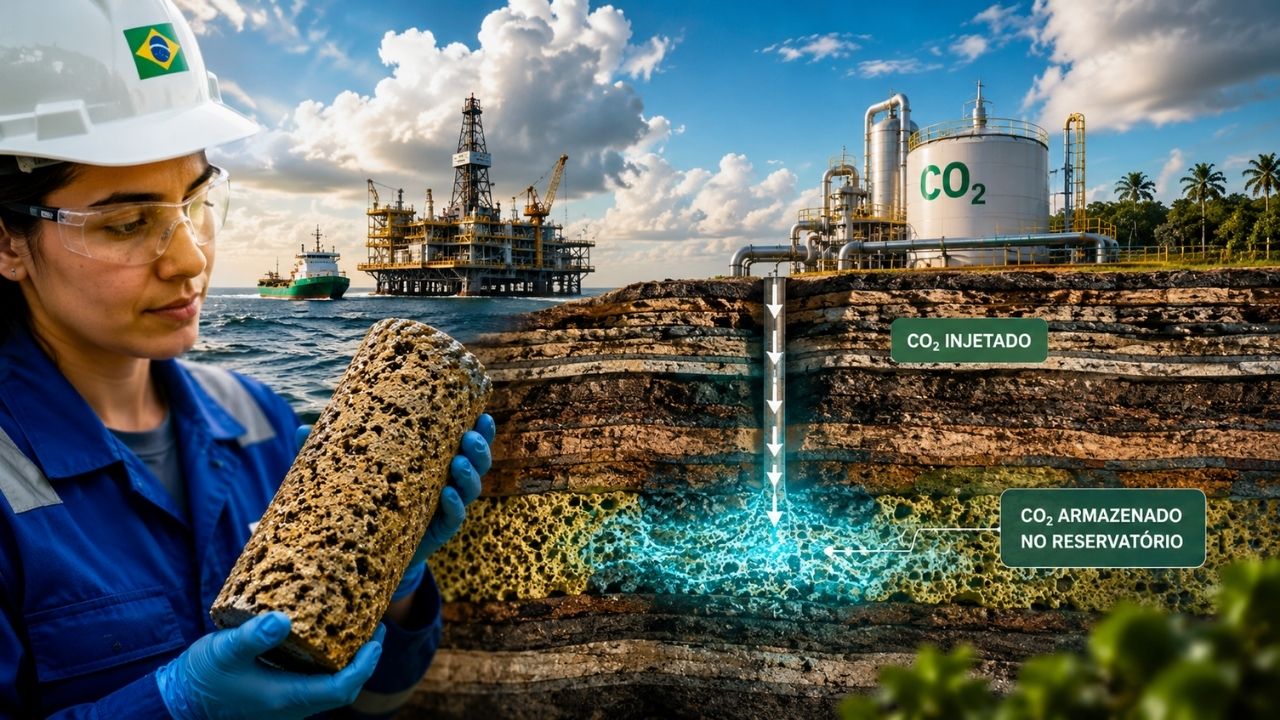
Carbon storage in underground structures of mature oil fields can help reduce emissions, extend old reservoirs, and attract investments for CCUS, geological monitoring, pipelines, and solutions from the Brazilian energy industry during the transition to operations with lower environmental impact in the country today in the national sector.
The underground structures of old oil fields are beginning to gain a new role in Brazil with the advancement of Carbon Capture, Storage, and Utilization, a technology known by the acronym CCUS. The proposal is to capture CO2 from industrial sources and direct this gas to geological reservoirs capable of storing it underground.
According to the Monitor do Mercado portal, the strategy draws attention because it unites two sensitive objectives for the energy industry: reducing emissions and making better use of mature fields, which have already lost some of their natural pressure over the years. Instead of abandoning old structures, the sector is now evaluating how these reservoirs can enter a new phase of use.
Mature fields can gain a new function with carbon storage
Mature fields are oil production areas that have already passed their peak extraction and face natural decline. In these locations, part of the infrastructure already exists, but production tends to become more difficult, more expensive, and less efficient over time.
-
Wikipedia Blocks AI-Generated Edits, Citing Distrust in Automated Systems and Outlining Plans to Use Technology Without Losing Article Control

-
NASA Tests Rover with Lizard-Like Suspension and Independent Wheel Traction, Aiming for Speed Ten Times Faster than Perseverance on Mars

-
Scientists Warn: Gulf Stream Shift Warms Canadian Waters by Up to 5°C, Revealing Rapid AMOC Response

-
Apple and Tesla on Alert After Cyberattack on Indian Supplier Exposes Over 200,000 Confidential Files, Industrial Projects, Employee Data, and Potential Trade Secrets on the Dark Web




With CCUS, these fields can be repurposed as underground structures to receive carbon dioxide. The gas is injected into porous rocks, where it can remain trapped under geological layers that act as natural barriers.
The logic is to transform old reservoirs into containment spaces, combining carbon storage with additional oil recovery. Thus, the technology attempts to reduce environmental impact without immediately shutting down assets that still have economic and operational value.
How CO2 injection helps in oil recovery

CO2 injection in mature fields can serve a dual function. On one hand, the captured carbon is directed underground. On the other hand, the gas helps alter the internal conditions of the reservoir, favoring the displacement of oil towards production wells.
This process is known as enhanced oil recovery. In practice, CO2 can reduce oil viscosity and help recover some of the pressure lost in the reservoir. This is why the technology appears as an alternative to extend the lifespan of areas that were already in decline.
The operation, however, is not simple. It requires detailed knowledge of the reservoir, control of injection pressure, rock analysis, and constant monitoring. In underground structures used for this purpose, any assessment failure can compromise safety, efficiency, and environmental credibility.
Geological seals are key to keeping carbon confined
For storage to work, it’s not enough to find an empty space underground. The reservoir needs to have porosity, permeability, and, most importantly, geological seals capable of preventing gas leakage to upper layers, aquifers, or the surface.
These seals are rock formations that act as natural caps. They help keep CO2 trapped within the underground structures chosen for the operation. Without a reliable geological barrier, storage loses its main technical argument: the permanence of carbon underground.
Therefore, seismic studies, geological modeling, and stability assessments are essential steps. The objective is to understand how the gas behaves after injection and to verify if the reservoir can withstand the pressure over time.
Long-term monitoring defines project safety
One of the biggest challenges of CCUS lies in continuous monitoring. Even after injection, carbon needs to be monitored to confirm that it remains in the planned location and does not cause undesirable effects in the reservoir.
Tools such as seismic monitoring, sensors, and digital analytics help observe CO2 movement within underground structures. Technology only gains environmental value if there is proof that the gas has been stored safely and traceably.
This control is also important for carbon credits and certifications. For geological storage to have economic value, it is necessary to demonstrate that emission reduction is not just a promise, but a verifiable result based on technical criteria.
Transport infrastructure will be decisive for scaling CCUS

Another critical point is the transportation of captured carbon. CO2 needs to move from emission sources, such as industrial facilities, to mature fields suitable for injection. For this, dedicated pipelines and compression systems may be necessary.
Without this infrastructure, the use of underground structures is limited to isolated projects. Scale depends on the ability to connect industries, oil fields, processing centers, and areas with suitable geological potential.
The economics of CCUS depend as much on subsurface engineering as on surface logistics. If the cost of capture, transport, and storage is too high, the model loses attractiveness for investors and operators.
Brazil has experience that can favor carbon projects
Brazil has relevant experience in offshore exploration, reservoir engineering, and gas reinjection, especially in areas linked to the pre-salt. This knowledge can help in the development of carbon storage projects in mature fields.
The Brazilian advantage lies in the combination of known sedimentary basins, a structured oil industry, and accumulated technical capacity. Still, transforming this experience into a new front for decarbonization requires clear rules, adequate licensing, and regulatory certainty.
Investors tend to view projects of this type with caution, because returns depend on technology, certification, climate policy, and carbon price. Therefore, the advancement of CCUS depends not only on engineering, but also on a predictable regulatory environment.
Emission reduction does not eliminate all questions
Carbon Capture and Storage is presented as a tool to reduce emissions in hard-to-decarbonize sectors. In oil, it can help lessen the impact of industrial and logistical operations that still depend on fossil fuels.
At the same time, the technology also generates debate. Critics question whether CCUS can prolong oil dependence, while proponents argue that it can reduce emissions during the energy transition. The central point is whether the technology will be used as a climate bridge or as a justification to postpone deeper changes.
In the case of mature fields, this discussion becomes even more evident. The same technique that stores carbon can prolong oil production. Therefore, transparency, clear goals, and independent monitoring will be fundamental to evaluate the results.
Underground structures can become a new frontier for the energy industry
The advancement of CCUS shows that underground structures, once seen only as oil reservoirs, can gain a new function in the low-carbon economy. They are also being evaluated as geological storage spaces, capable of receiving CO2 captured from industrial activities.
This movement can prolong the lifespan of mature fields, preserve jobs, leverage existing infrastructure, and attract investments in monitoring technology, geophysics, pipelines, and reservoir engineering. But none of this dispenses with technical rigor.
In the end, the question remains whether Brazil will be able to transform old fields into a real solution for emission reduction without creating new environmental risks or merely prolonging oil dependence. Do you believe that carbon storage in underground structures is a smart solution for the energy transition or too risky a bet? Leave your opinion in the comments.



Be the first to react!