






 Portuguese
  Spanish


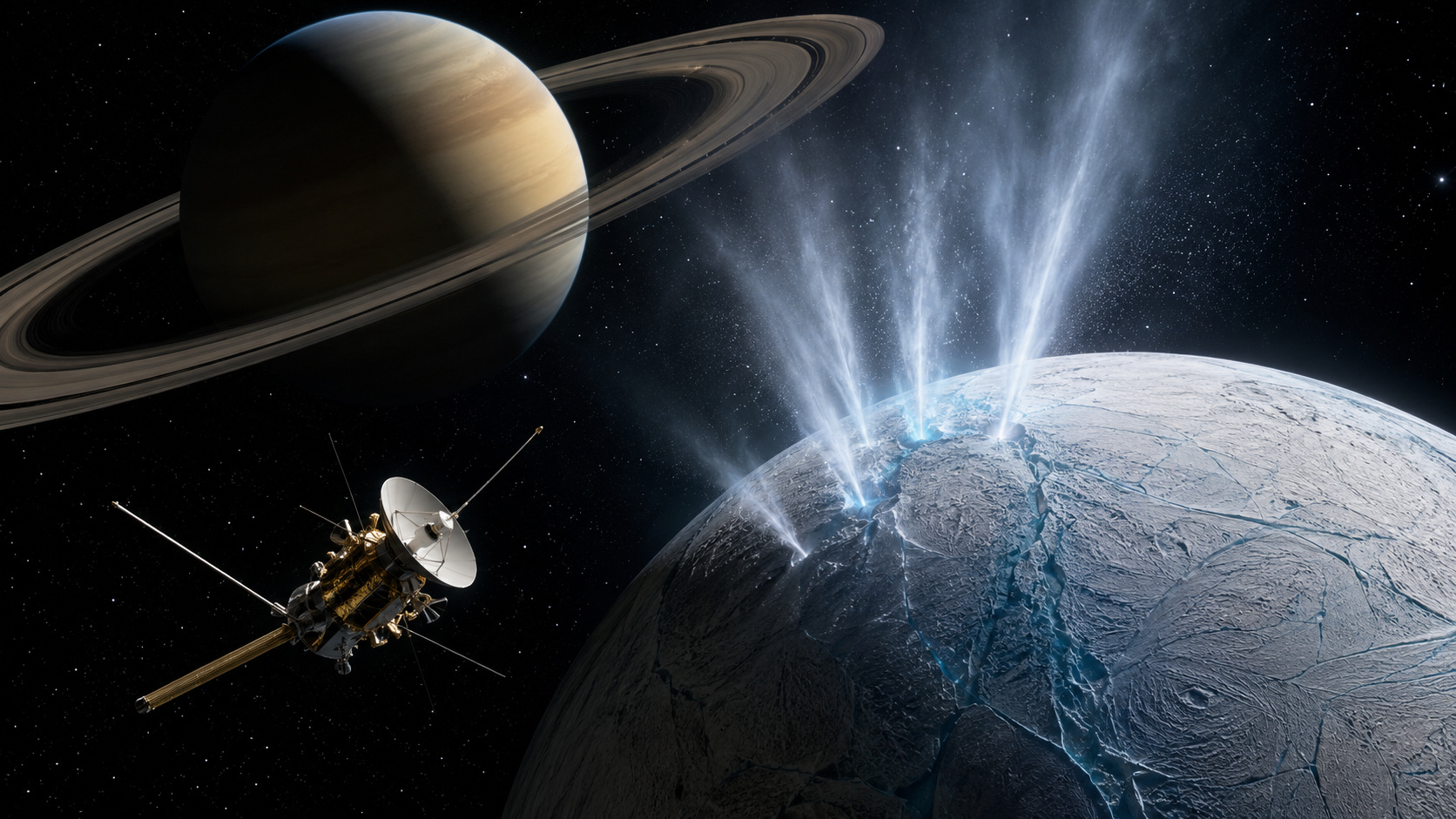

Nature study found complex organic compounds in ice grains expelled by Enceladus
When the Cassini probe traversed the plumes expelled by Enceladus, scientists already knew that the small moon of Saturn hid something out of the ordinary. The material launched into space contained water, salts, and simple organic compounds from a global underground ocean beneath the ice crust. Years later, the reanalysis of these data revealed an even more interesting picture: in addition to the already known compounds, researchers identified new organic molecules in newly ejected ice grains.
The discovery does not prove extraterrestrial life, but it strengthens the hypothesis that Enceladus has relevant chemical conditions for habitability.
Cassini mission on Enceladus showed ice plumes and a subterranean ocean that launches material into space
The Cassini-Huygens mission, conducted by NASA and other space agencies, transformed Enceladus into one of the most studied ocean worlds in the Solar System.
-
Scientists Discover Simple Fluids Can Shatter Like Solids Under Extreme Force, Challenging Our Understanding of Matter

-
Xiaomi to Launch Robot Vacuum 6 Max Globally: Features 85°C Mop Cleaning, 35,000 Pa Suction, Extendable Arms, AI with 3 Cameras, and 6 cm Obstacle Clearance
-
Engineers Develop Jacket That Converts Air Humidity Into Drinkable Water, Producing Up to 900 ml Daily for Hikers, Campers, Rescuers, Rural Workers, and Military in Remote Areas

-
NASA Plans to Repurpose Mars Rover for Lunar Mission, Sending a 1-Ton Nuclear-Powered Vehicle to Explore the Moon’s South Pole Without Solar Dependence


The probe operated in the Saturn system between 2004 and 2017 and showed that the moon, about 500 kilometers in diameter, is geologically active.


One of the decisive moments came in 2005, when the mission identified huge plumes of water vapor and ice particles escaping through fractures at the south pole. These fissures, often called tiger stripes, began to be interpreted as exit channels for material coming from the moon’s interior.
The most important point for science is that Enceladus practically delivers samples of its own ocean into space. Instead of drilling through kilometers of ice, Cassini was able to traverse these columns and directly analyze particles and gases expelled from the subsurface.
Nature Study Found Complex Organic Compounds in Ice Grains Ejected by Enceladus
In 2018, a team led by Frank Postberg published evidence in the journal Nature of macromolecular organic compounds in the ice grains of Enceladus. The study showed molecules with masses exceeding 200 atomic units, something much more complex than the simple compounds detected before.
According to the article, these organic materials seem to be linked to the moon’s oceanic environment itself and may reflect chemical processes occurring between liquid water and the rocky core. The work also reinforced the hypothesis that there is hydrothermal activity in the depths of Enceladus.
The authors made it clear, however, that the presence of organic molecules does not equate to evidence of living organisms. Carbon-based compounds can form through geochemical routes, without any biological participation, and this caution remains central in interpreting the data.
New Reanalysis of Cassini Data Identified Fresh Organic Molecules with Carbon, Oxygen, and Nitrogen
The most important update came in 2025, when researchers published in Nature Astronomy a new analysis of particles collected during the E5 flyby, conducted in 2008. The study examined ice grains sampled directly in a plume, very close to the surface, before they were altered by prolonged exposure to the space environment.
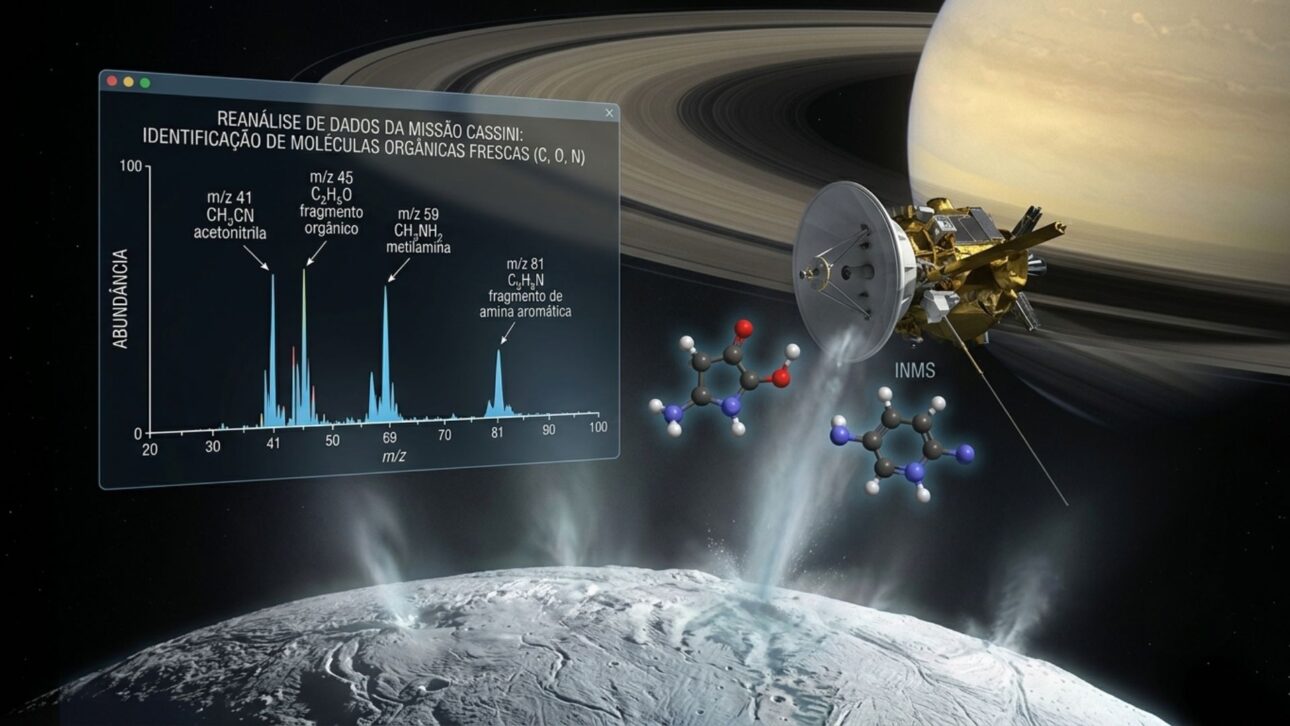
This work again detected aromatic compounds and groups with oxygen, but also revealed previously unobserved molecular fragments, allowing the identification of aliphatic molecules, esters, ethers, and compounds containing nitrogen and oxygen in a preliminary way. Scientifically, this expanded the known chemical diversity of Enceladus’s ocean.
NASA highlighted that these grains had been collected just 21 kilometers from the surface and were, in essence, very “fresh” samples from the moon’s interior. This strengthens the interpretation that the observed compounds truly come from the subsurface ocean, rather than from later alterations caused by radiation in Saturn’s E ring.
Habitability of Enceladus gains strength with liquid water, hydrothermal activity, and complex organic chemistry
Today, Enceladus is considered one of the most promising environments in the Solar System for the study of extraterrestrial habitability. The combination of liquid water, organic compounds, and signs of interaction between water and rock has placed Saturn’s moon at the center of modern astrobiology.
NASA itself relates the moon to a possible habitable oceanic environment because Cassini found evidence of hydrothermal vents at the bottom of the subsurface ocean. In the terrestrial context, such systems are relevant because they offer energy and chemical gradients capable of sustaining entire ecosystems without sunlight.

The 2025 study also highlighted that the material from Enceladus already contains five of the six essential bioelements CHNOPS detected in the moon’s samples. This does not prove the existence of life, but it shows that the chemistry available in its ocean is much richer than it seemed when the first plumes were discovered.
Saturn’s moon fully enters the scientific race for signs of life beyond Earth
Even without any direct evidence of organisms, Enceladus has established itself as one of the top scientific priorities in the search for habitable environments beyond Earth.
The moon contains a global ocean, continuous ejection of material into space, and a chemistry that has become progressively more complex with each new reading of Cassini’s data.
Therefore, the importance of the Cassini mission did not diminish with the end of the probe in 2017. On the contrary: with each new reanalysis, Enceladus strengthens as one of the most promising places in the Solar System to try to answer, with real scientific basis, if environments capable of sustaining life can exist far beyond our planet.


