






 Portuguese
  Spanish



The Battery Showed High Capacity of 5.05 mAh / cm2, Electrochemical Performance Superior by Up to 50% Compared to Conventional Cell Phone Batteries
Researchers from the Korea Institute of Science and Technology developed a high-capacity lithium-ion battery that has a flexible enough structure to last longer during use, especially in cell phones.
- Equinor Has Strong Operational Performance but Suffers Losses Due to Low-Price Commodities
- Have Technical Training and Want to Work for One of the Largest Companies in the Country? Ambev Has Over 35 Job Openings for Technicians on This Day 06
- Offshore Multinational Opens Selection Process for Embarkation on FPSO with 28×28 Schedule
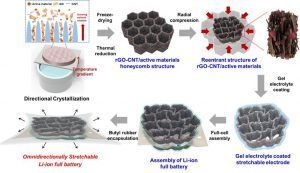
Schematic Diagram of the Manufacturing Process of the Expandable Battery. (Image courtesy of the Korea Institute of Science and Technology).
-
At 14 years old, she worked in a factory in Hong Kong, studied economics abroad, and then entered the Chinese real estate market, which helped change the landscape of Beijing.

-
While NATO secured more than $10 billion in missiles and space surveillance at a single forum, Brazil still spends 1.1% of its GDP on defense and is stalling its own anti-aircraft system.

-
Corn ethanol attracts R$ 23 billion in 21 new plants and prepares for a nearly 50% jump in Brazilian production by 2027, even with high interest rates.
-
A newly opened terminal in the middle of the Amazon has begun transporting soy and corn through Amapá, eyeing the queue of ships that is congesting the ports in the South.


In an article published in the journal ACS Nano, the scientists said they were able to make the honeycomb-shaped composite structure project inward using a radial compression process. This process resembles rolling Korean rice rolls, or gimbap, and resulted in the creation of elastic properties.
The structurally expandable electrode consists exclusively of electrode materials and was assembled with a stretchable gel electrolyte and a stretchable package. These elements block air and moisture and prevent the electrolytes from leaking.
According to the proponents, the resulting elastic battery showed high capacity of 5.05 mAh / cm2, superior electrochemical performance by up to 50% under repeated (up to 500) stretch-release cycles and long-term stability of 95.7% after 100 cycles in Air Conditions.
“The elastic lithium-ion battery developed through this research is expected to present a new paradigm in terms of elastic energy storage systems for the further development of electronic devices such as cell phones and other gadgets,” said Jeong Gon Son in a press statement.
In the researcher’s view, the rapidly growing market for high-performance wearable devices has increased the need for energy storage mechanisms to be designed in flexible and stretchable forms.








