Portuguese
  Spanish


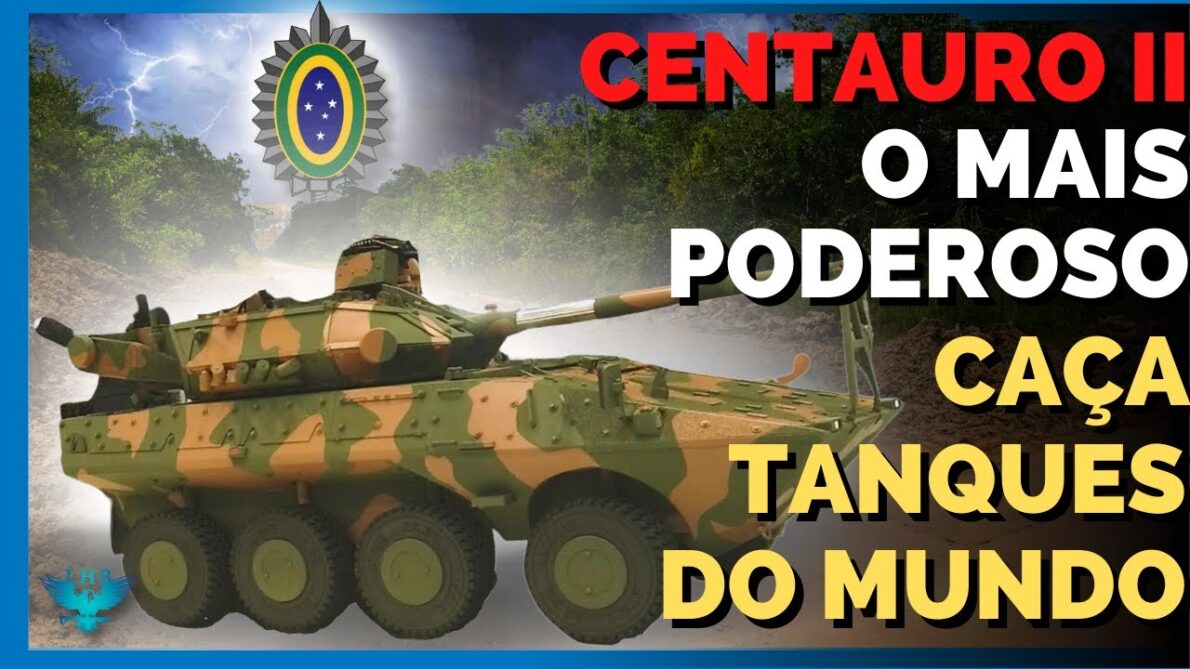

New Tank Hunter From Italy Will Be Purchased By The Brazilian Army. The Centauro II Armored Vehicle In Brazil Should Be Delivered This Year.
The first unit of the Centauro II armored vehicle, from a purchase made by the Brazilian army last year, is about to be shipped to Brazil. In total, 98 units of the tank hunter have been ordered, which are being assembled in Italy. In this year of 2024, two units will be delivered: the first should ship in the coming weeks, while the second, currently in the testing phase in Italy, is expected to be delivered in the second half.
More Than 200 Units Of The Centauro II May Arrive In Brazil This Year


In total, the army’s order for tank hunters could be expanded to up to 221 units. This first unit of the Centauro II armored vehicle in Brazil does not include some systems, which will be installed later.
The Centauro II is a modern tank hunter armored vehicle with 8×8 traction, equipped with an Oto Melara 120 MM turret. Being the first 8×8 wheeled tank hunter armored vehicle, this new version, which is an evolution of the Centauro B1, has been completely redesigned to withstand improvised explosive devices.
-
Flower Farms Supplying London and Amsterdam Face Backlash for Environmental Impact on African Lake, Threatening Jobs for 50,000 Workers

-
World’s Largest Container Ship Departs Shanghai with 24,000 Containers, Set to Debut in Europe in July

-
NASA Explores How Microgravity and Sensors Alter Soccer Ball Spin in Space
-
Qatar Commissions World’s Largest Gas Ship, a 344-Meter Giant Now Under Construction



The hull of the Centauro II armored vehicle in Brazil is made of high-strength monocoque ballistic steel with a unique geometry. Its V-shaped bottom and the elimination of recesses in the wheel box and fenders help dissipate the energy from a possible landmine that may be detonated underneath the vehicle.
The tank hunter is powered by a FPT Vector V8 Diesel engine with 720 horsepower. It can reach speeds between 40 and 80 km/h on rough terrain, and up to 110 km/h on paved roads. The Centauro II armored vehicle in Brazil weighs 32 tons and has an operational range of 800 km.
Now, Brazil joins Italy as an operator of the vehicle, being the first international operator of the Centauro II tank hunter armored vehicle.
Learn How The Tank Hunter Armored Vehicle Came To Be

During the Cold War, the Italian Army (EI) kept its main combat units in the northern part of the country, as a way to contain a potential invasion by Soviet forces from Eastern European countries. However, the increased movement of Soviet naval assets in the Mediterranean exposed a major vulnerability represented by the possibility of an amphibious landing in the south.
As a result, in the 1980s, requirements were presented for a vehicle that would combine the firepower and lethality of the EI’s main battle tank at the time, the Leopard 1, with strategic mobility that would allow rapid movement on the road network and the ability to engage initial threats until heavier forces could arrive.
After several proposals and tests, in 1987, the Iveco – OTO Melara Consortium (CIO) presented the final version of the Centauro, a modern wheeled tank hunter armored vehicle with 8×8 traction, weighing 24 tons. The name Centauro was adopted by the EI in 1989, for a total of 400 units.
The First Version Of The Tank Hunter Armored Vehicle
The first version was equipped with a 520 HP engine and featured an OTO Melara 105/52 cannon, 105 mm in caliber.
The cannon of the Centauro armored vehicle could fire all types of ammunition in the NATO standard, both kinetic, such as APFSDS-T (armor piercing, fin-stabilized, discarding sabot-tracer), and chemical, such as HEAT and HESH, having 14 ready-to-use cartridges and another 26 in the chassis.
The barrel was covered by a thermal sleeve, to prevent distortions, and had an extractor to prevent smoke from entering the combat compartment after firing, poisoning the crew.
The secondary armament consisted of three MG42 machine guns, in the 7.62x51mm caliber, one coaxial to the gun and the others on anti-aircraft mounts on the roof, operated by the vehicle commander and the loader.