






 Portuguese
  Spanish
  3 min of reading
  7 comments





With Maglev Technology and Vacuum Tubes, the Floating Train Promises Unprecedented Speeds, Surpassing Traditional Trains by Up to 400 MPH and Connecting Cities in Minutes. China Already Leads with the Installation of the First Experimental Track.
Imagine a train that doesn’t touch the tracks, floats in the air, and travels faster than a commercial airplane. Sounds like science fiction, right? But China is making this dream a reality with its ambitious plan to build a floating train capable of 1,000 km/h. The project has already taken a big step forward with the installation of the first track.
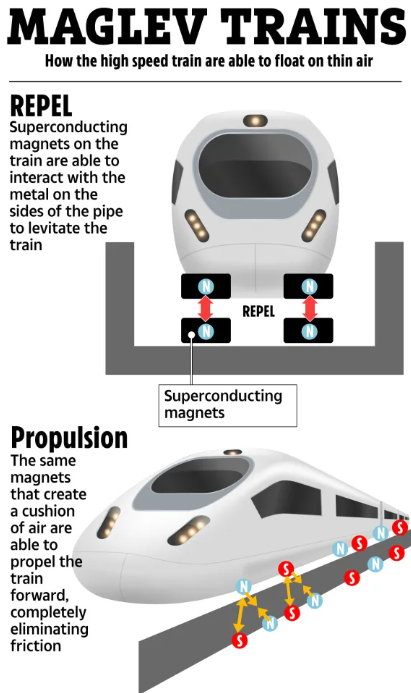
The secret of the floating train lies in magnetic levitation, or maglev. This technology uses superconducting magnets to create magnetic fields that lift and propel the train in a low vacuum tube. Without the friction of wheels on tracks, speeds reach incredible levels while operating silently and efficiently.
Existing maglev trains in China are already impressive, reaching speeds of 349.23 km/h. However, this new project aims to break barriers, surpassing 1,000 km/h — faster than the cruising speed of many commercial airplanes, which is around 925.37 km/h. It’s like flying but without leaving the ground!
-
Helicopter Drops 180 Tons of Sand and Gravel on Swedish River to Revive Ecosystem Damaged by Decades of Exploitation

-
Brazilian Company Launches Retro Smartphone with 48 MP Camera, T9 Keyboard, and Privacy Features for Social Media-Free Use

-
Self-Taught Chinese Farmer Builds 5-Ton Submarine from Scrap, Launches It in Anhui River
-
Invisible Induction Technology Enables Wireless Power for Blenders, Coffee Makers, and Air Fryers, Reducing Countertop Cables




The Floating Train Project in China
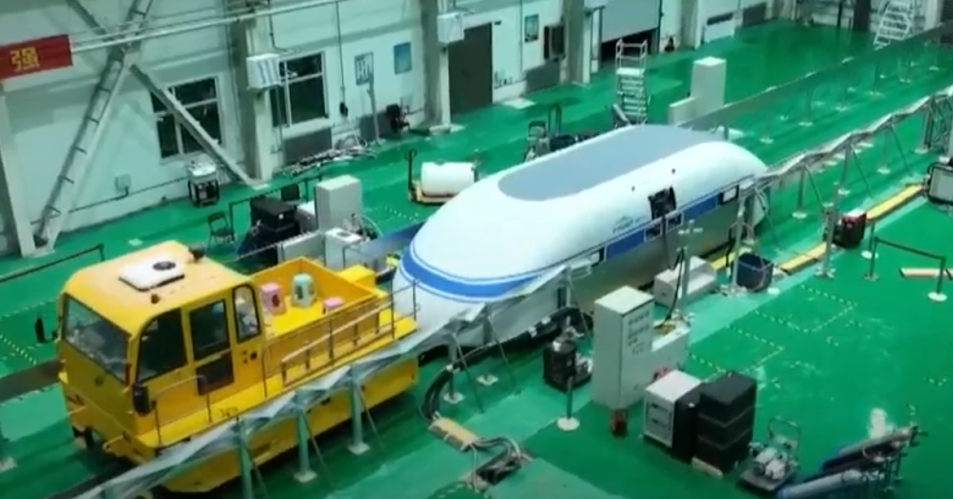
The installation of the first track is a milestone. This experimental line will be used to test the feasibility of transporting passengers at near-supersonic speeds. This paves the way for a revolution in public transport, connecting cities in minutes and drastically reducing travel time.
The project will connect to the current Maglev Express Line S2, which already impresses travelers with its 18.5 km length. This integration will ensure that the new technology fits seamlessly into the existing infrastructure, maximizing its efficiency.
Benefits and Challenges of the Floating Train
Besides speed, the floating train promises to be more environmentally friendly. With lower energy consumption and zero emissions, it offers a sustainable alternative to air and road transport. For passengers, this means faster, more comfortable, and connected travel.
But not everything is simple. Maintaining connectivity at such high speeds is a challenge. The signal changes constantly, making communication difficult. Chinese researchers proposed a creative solution: cables running parallel along the tube to emit electromagnetic signals. Still, adjusting the infrastructure to support this technology is a monumental task.
China in the Global High-Speed Landscape
While China is leading, other powers also have their high-speed train projects. Germany and the Netherlands, for example, operate the ICE 3, with speeds of up to 320 km/h. However, the Chinese floating train takes competition to another level.
China’s leadership is due to its ambitious vision and investment in research. With a well-established high-speed rail network and innovative projects like the floating train, the country continues to stand out as a pioneer in this sector.
The 1,000 km/h floating train from China represents more than speed. It symbolizes a new era for transportation, where innovation and sustainability go hand in hand. If successful, this project could redefine how we move around the world.





Também um acidente seria de separar os ossos da carne o que eu espero que nunca aconteça
De onde tiraram que 1000km/h é 673km/h a mais que 850km/h?
Essa página e suas reportagens malucas.
Mas, a gente acaba caindo no click bait mesmo assim
Impressionante, eles estão utilizando um sistema parecido com o sistema da ressonância magnética. A China realmente está em outro patamar.