






 Portuguese
  Spanish
  6 min of reading
  0 comments


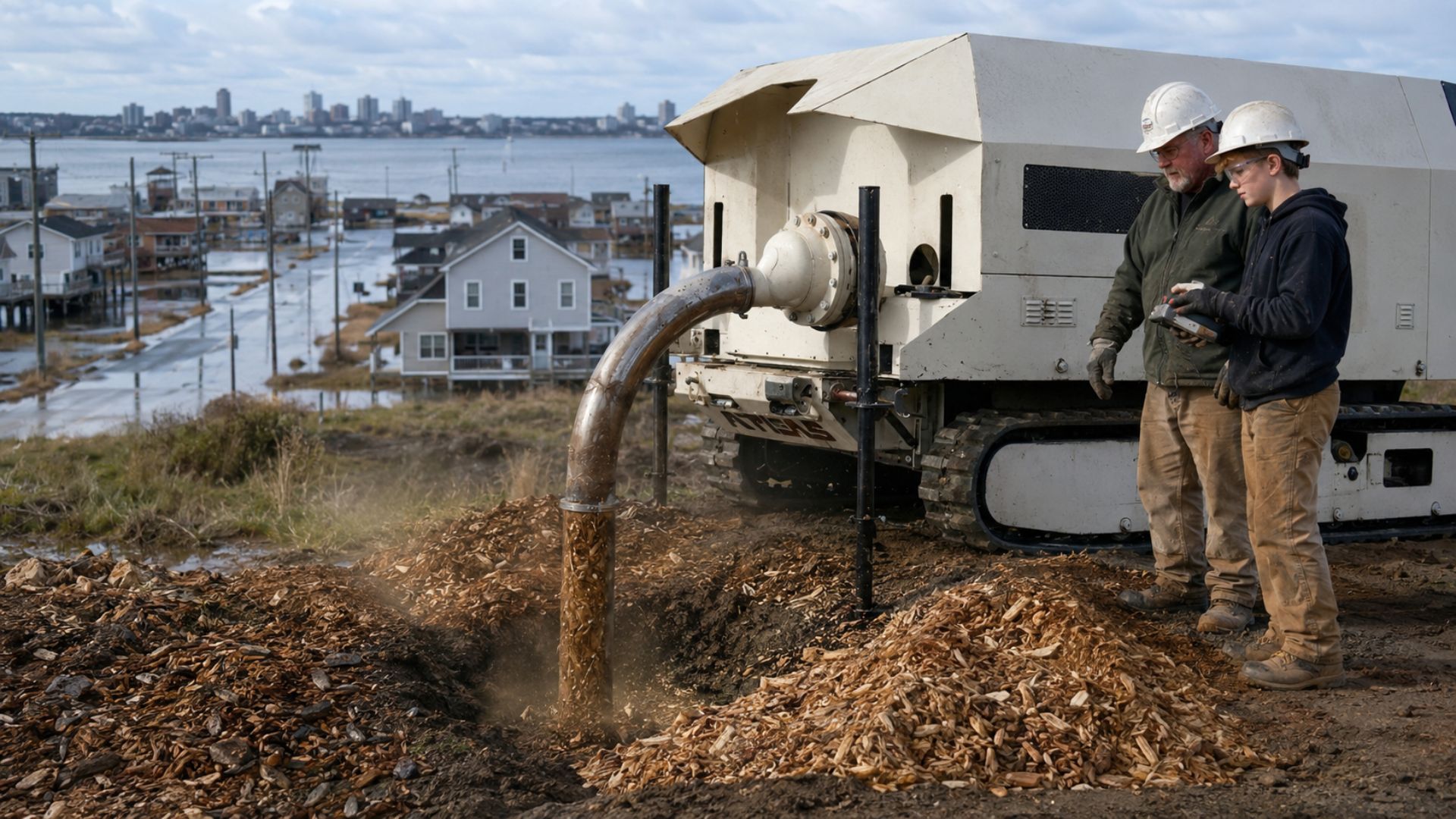
In San Rafael, California, the startup Terranova bets on autonomous robots that pump a paste of wood waste into the underground and gradually elevate the land. The idea is to free sinking neighborhoods from floods for about 92 million dollars, instead of almost a billion in walls.
A startup from California decided to tackle floods in an unusual way: instead of building walls against the sea, it wants to lift the city itself. For this, Terranova developed autonomous robots that inject wood waste into the underground and gradually raise the land, giving sinking neighborhoods some protection against floods.
The project was born in San Rafael, in the San Francisco Bay Area, and has a family face: it was led by Laurence Allen, co-founder and CEO, alongside his father, Trip Allen, the company’s president. The duo estimates that it’s possible to protect the city for about 92 million dollars, a value well below the 500 million to 900 million estimated for maritime containment walls. In November 2025, the startup raised 7 million dollars in an initial investment round.
Why San Rafael is sinking and needs a solution

San Rafael faces a silent problem: parts of the city are sinking. The so-called Canal District, neighboring the bay, has already sunk about 90 centimeters and is below sea level, leaving the area exposed to floods that are likely to worsen with rising oceans. Estimates cited by the company indicate that the soil continues to descend by a few centimeters per year, and without intervention, the downtown and canal area could be submerged in the coming decades.
-
The Zuluk road has 32 zigzag curves at 3,400 meters in the Himalayas, originated as the Silk Route in Sikkim and became a military border where foreigners cannot pass.

-
Rio de Janeiro receives more than R$ 5.5 billion in sanitation, includes almost 1 million residents from communities in the formal customer base, and brings water, sewage, and proof of residence to regions historically neglected by urban infrastructure.

-
Via Mar promises to relieve BR-101 in Santa Catarina, but it will be the state’s first toll state highway and faces soft soil and rice fields that threaten the timeline.
-
To halt the advance of the Sahara, the 8,000 km Great Green Wall in the Sahel relies on reforestation to combat desertification, but by 2026 it remains far behind the goal of 100 million hectares.


The obstacle is the cost. According to Terranova, the solutions presented to the city by consultants always revolved around 500 million to 900 million dollars in containment walls, a difficult amount to afford for a municipality of about 60,000 inhabitants, some of whom live in poverty. It is in this scenario that the proposal to raise the ground instead of blocking the water comes in, using robots instead of large concrete works.
How Robots Raise the Ground with Wood

The technology is less complex than it seems. The company mixes wood chips with water and a thickening agent, forming a paste that is pumped from a container to the injection equipment.
The robots, which move autonomously around the site, drill wells and push this material to depths of about 12 to 18 meters, under low pressure. The effect is that of a slow elevator: the surface rises so gradually that, according to the creators, it’s barely noticeable in day-to-day life.

By working over a wide area and in deep layers, the system would not compromise surface structures, according to the company. The founders often use San Francisco airport as an example: it would be possible to raise the ground while planes continue to land normally. In operational mode, the robots can lift about an acre-foot of land per day, with the latest version of the equipment pumping close to 1,500 gallons per minute, compared to the 200 gallons per minute of the first prototypes.
Arca, Atlas, Prometheus, and Vulcan: the Robot Fleet
The equipment has been given significant names. The Arca functions as a mothership, receiving raw materials and supplying the other machines in the field. The Atlas is the unit that carries and moves the machinery around the site, with a battery capable of sustaining about ten hours of work. The Prometheus is the capsule that actually performs the injections, lowering its supports and pushing the paste underground, while the Vulcan is the drilling platform.
The choice of names mixes Greek mythology and Noah’s Ark, in a playful nod to the mission of saving cities from the waters. The assembly of the robots is also impressive for its speed: according to the team, one of the Atlas units was built in just two weeks, with a team of three people. For 2026, the plan is ambitious, with the intention of manufacturing about ten of these robots and three motherships, which requires an almost industrial production model.
Cheaper than a Wall and with Carbon Credit
The main advantage of the proposal is financial. Terranova estimates that it can raise about 240 acres in San Rafael by nearly 1.2 meters for approximately 92 million dollars, a fraction of what containment walls would cost. Part of the bill could still be reduced by selling carbon credits, as the buried wood remains underground instead of being burned or discarded in landfills, which sequesters carbon and can reduce the final cost for taxpayers.
The raw material is precisely a problem that California has in abundance. In a region marked by fires and a large volume of pruning waste, there is excess wood that is usually sent for burning. The founders claim that a single truckload of wood yields about eight times more volume than a truckload of soil, making transportation much cheaper. The inspiration came from experiments in the 1970s around Venice, where buildings were erected with mud injection, a technique that was hindered by the high cost of transporting the material.
Safety, doubts, and the city’s resistance
On the safety side, the company claims that the material is harmless. According to Terranova, the injected content is basically wood chips mixed with water, and tests would indicate that the process can even help remove nitrates from the groundwater. The company claims to have received indications from environmental agencies not to treat the injection as a threat to the groundwater.
But not everyone is convinced. Some engineers have raised the question of whether the soil filled with the wood paste could amplify shaking in the event of an earthquake, something sensitive in a seismic region like California. The San Rafael city council itself has shown reservations, with questions about how to connect streets, buildings, and tracks after raising the land, and about the use of AI-assisted engineering. Trip Allen even attributed the resistance to a certain skepticism with local solutions, but the discussion about risks and feasibility remains open.
From the flooded backyard to the dream of terraforming Earth


The founders’ motivation is personal. Trip Allen says he saw his own backyard flood in San Rafael, where he has lived for more than two decades, and the feeling of potentially losing his hometown was what pushed the family to act. Laurence, who worked at SpaceX before running Terranova, finds it curious how much is said about terraforming Mars while entire cities are drowning on Earth without much being done about it.
For them, the robots that lift the soil are just a first step towards something bigger: the idea of reshaping the terrain on a large scale to make coastal areas habitable in the long term. It is an ambition that mixes heavy engineering, soil science, and a discourse of climate resilience, with the symbolic detail of being carried out by father and son side by side.
Terranova’s bet raises an interesting question: in the face of sinking cities, does it make more sense to spend almost a billion dollars on walls or rely on robots that lift the ground with wood for a fraction of the price?
Tell us in the comments if you would agree to see your city being elevated in this way or if you still trust more in traditional containment solutions.




Be the first to react!