






 Portuguese
  Spanish
  6 min of reading
  0 comments


The painting shows Christ as a young, beardless shepherd, dressed in Roman fashion, quite different from the bearded image that would be established centuries later. It is not a real portrait of Jesus, but the way the early Christians imagined him. And it came to light precisely where one of the pillars of Christian faith was born.
A series of archaeological discoveries in Turkey is changing what historians knew about the beginning of Christianity. The jewel of these excavations is a fresco about 1,800 years old that reveals a young, beardless Jesus, depicted as the “Good Shepherd,” hidden in an underground tomb in Iznik, the ancient Nicaea, city of the historic Council that marked the religion forever.
The painting was found in August 2025, in the Hisardere Necropolis, during excavations coordinated by the Iznik Museum, and gained worldwide attention in the following months. First of all, an important clarification: the image is not a real portrait of Jesus’ face, something impossible to exist, but an artistic representation of how the early Christians imagined him. Still, it is one of the oldest and best-preserved images of Christ ever found in the region of Anatolia, which explains the enormous interest it sparked.
The “Good Shepherd” fresco

The fresco depicts Jesus as the “Good Shepherd,” a young, beardless man, dressed in a Roman tunic, carrying a goat or sheep on his shoulders and surrounded by animals, in a scene that directly refers to the passage from the Gospel of John where Christ says “I am the good shepherd.”
-
Federal Police involved in the case to identify the person responsible for hacking the Civil Defense system, which sent ten false alerts, frightened residents of different capitals, and turned messages about real risks into notifications with “misanthropy” and even alien attacks.

-
Extreme drought causes ghost village to reappear at the bottom of the reservoir that supplies Athens, revealing houses, a school, and ruins swallowed since the 1980s as the lake shrinks and exposes the water crisis threatening the capital of Greece.

-
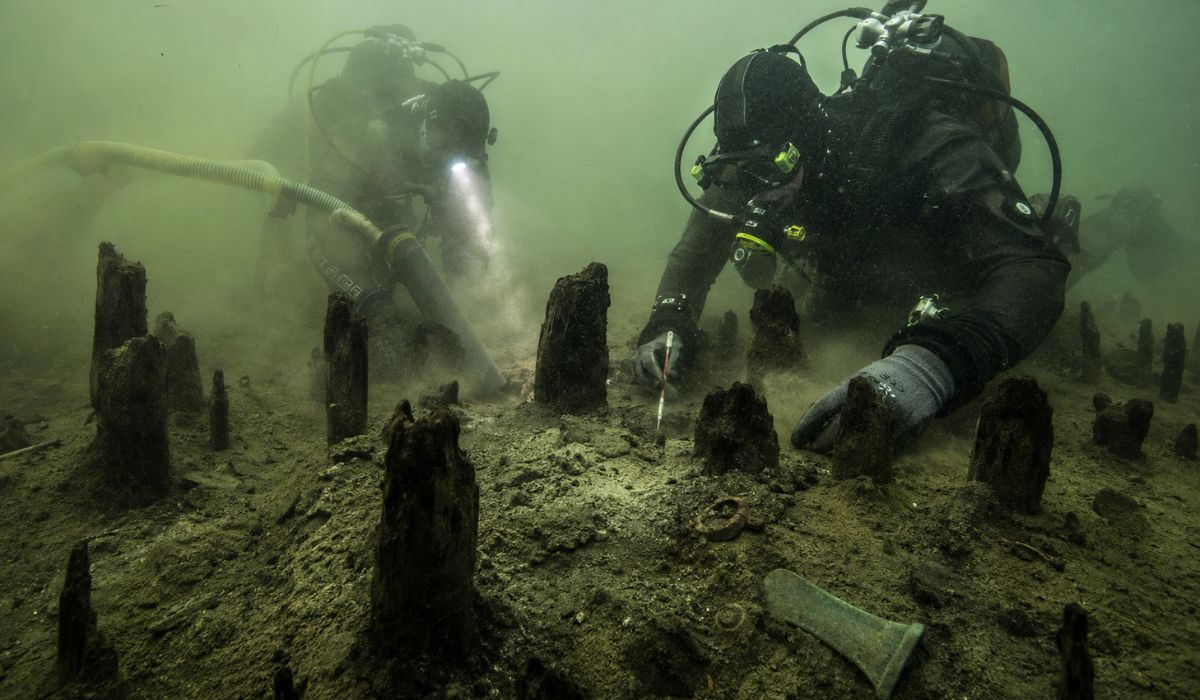
An entire village lay asleep at the bottom of a lake for 3,000 years: divers suction sediments in Italy and reveal more than 600 wooden stakes, bronze tools, and traces of a Bronze Age settlement hidden underwater.
-
They call it the “Shopee house” and even cardboard, but the R$ 20,000 house is a certified Wood Frame from Alea, financed by Minha Casa Minha Vida: understand if it’s worth more than masonry.



According to researchers, this shepherd motif was an image that did not openly identify the Christian faith, allowing followers to express their beliefs without arousing persecution, at a time when Christianity was not yet legalized in the Roman Empire.
The archaeologist responsible for the excavation, Gulsen Kutbay, even described the work as possibly the only example of its kind ever documented in Anatolia, which reinforces its rarity.
Why the Beardless Jesus Surprises

The Jesus depicted is young and beardless, with features and clothing typical of Roman culture from the 2nd and 3rd centuries, quite different from the bearded and more mature image of Christ that would become established in Byzantine representations of the following centuries, and which has become the most well-known to this day.
This contrast is precious for scholars, as it shows how the image of Jesus transformed over time, adapting to the artistic conventions of each era and culture.
The fresco of Nicaea is, therefore, a window to understand how the early Christians saw and represented their greatest figure, at a time when the iconography of faith was still forming and strongly dialogued with classical Roman aesthetics.
A Tomb Sealed for Centuries
The excellent state of preservation of the painting has a practical explanation.
The tomb in which the fresco was found remained practically sealed for about 1,800 years, with little oxygen circulation, which helped preserve the pigments almost intact, allowing the features of the face, the folds of the tunic, and the details of the animals to be seen clearly.
A note on the dating: as no objects were found inside the tomb that would allow it to be dated directly, archaeologists attributed the 3rd century AD to the structure based on its architectural characteristics, compared to other known tombs from the same necropolis.
The excavation also revealed the skeletons of five people, including two young adults and a baby about six months old, according to researchers, giving a human dimension to the find.
The City of the Council of Nicaea
The location of the discovery could not be more symbolic for Christian history.
Iznik is the ancient Nicaea, a city that went down in history for hosting, in 325 AD, the First Council of Nicaea, a meeting that resulted in the Nicene Creed, a declaration of faith still recited by millions of Christians around the world.
In 2025, it will be 1,700 years since this milestone.
Not by chance, the discovery gained even more prominence as it was announced shortly after Pope Leo XIV visited the city on his first international trip to celebrate precisely this anniversary of the Council.
The Turkish president, Recep Tayyip Erdogan, even gifted the pontiff with a reproduction of the Good Shepherd fresco in tile, symbolizing the importance of the find.
A mosaic of other discoveries
The fresco is just the most famous piece of a much larger set.
According to a report by the British newspaper The Independent, only in recent years have archaeologists identified in Turkey at least a dozen previously unknown churches, many from the 4th and 5th centuries, as well as remnants in cities mentioned in the Book of Revelation, such as Laodicea, Sardis, Smyrna, Pergamon, and Ephesus.
Among the finds are a rare 4th-century house church in Laodicea, a large religious structure in Sardis that may have influenced the architecture of the future Hagia Sophia, and ancient Christian inscriptions in Smyrna.
In Ephesus, researchers excavated an entire preserved neighborhood, with thousands of everyday Byzantine Christian objects.
Each of these sites helps piece together the puzzle of how Anatolia was one of the great cradles of Christian expansion.
Theories about the expansion of Christianity
Along with the material discoveries, historians revisit old questions, and caution is needed here.
Different research attempts to explain how Christianity went from a small movement in Judea to the official religion of the largest ancient empire in about three centuries, raising hypotheses related to community organization, care for the sick, and social assistance offered by the early communities, which would have attracted converts.
It is important to emphasize that these explanations are interpretations and hypotheses of scholars, not definitive truths.
Some works suggest that demographic and social factors may have favored Christian growth, while others analyze the opposition of faith to the Roman imperial cult, in which emperors were worshiped as deities.
These are lines of research in debate, coexisting with different viewpoints and continuing to be studied and revised by the academic community.
The archaeological discoveries in Turkey, with emphasis on the Good Shepherd Jesus fresco in Nicaea, offer a rare and exciting window into the early centuries of Christianity, revealing how faith was lived, hidden, and represented in a time of persecution.
More than closed answers, these findings bring new questions and enrich the debate among archaeologists, historians, and believers.
Between the science that digs into the past and the spiritual significance that these images carry for millions of people, there is the certainty that the soil still holds many chapters of human history waiting to be revealed.
And you, were you impressed by the discovery of the fresco showing a young, beardless Jesus? What did you think of seeing how the early Christians imagined Christ, so different from the image we know today? Leave your comment with respect for different beliefs, tell us what caught your attention the most, and share the article with those interested in history, archaeology, and religion.





Be the first to react!