






 Portuguese
  Spanish


With Capacity to Operate 120 Days Without Refueling and Drill More Than 11,000 Meters Deep, Ship Meng Xiang Leads Chinese Ambition to Reach the Boundary Between the Crust and the Mantle
China has taken a monumental step in its scientific and geopolitical ambitions by commissioning the Meng Xiang (“Dream”), its first ocean drilling ship fully developed in the country, designed to penetrate the Earth’s crust and reach the mysterious Moho Discontinuity. The vessel will operate in the South China Sea starting in 2025, with missions planned until 2035.
According to New Atlas and Xinhua news agency, the project is part of a multidisciplinary program that involves geological research, exploration of underground fuels, and advancements in naval technologies, positioning the Meng Xiang as one of the most advanced scientific vessels in the world.
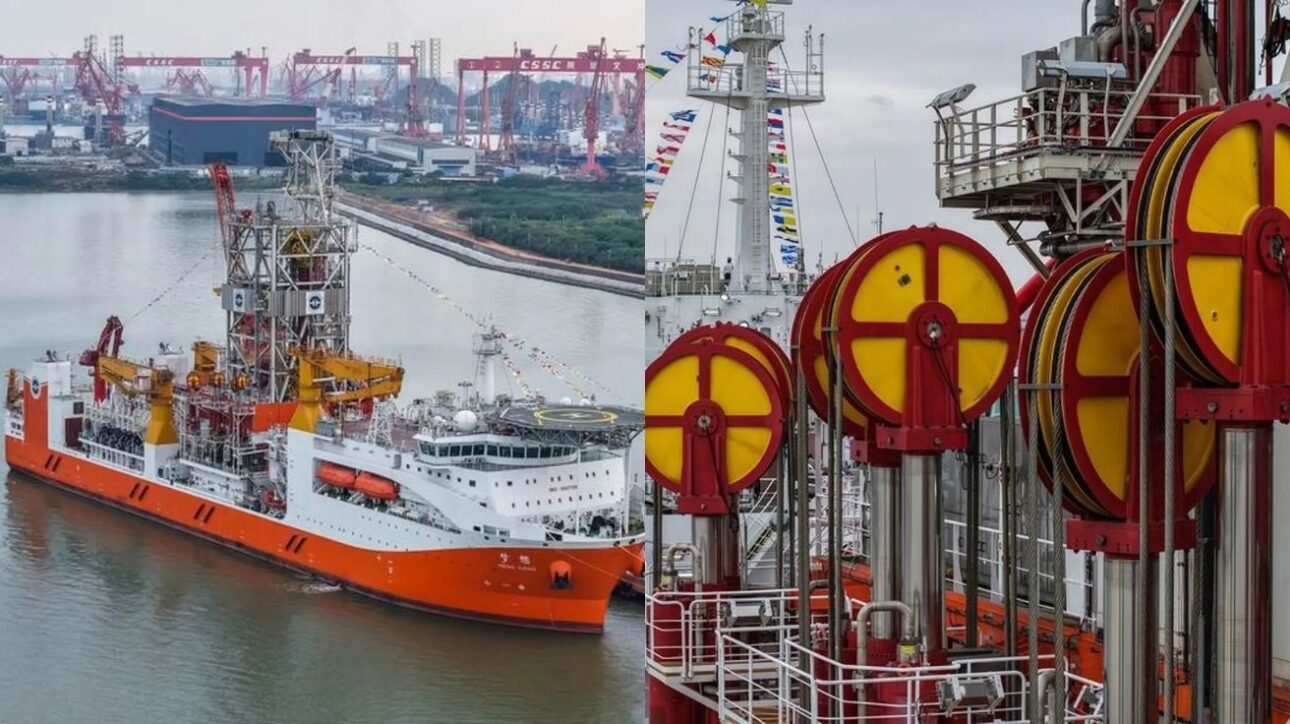
The New Race to the Center of the Earth
Inspired by the ancient U.S. Project Moho (1958), the Chinese ship aims to reach the layer that separates the crust from the mantle: the Mohorovičić Discontinuity, or simply Moho. This boundary, located 5–10 km below the ocean floor, marks the transition between the lighter rocks of the crust and the ultramafic rocks of the mantle, under extreme temperature and pressure conditions.
-
Venezuela Faces UN Alert for Hunger, Disease, and Service Collapse After Earthquakes Cause Nearly 2,000 Deaths and $6.7 Billion in Damages

-
Belgian Port to Install Shore Power for Cruise Ships by 2027, Cutting Dock Emissions by Up to 5% and Meeting EU Regulations

-
Post-Katrina Engineering System Uses Steel Frames, Floating Blocks, and Guide Posts to Elevate Homes During Floods
-
Brazil Deploys Navy Field Hospital with ICU, Orthopedics, Pediatrics to Earthquake-Stricken Area in Venezuela, Offering 30 Beds and 150 Daily Consultations



To date, no attempts to physically reach this boundary have been successful. The Soviet Kola Superdeep Borehole project (1979) reached 12 km in depth, but through continental crust, without reaching the Moho.
The Meng Xiang, with its marine drilling platform, intends to reach depths greater than 11,000 meters, facing pressures of up to 2,000 atmospheres and temperatures of up to 300 °C.
Additionally, the vessel has an automated sample storage system and specialized laboratories in geology, microbiology, oceanography, and mining.
The goal is to collect direct samples from the lower crust and initiate experiments that help decipher fundamental thermal, tectonic, and metamorphic processes.
Scientists also hope to find natural gas hydrates, known as “flammable ice,” with extremely high energy potential.
Beyond the scientific component, the project carries symbolic weight of exploration and technological sovereignty, drawing parallels with space missions.
Technological Power and Global Projection
Measuring 180 meters long and 33 meters wide, the Meng Xiang displaces more than 42,000 tons and houses 180 crew members. Its range is 27,780 km and it can operate without refueling for up to 120 days.
The vessel incorporates dynamic positioning technologies, drilling mud recycling systems, and resilience to extreme sea conditions up to the level of a Category 12 typhoon.
Unlike other platforms, it has been built with a multidisciplinary focus: science, energy, mineral exploration, and geopolitical sovereignty.
China intends to use the ship not only for geological research but also to explore oil and gas reserves in extreme oceanic depths.
The vessel will also serve as a base for future developments in seabed mining and biotechnology.
With onboard laboratories, the Meng Xiang can analyze in real-time the properties of the drilled materials, reducing reliance on land-based laboratories.
Its construction and commissioning symbolize China’s definitive entry into the elite of global underwater exploration.
Controversies and Strategic Interests
Despite promoting international collaboration, the operation of the Meng Xiang in the South China Sea region is viewed with suspicion by several countries.
China has a history of territorial tensions with Vietnam, the Philippines, Malaysia, and Brunei in the region, which is rich in resources and geologically complex.
In 2014, the Hai Yang Shi You 981 platform was accused of invading Vietnamese waters, generating intense diplomatic protests.
The presence of the Meng Xiang may be seen as yet another move to bolster Chinese presence in disputed waters.
The vessel also raises environmental concerns due to the sensitivity of deep-sea ecosystems.
Furthermore, there is fear that scientific research may be used as a smokescreen for espionage operations and strategic prospecting.
Rival countries may monitor the Meng Xiang with “observer” ships undertaking counterintelligence and quiet diplomacy missions.
Thus, the ship symbolizes not only a technological advance but also a new layer of geopolitical and environmental complexity.


