Portuguese
  Spanish


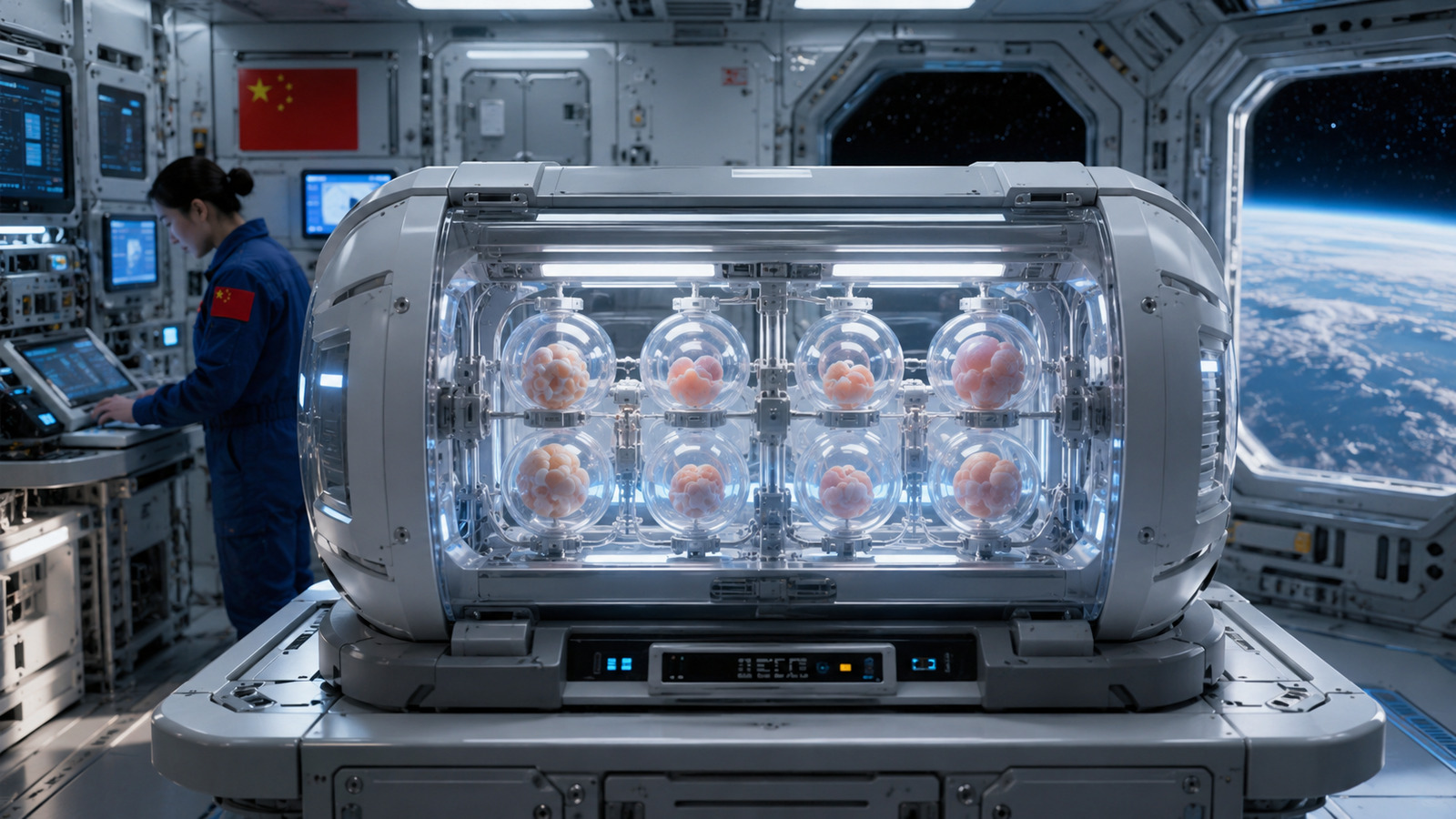

Chinese experiment sent by the Tianzhou-10 mission uses structures created from stem cells to analyze the effects of microgravity and cosmic radiation on the early development of life outside Earth
China sent artificial embryos into space in a groundbreaking experiment that seeks to understand how the near absence of gravity and cosmic radiation affect the early stages of life formation.


Mission carried 41 experiments
The study is part of the Tianzhou-10 mission, which transported more than 760 kg of materials to the Chinese space station. The cargo includes 41 experiments from different scientific areas, including research focused on embryonic development.
The artificial embryos were produced from stem cells. These structures resemble embryos but do not have the capacity to develop into a human being.
-
Netherlands Reports First Child Euthanasia Case Since Rule Expansion for Minors

-
Brazilian Innovator Survives Homemade Submarine Dive in Paraty Despite Hatch Leak and False Oxygen Alarm

-
China Develops Custom 140-Ton Electric Mining Truck with 770 kWh Swappable Battery, Deploys 290 Units in Xinjiang’s Largest Zinc Mine
-
Meta to Launch Arena, a New Prediction App Targeting 3.56 Billion Users, Competing with Polymarket and Kalshi




Artificial embryos simulate delicate phase
Yu Leqian, responsible for the project, explained that these structures help study important questions about embryonic development in the early stages. The experiment targets a stage equivalent to the period between 14 and 21 days after fertilization.
This stage is considered crucial because it marks the beginning of the formation of the main body structures. Alterations at this delicate moment can affect health and be related to congenital diseases and deformities, as the researcher explained.
Test will last five days in space
For five days, the artificial embryos will remain in development inside the Chinese space station. Monitoring will be carried out by Chinese astronauts, while automatic systems will maintain the necessary conditions for the growth of the biological structures.
At the end of the experiment, the samples will be frozen and sent back to Earth. They will then undergo detailed laboratory analyses, an essential step to evaluate effects during their stay in space.
Gravity and radiation are at the center of the study
The focus of the experiment is to observe how a real space environment can interfere with the initial development of life. The near absence of gravity and exposure to cosmic radiation are the central factors of the investigation.
With this data, scientists aim to expand knowledge about biology and medicine. The study also seeks to clarify limits in embryonic formation outside the terrestrial environment.
Research targets the Moon and Mars
The experiment is considered important for long-duration space missions. It is also connected to projects for human permanence on the Moon and Mars, where reproduction outside Earth still needs to be understood.
The collected data could help researchers assess whether human life could develop and reproduce outside the planet. The investigation paves the way for future analyses.
With information from TVBrics.